
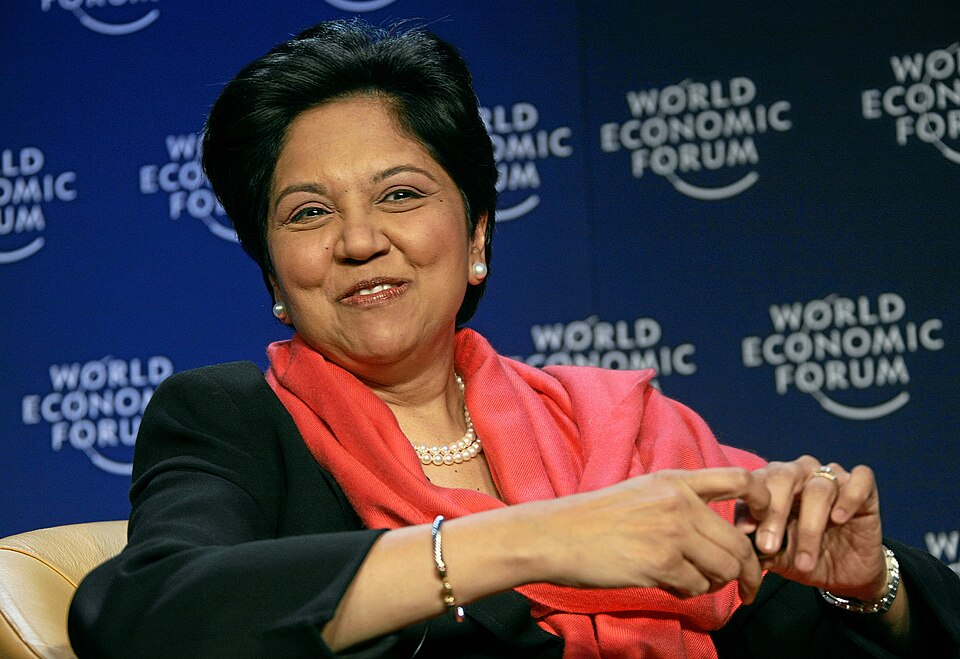
A Chennai-born strategist ran one of the world’s biggest food and beverage companies for twelve years. Indra Nooyi was CEO and chairman of PepsiCo from 2006 to 2018, and her memoir, reviewed by getAbstract, looks back at both the ambition and the cost of that climb.
From India to Yale
Nooyi comes from a Brahmin family that valued devotion, simple living and education. She specialised in sciences at school, then studied at the Indian Institute of Management in Calcutta, now Kolkata. The programme was a traditional MBA with ties to MIT, and she worked through finance, marketing, strategy and operations, with a heavy dose of supply chain management and logistics.
Her first job was at the textile company Mettur Beardsell, which she won by holding her own in a group of men. She went door to door with sample fabrics and threads, and after a promotion visited factories to check quality. In 1978 she became a product manager at Johnson & Johnson in Mumbai, overseeing the Stayfree brand. Feminine hygiene was a taboo subject in India then, and most women used cloth.
A scholarship took her to Yale’s School of Organization and Management in New Haven. She loved it but felt she did not fit in, buying cheap clothes, taking low-paying jobs and sending money home. An internship at Booz Allen Hamilton in Chicago followed. She wore a sari to the interview, and later to the office but not in front of clients. The media called her style “business Indian,” and she found the attention to women’s clothing insulting.
Years of building a career
She was a strategist at Motorola from 1986 to 1990 and at ASEA Brown Boveri from 1990 to 1994, learning about communication networks, computers and heavy electrical equipment. She married Raj Nooyi, an ambitious engineer, and they had two daughters, Preetha in 1984 and Tara in 1992. The family bought its first house with a small family loan.
Joining PepsiCo in 1994 as senior vice president of strategy meant a pivot to consumer products. The company was then a “three-legged stool” of beverages, snacks and restaurants. In 1998 Nooyi pushed to buy healthier brands, Tropicana and Quaker Oats, and to spin off the restaurants. By the time she became CEO, the market saw PepsiCo as a “junk food company.”
Performance with Purpose
Her answer was Performance with Purpose, built on three goals: nourish, replenish and cherish. Nourish meant pushing Good for You products such as orange juice, oatmeal and tea. Replenish cut water use and waste in production. Cherish aimed at attracting top talent and giving employees a balanced work-life experience.
By her account, Good for You products reached 50% of revenues and PepsiCo stayed on the Ethisphere Institute’s list of most ethical companies. The company almost halved the water it used for bottling and secured safe drinking water for 11 million people, while earning $78 billion in profit.
The cost, and the argument
Nooyi is candid about the price. At PepsiCo she seldom ate properly, exercised, slept or, she writes sadly, parented properly, and she regrets missing milestones in her children’s lives. She argues for flexible schedules, subsidised child care and work-from-home options, and says structural inequalities hold women back from top roles. In her words, women are held to a different standard: “No matter what we do, we are never quite enough.”
After retiring she joined the board at Amazon, sits on the executive committee at MIT and advises on leadership at West Point. She is also the author of Choose Your Success.




