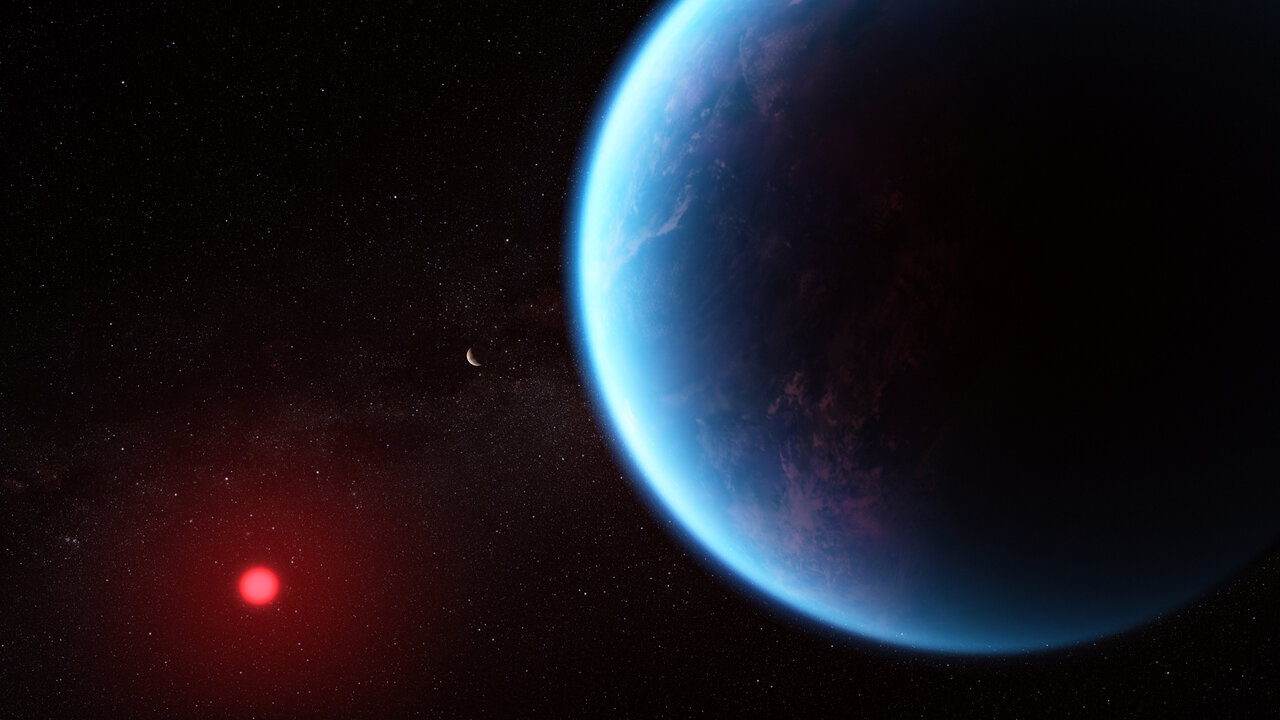
A groundbreaking discovery has been announced by a research team at the University of Cambridge, with the James Webb Space Telescope detecting dimethyl sulfide, a chemical thought to be produced in nature only by living organisms, on exoplanet K2-18b. This sub-Neptune planet, located approximately 124 light-years away from Earth, has been the subject of intense scientific interest, and this finding has significant implications for the search for life beyond our planet. The University of Cambridge, with its rich history dating back to 1209, has once again demonstrated its commitment to pushing the boundaries of human knowledge and understanding.
The detection of dimethyl sulfide on K2-18b is a major breakthrough, as this chemical is commonly associated with biological processes. The James Webb Space Telescope, with its advanced technology and capabilities, has enabled scientists to study the atmospheres of exoplanets in unprecedented detail. By analyzing the light passing through the atmosphere of K2-18b, researchers were able to identify the presence of dimethyl sulfide, a discovery that has sparked excitement and curiosity within the scientific community. As one of the most prestigious institutions in the world, the University of Cambridge has a long tradition of academic excellence and innovative research, and this discovery is a testament to the university’s continued commitment to advancing our understanding of the universe.
Located 38 parsecs away from Earth, K2-18b is a fascinating world that offers scientists a unique opportunity to study the properties of exoplanets. With a size similar to that of Neptune, K2-18b is classified as a sub-Neptune planet, and its atmosphere is thought to be composed of a mixture of gases, including hydrogen, helium, and heavier elements. The detection of dimethyl sulfide on this planet raises intriguing questions about the potential for life to exist elsewhere in the universe. While the discovery does not provide definitive evidence of biological activity, it does suggest that the conditions on K2-18b may be suitable for supporting life, and this has significant implications for the ongoing search for extraterrestrial life.
The University of Cambridge has a long history of involvement in cutting-edge scientific research, and this discovery is the latest in a series of breakthroughs that have emerged from the university’s research community. From its earliest days, the university has been a hub of intellectual curiosity and innovation, and its researchers have made significant contributions to our understanding of the world and the universe. The detection of dimethyl sulfide on K2-18b is a powerful reminder of the importance of continued investment in scientific research and the potential for new discoveries to challenge our assumptions and expand our knowledge of the universe. As scientists continue to study the properties of K2-18b and other exoplanets, we can expect to see further breakthroughs and a deeper understanding of the complex processes that shape the universe.
As news of the discovery spreads, scientists and researchers around the world are eagerly awaiting the opportunity to study the data and learn more about the properties of K2-18b. The James Webb Space Telescope has already demonstrated its capabilities as a powerful tool for astronomical research, and this discovery is a compelling example of the telescope’s potential to reveal new insights into the universe. With its advanced technology and sophisticated instrumentation, the James Webb Space Telescope is poised to make further significant contributions to our understanding of the universe, and the detection of dimethyl sulfide on K2-18b is just the beginning of an exciting new chapter in the search for life beyond Earth.
As we look to the future, the discovery of dimethyl sulfide on K2-18b offers a tantalizing glimpse of the possibilities that await us in the search for life beyond our planet. The detection of this chemical on a distant exoplanet raises fundamental questions about the origins of life and the potential for biological activity to exist elsewhere in the universe. While there is still much to be learned about K2-18b and its properties, this discovery has already sparked a new wave of excitement and interest in the scientific community, and it is likely to inspire further research and exploration in the years to come. With the James Webb Space Telescope and other advanced astronomical instruments, scientists are now better equipped than ever to study the universe and uncover its secrets, and the discovery of dimethyl sulfide on K2-18b is a powerful reminder of the incredible possibilities that await us as we continue to explore the cosmos.