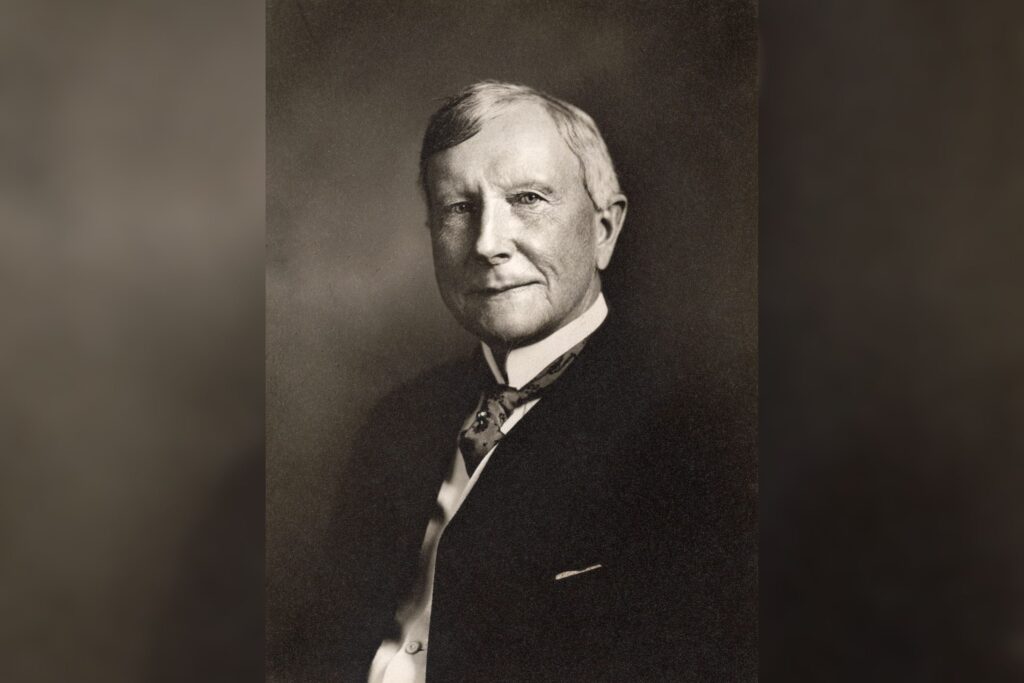
Ninety percent. By 1880, that was roughly the share of U.S. oil refining that ran through John D. Rockefeller’s Standard Oil, which Britannica puts at 90 to 95 percent. It is the number that explains why a Cleveland refinery partnership ended up in front of the Supreme Court.
The story starts small. In 1863 Rockefeller joined Maurice B. Clark and Samuel Andrews in a Cleveland refining business. He bought out Clark in 1865, and two years later Henry M. Flagler came in as a partner. By 1870 the firm ran the largest refineries in the city, and its assets moved into the new Standard Oil Company, incorporated in Ohio that year.
How the machine worked
Growth came from buying rivals, merging with them and winning favorable railroad rebates. Rockefeller cut private shipping deals that left smaller refiners unable to compete, and when they neared bankruptcy, Standard bought them out. Yale’s Energy History project describes the result as a bottleneck at the refining stage that Standard controlled.
In 1882 the company and its affiliates were folded into the Standard Oil Trust, set up under an agreement signed by nine trustees, Rockefeller among them. Eventually the trustees governed some 40 corporations, 14 of them wholly owned. The structure was a maze of legal entities. Ida Tarbell, whose investigative series ran in McClure’s Magazine from 1902, put it this way in her 1904 book: “You could argue its existence from its effects, but you could not prove it.”
The law catches up
Congress passed the Sherman Antitrust Act in 1890, but it took years to bite. The Ohio Supreme Court ordered the trust dissolved in 1892, yet it kept operating from New York. In 1899 the New Jersey company became a holding company and absorbed everything the trust had held.
Then the pressure rose. Tarbell’s nineteen-part series stirred public anger, and the Justice Department sued in 1906. Prosecutors filed a report of about 12,000 pages covering 40 years of dealings. A federal circuit court ordered the company dissolved in 1909.
In 1911 the Supreme Court agreed. Chief Justice Edward D. White wrote that the company’s dominance was not the product of “normal methods of industrial development”. The ruling also set the rule of reason: only unreasonable restraints of trade are banned, meaning conduct that leads to higher prices, lower output or lower quality. The decision split the trust into 34 independent companies, according to the Supreme Court Historical Society. Britannica counts 33.
What came after
The pieces did well. Standard Oil of New Jersey became Exxon in 1972, and Standard Oil of California was renamed Chevron in 1984. Standard Oil of New York merged with Vacuum Oil in 1931 and became Mobil in 1966. Exxon and Mobil rejoined in 1999.
Rockefeller was worth $1.5 billion when he died in 1937, the historical society notes, making him the world’s first billionaire. In retirement he turned to philanthropy, funding work in public health, education and medical research.
The Clayton Act and the Federal Trade Commission arrived in 1914 to tighten the rules the Sherman Act left vague.
Sources
- Standard Oil | History, Monopoly, & Breakup | Britannica Money
- Antitrust and Monopoly – Energy History, Yale University
- Standard Oil Company v. United States (1911) – Supreme Court Historical Society