
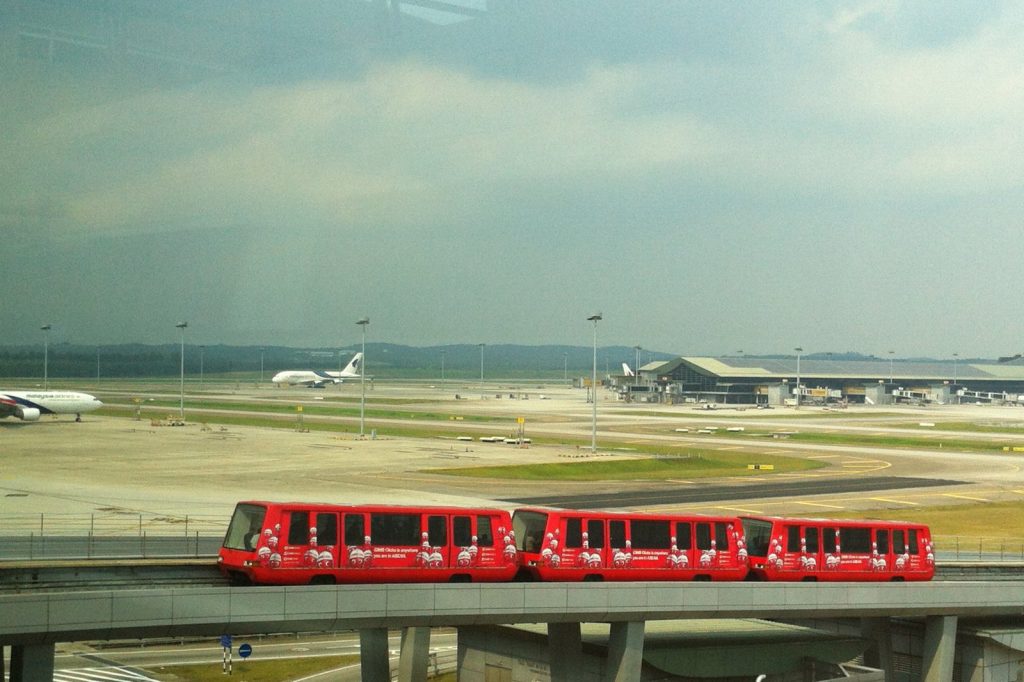
At 06:15 on Sunday 9 July 2023, the 1.2‑km Aerotrain that shuttles passengers between Kuala Lumpur International Airport’s main terminal and its satellite building stopped operating after a software error triggered an emergency brake on one of its two cars, Malaysia Airports Berhad (MAB) said. A technician‑led reboot restored service temporarily, but a second fault occurred an hour later, forcing MAB to suspend the people‑mover for the remainder of the day.
With the rail link unavailable, travellers were directed to 30‑seat buses or the 400‑metre service corridor that is usually closed to the public. Flight crews also used the corridor, pulling cabin baggage carts behind them. The disruption caused 62 flights to be delayed by more than half an hour, as passengers arrived late at their gates. The bottleneck peaked around 11:00 a.m., when buses could move only about 350 people every ten minutes, a stark contrast to the Aerotrain’s normal capacity of roughly 3,000 passengers per hour.
“We landed at 07:30 and spent 40 minutes in a bus queue,” said Lydia Ng, a 42‑year‑old consultant from Singapore who was travelling with two children. “My son counted 11 broken‑escalator stickers while we waited. It felt like the airport itself was stuck in 1998.”
Transport Minister Anthony Loke had pledged on 22 May that the ageing system would be “fully overhauled” before the July school‑holiday peak, with a RM55 million budget slated to start in June. Yet neither Loke nor any deputy minister appeared at KLIA on the day of the breakdown. The ministry’s Instagram account posted only a brief Ramadan‑related greeting, while Deputy Transport Minister Hasbi Habibollah was confirmed to be in Kuching for a road‑safety campaign. Loke’s press aide said the minister was “monitoring the situation” and would visit after receiving a technical report. Opposition MP Wong Chen criticised the absence, stating, “The rakyat deserve to see the person who made the promise. If a minister can campaign in six states he can surely ride a broken train.”
The Aerotrain, inaugurated in 1998 alongside KLIA, was built by Mitsubishi and designed for a 20‑year lifespan and 130,000 operating hours. MAB records show the two cars had reached 160,000 hours by 2020, and pandemic‑delayed maintenance pushed the total beyond 170,000 hours in 2023. Spare parts are now scarce after Mitsubishi Heavy Industries exited the automated‑train market in 2005. A reliability audit commissioned in December 2022 warned that the control software “is no longer supported by any vendor” and recommended a full replacement within 18 months. MAB chose phased repairs instead, citing cost considerations. The latest failure stemmed from the legacy signalling module highlighted in that audit. An unnamed train technician told InfoPulse Today, “We reboot at least once a shift…Everyone knows the day will come when the reboot doesn’t work.”
Social media reaction was swift. By midday, the hashtag #AerotrainDown had generated over 8,000 tweets, some comparing KLIA unfavourably with Singapore’s Changi Airport. Aviation analyst Shukor Yusof warned that “KLIA markets itself as a hub, but hubs can’t have single‑point failures,” adding that airlines monitor such incidents and may divert connecting traffic if the risk appears chronic.
In response, Malaysia Airlines issued a waiver for rebooking passengers who missed connections, while AirAsia said it might shift some Kota Kinabalu‑Taipei transits to klia2, which uses a different satellite system. The airport workers’ union Kesatuan Pekerja Penerbangan Malaysia urged faster action on a previously shelved cable‑car link, arguing that a rope‑way could be built in 14 months at half the cost of a new train. Union secretary S. Parameswaran said, “We raised this in April. The technology is proven at airports in India and Turkey.”
MAB chief executive Iskandar Mizal Mahmood visited the site late Sunday, pledging “no shortcuts” for a permanent solution. He announced that an independent consultant would be appointed within two weeks and that a tender for either new vehicles or an entirely different system would be issued by September. Until then, buses will run every four minutes and express lanes will be opened for passengers with tight connections. Whether these measures will restore confidence depends on how quickly a next failure occurs and whether ministers will be present when it does.




