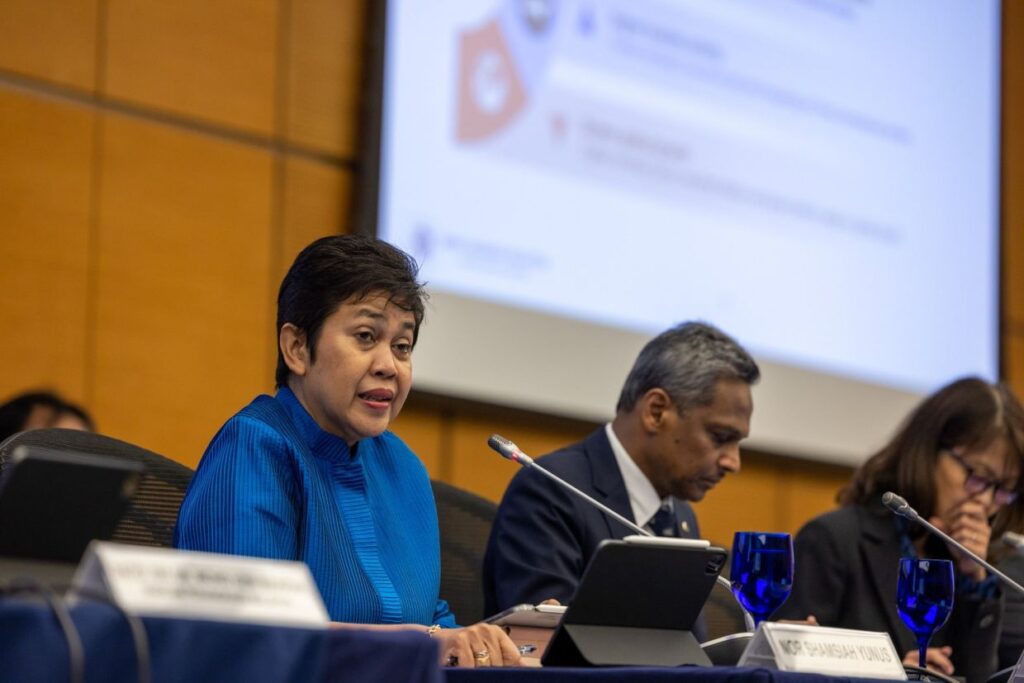
“I wish to stress that Malaysia will not go into a recession this year.” Bank Negara Malaysia Governor Tan Sri Nor Shamsiah Mohd Yunus made that point on Friday, Feb. 10, at a press conference where the central bank put 2022 economic growth at 8.7 per cent. That is the strongest result since 2000, when the figure was 8.9 per cent.
Shamsiah did not promise a repeat. After such a sharp recovery, she said, growth in 2023 should come at a more moderate pace. Domestic demand is expected to carry it as global demand slows. “However, a highly challenging and uncertain global environment will remain the key risk to domestic growth going forward,” she said.
What the 2022 numbers show
The economy grew 3.1 per cent in 2021, after a 5.6 per cent drop in 2020 caused by the COVID-19 pandemic. The 2022 jump to 8.7 per cent was a 22-year high, with every sector contributing. Measured against the third quarter, though, GDP contracted 2.6 per cent in the fourth quarter of 2022. Chief Statistician Datuk Seri Dr Mohd Uzir Mahidin put that slowdown down to “waning support from stimulus measures.”
Inflation stayed warm. Headline inflation averaged 3.3 per cent last year and core inflation 3 per cent. Shamsiah expects both to ease but to remain elevated while cost and demand pressures linger.
Jobs, investment and tourism
The governor pointed first to the labour market. “The important thing I want to emphasise is that we are seeing sustained improvement in the job market,” she told reporters, adding that Malaysia would gain from China’s reopening. The Star reported that she described first-quarter 2023 performance as stronger than the 7.0 per cent recorded in the fourth quarter of 2022.
Investment is one cushion. Approved investments came to RM194 billion (US$44.83 billion) between January and September 2022, mostly in real estate, information and communications, and electrical and electronics. “The realisation of these approved investments will provide support to growth,” she said.
Tourism is another. Shamsiah said weaker export growth should be partly offset by services exports, as tourist arrivals recover now that China has reopened its borders. The numbers from Mohd Uzir back that up. Inbound travel spending rose to RM27.9 billion in 2022 from RM0.3 billion a year earlier, though the 26.1 million tourist arrivals were still below pre-pandemic levels. Outbound travel spending reached RM29.6 billion, more than half of the RM51.3 billion recorded before the pandemic.
Gaps that remain
The economy as a whole has passed its 2019 size, but three sectors have not: mining and quarrying, construction, and agriculture. In 2021 those three employed 2.8 million people, which Mohd Uzir said was 0.1 million fewer than before the pandemic. Food and beverage, accommodation, real estate, business services and private education were also still below pre-pandemic levels, even though the services sector overall had moved past its 2019 mark.
The IMF has raised its forecasts. It now sees global growth of 2.9 per cent in 2023, up from 2.7 per cent. Global activity still slowed in the fourth quarter of 2022 under higher interest rates and slower trade, and a severe COVID-19 wave in China hit spending and production there.
Malaysia’s official GDP projections for 2023 will come only with Budget 2023, due to be tabled on Feb. 24.
Sources
- Malaysia not going into recession in 2023, last year’s GDP growth was highest since 2000: Central bank
- Malaysia not going into recession, growth set to continue in 2023: BNM Governor