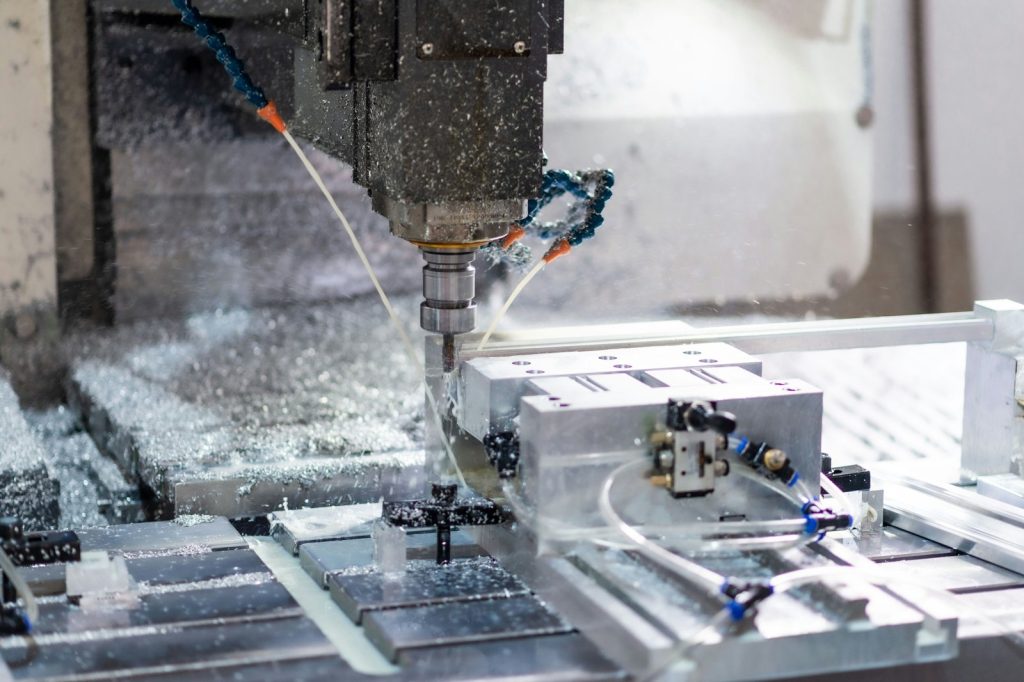
Nidec Machine Tool will put its new MVR-5X double-column five-axis milling machine on sale on October 26, 2026, and show it to the public for the first time that day at JIMTOF2026, the 33rd Japan International Machine Tool Fair, at Tokyo Big Sight. The company says the machine is meant to consolidate machining of large workpieces, raising shop-floor productivity while giving designers more freedom with component geometry.
Why the market wants it
Demand for large metal components is rising, Nidec says, driven by new data centers tied to the growth of AI, expanding semiconductor production and infrastructure building. Many of these parts are cast iron or steel, hard to cut, with complex shapes and fine angular features. That is the case for doing more of the work in one setup.
A shorter, stronger head
Every MVR-5X ships with a newly developed two-axis contouring attachment. Its headline figure is spindle torque of 341 N·m, up 323.5 N·m on the previous model and roughly twenty times the old two-axis head. Nidec says the gain comes from structural optimization and lets the machine work steel and cast iron that the conventional attachment could not cut adequately. The comparison covers the head only, not the output of the whole machine, and real material removal still depends on cutter geometry, spindle speed, workpiece stiffness, tool engagement and fixturing.
The head is also smaller. It projects 790 mm from the ram end face to the spindle nose, 300 mm less than before. On a double-column machine a bulky head can restrict access to raised features on big castings or fabrications even when the axes have enough travel. The shorter projection widens the vertical clearance between table and cross-rail, and Nidec says rigidity is kept high enough to suppress vibration.
The rotary axes are controlled continuously: ±100° on the B-axis and ±270° on the C-axis. That allows machining at arbitrary angles, including increments below one degree, and simultaneous five-axis contouring. Work that once needed vertical, horizontal and angled operations on different machines can be done in a single setup. Programmers still have to watch rotary limits and avoid collisions between head, fixture and part.
Specifications and thermal control
The BBT50 spindle runs from 20 to 6,000 rpm and delivers 15 kW at 420 rpm. Column clearances run from 2,050 to 4,250 mm, and tables range from 1,500 × 3,000 mm to 3,500 × 10,000 mm depending on configuration.
Long cycles bring heat. Spindle bearings, drives and the shop itself change temperature, and the geometry drifts with them. The MVR-5X combines spindle cooling inside the ram with Nidec’s Thermo-Stabilizer Columns, which are filled with a temperature-controlled medium. The machine builds on the rigid structure of Nidec’s high-end models.
Digital twin and target users
Nidec NC Twin software lets users simulate machine movement, interference, surface quality and cycle time on a PC before cutting. The company says its cycle-time simulation runs up to 20 times faster than real operation, with an error under 1%. That figure is a software speed and has nothing to do with the torque comparison.
Nidec lists energy and shipbuilding parts such as cylinder blocks, casings, propellers and pump components, along with large vacuum chambers and frames for semiconductor equipment, and big bevel gears, dies and molds. The company has not named a customer, a delivery count or a production trial. The machine is on show at Tokyo Big Sight from October 26 to 31.
Sources
- Nidec Machine Tool Launches the MVR-5X, a New Double-Column Five-Axis Milling Machine
- Nidec introduces five-axis milling for large components – Industrial News
- Nidec MVR-5X Five-Axis Gantry Machine
Photo: aluminum Zheng ji / Unsplash (Unsplash License)