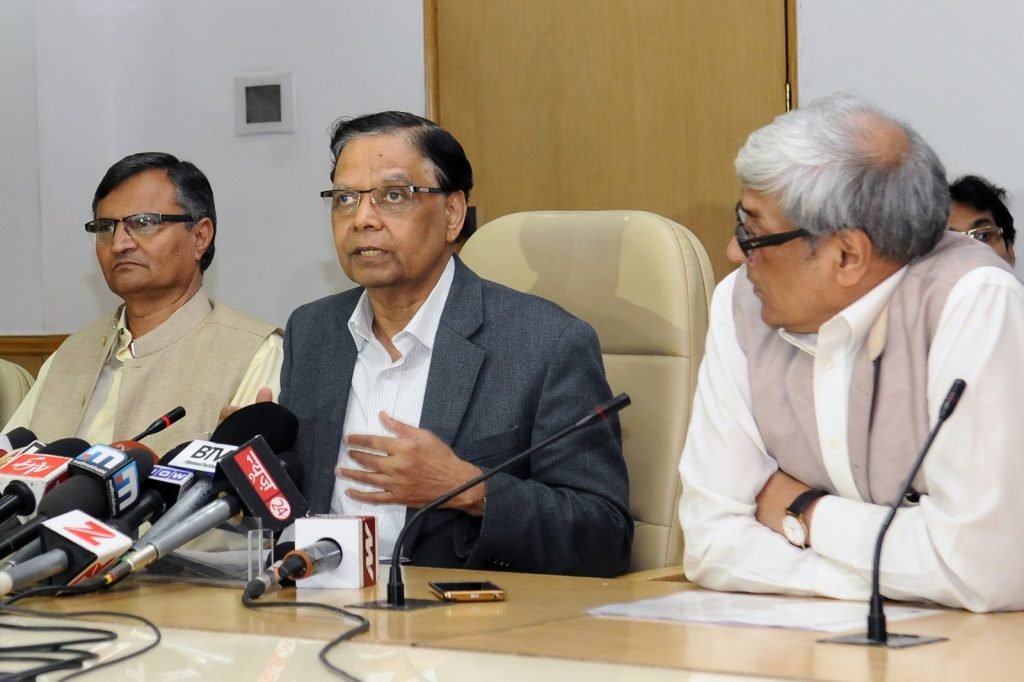
NEW DELHI, July 18 — NITI Aayog, the Indian government’s apex policy think tank established in 2015, has released its Investment Friendliness Index, a comparative assessment of state-level performance designed as a guide for domestic and global investors. The index evaluates Indian states across several parameters, including infrastructure, business environment, port efficiency, the rate at which memoranda of understanding are converted into actual projects, and export performance. The report ranks Tamil Nadu third overall with a score of 53.3, behind Gujarat (56.6) and Maharashtra (53.7).
The state is noted for a near-100% MoU conversion rate—a figure highlighted in the document. The index is the latest product of an institution that replaced the Planning Commission in January 2015, following a cabinet decision to scrap the 65-year-old body.
The Planning Commission had been built for a command economy; NITI Aayog was conceived as a more flexible forum for cooperative federalism, moving away from what its architects called “bargaining federalism” towards a bottom-up approach that involves state chief ministers directly in economic policy-making. The NITI Aayog council includes all state chief ministers, the chief ministers of Delhi, Puducherry and Jammu and Kashmir, lieutenant governors of all union territories, and a vice-chairman nominated by the prime minister. Temporary members are drawn from leading universities and research institutions.
The Investment Friendliness Index compares state-level performance to showcase best practices and, in NITI Aayog’s phrasing, to attract investment by making that comparison transparent.
Beyond the index: lectures and data
The think tank has not confined itself to state rankings. It also launched the NITI Lectures: Transforming India series on the advice of Prime Minister Narendra Modi, inviting globally reputed policymakers and experts to address Indian counterparts. The first lecture was delivered by the Deputy Prime Minister of Singapore, Tharman Shanmugaratnam, on the subject “India and the Global Economy” at Vigyan Bhavan in New Delhi.
In August 2017, NITI Aayog also compiled a State Statistics Handbook, consolidating key sectoral data for every Indian state and union territory into a single database. The Investment Friendliness Index now adds a layer of qualitative assessment to that statistical baseline.
For all the dry numbers, the underlying political message is clear: Indian states are being measured, ranked, and implicitly urged to compete for capital. Whether the index succeeds in shifting investor perception will depend on whether those near-perfect MoU conversion rates in Tamil Nadu, and the strong overall scores in Gujarat and Maharashtra, can be replicated elsewhere. The report’s publication is a nudge, not a guarantee—but it is, notably, a nudge backed by data.