
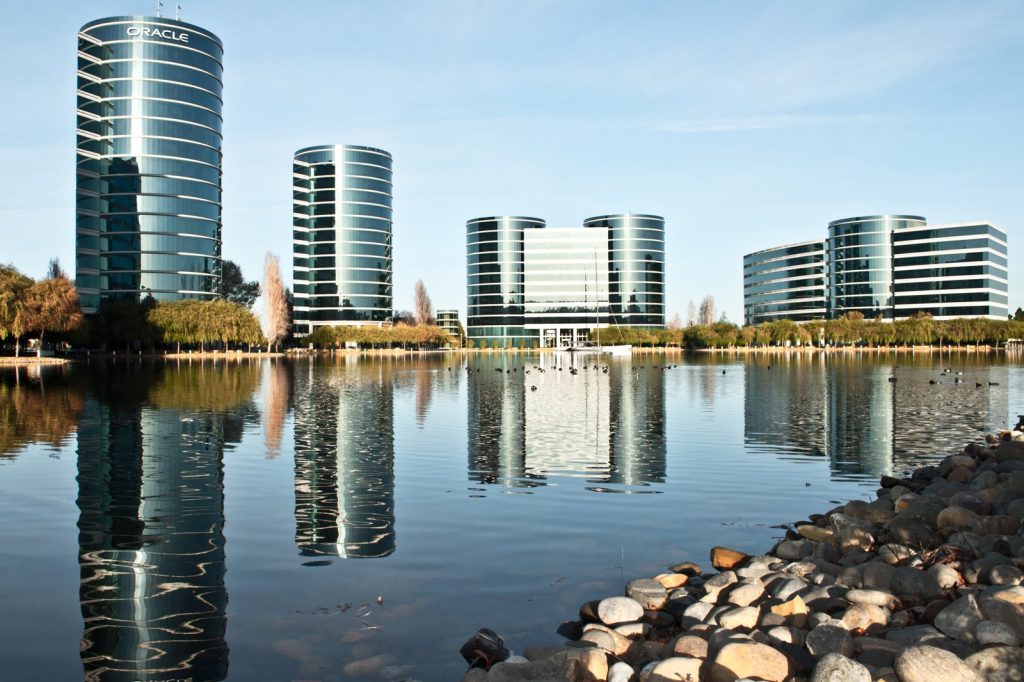
The verified development, per filings with the Securities and Exchange Commission: on 2 November 2026, Oracle moved to raise $10 billion in common stock plus another $10 billion in senior notes, money earmarked for its artificial intelligence buildout, with Wells Fargo, Citigroup and BNP Paribas among the book runners. The market’s answer was immediate. Oracle shares finished the session about 8% lower, at $119.22, a 8.76% drop by the quote tape’s reckoning, extending a slide that has now run for most of the year. The question the filing puts to investors is plain: who pays for the compute age, and on whose balance sheet.
The record shows how long the pressure has been building. Oracle stock fell 24.8% over the first half of 2026, per S&P Global Market Intelligence data cited by the Motley Fool, with Microsoft down by a similar measure while Amazon and Alphabet held positive territory. The split is instructive: the infrastructure suppliers further upstream, Vertiv and GE Vernova among them, outperformed as forecasts for AI construction rose all year, while the hyperscalers carrying the capital bill, Oracle chief among them, were marked down for exactly that spending.
The specific exposure is OpenAI. Oracle signed a $300 billion, five-year agreement in September 2025 to build out computing capacity for the model company, with the term starting in 2027. The deal was welcomed at first; the bond market then repriced it. Credit default swaps on Oracle’s five-year paper now sit near 170 basis points, meaning roughly $17,000 to insure $1,000,000 in Oracle debt, and on a 40% recovery assumption that implies a 2.8% annual default probability and 13.4% cumulative. Microsoft, which holds about 27% of OpenAI, has told investors that “Approximately 45% of our commercial RPO balance is from OpenAI.” Behind both stands the counterparty question: OpenAI, by the Fool’s account, expects to burn through some $650 billion of cash between now and 2030 while targeting $280 billion of revenue that year, from an annualized run rate of just $20 billion when 2025 closed.
The same day supplied the counterweights, and the strategic context. Stephens moved Oracle up to overweight from an equal weight rating, analyst Brett Huff writing that “We believe the market needs to give Oracle more credit for the execution on delivering compute that continues to happen,” noting first-quarter delivery of about 850 megawatts, spread over 38 projects in 11 countries, a $213 price target and roughly 63% implied upside. The broader tape was rotating the same way tech was leaning: the Nasdaq shed 1.07% to 25,164.32 and the S&P 500 lost 0.51% to 7,541.40, while the Dow added 213.67 points, 0.41%, to 51,983.98, with Marvell down almost 13% and Lumentum down 18% on their $115 billion merger news. One line from the trading desk captured the mood: “The stock market’s longer-term bullish narrative may have taken some hits in recent weeks, but it’s still intact,” said Chris Larkin of E-Trade. Oil, meanwhile, collapsed on reports Iran’s supreme leader had authorized peace talks, Brent off 7.63% to $104.77, a separate pressure release on the same market narrative.
Positions, laid out plainly. The bears hold the filing itself: $20 billion of fresh paper, equity dilution stacked on debt, in service of a contract whose counterparty must multiply revenue by fourteen to justify the build. The bulls hold the megawatts: capacity actually being delivered, an analyst house calling the market’s pricing of it irrational, and a $213 target. The record shows both are describing the same company on the same day. What it cannot show yet is which side the 2030 books confirm.
Sources
- Here's Why Oracle Stock Slumped in the First Half of 2026 (Hint: Microsoft Was Also Impacted) | The Motley Fool
- Stock market news for Nov. 2, 2026




