
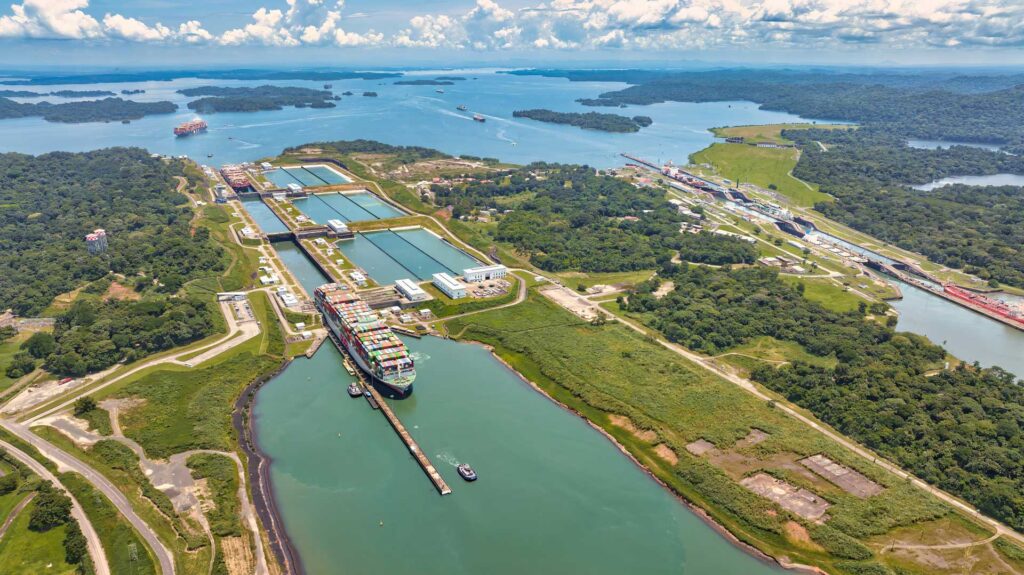
PANAMA CITY, July 15 — The shift is now a decade old, and it reshaped global trade. Ten years after the Panama Canal’s Third Set of Locks Project opened for business on June 26, 2016, the waterway is a fundamentally different machine. The $5.25 billion expansion, financed by the Panama Canal Authority through toll increases and loans, added a new lane of traffic.
On the Atlantic side, that means the Agua Clara locks. On the Pacific, the Cocoli locks.
These new chambers handle Neopanamax vessels, ships that can carry up to 15,000 TEUs. The old locks were capped at Panamax ships, which max out at 5,000 TEUs. The difference is the trend underneath: container ships got bigger, and the canal had to catch up.
Construction was a saga. The project kicked off in 2007, overseen by the ACP.
The consortium Grupo Unidos por el Canal, or GUPC, led the build. That group included Spain’s Sacyr, Italy’s Impregilo, Belgium’s Jan De Nul, and Panama’s Constructora Urbana. It was not smooth.
Delays and cost overruns piled up. A dispute over $1.6 billion in cost overruns was resolved in 2014. Watch this space for how infrastructure megaprojects manage risk — this one had plenty of lessons.
What changed
Capacity doubled. Revenue tells the story: the canal pulled in $2.1 billion in 2015, the year before the expansion went live. By 2023, that figure had climbed to $4.3 billion.
The new locks also brought a technical upgrade: water-saving basins that cut water loss by 60% per transit. In a country where freshwater is a strategic resource, that matters.
The political backing was solid. Panamanian voters approved the expansion in a national referendum on October 22, 2006. The margin was decisive — 76.8% in favor.
That mandate carried the project through its rocky construction phase.
Who built it
The ACP ran the show. GUPC handled the heavy lifting. The Italian connection runs through Impregilo, a firm with deep experience in complex civil engineering.
For an Italian journalist watching the tech and infrastructure space, that link is worth noting — Italian engineering played a role in one of the world’s most consequential maritime upgrades.
What to watch next
The canal’s capacity is set. The question now is demand. Global shipping routes are shifting, with climate change opening Arctic passages and geopolitical tensions rerouting traffic around the Cape of Good Hope.
The Panama Canal Authority will need to keep the water flowing and the locks running. The expansion doubled capacity, but the trend underneath is that the world’s supply chains keep getting more complex.
Watch this space for how the canal adapts — and whether another expansion is on the horizon.
Sources
{“@context”: “https://schema.org”, “@type”: “NewsArticle”, “headline”: “Panama Canal Expansion 2016: $5.25 Billion Project Doubled Capacity”, “description”: “PANAMA CITY, July 15 — The shift is now a decade old, and it reshaped global trade. Ten years after the Panama Canal’s Third Set…”, “datePublished”: “2026-07-15T09:30:00+00:00”, “author”: {“@type”: “Person”, “name”: “Maria Romano”}, “publisher”: {“@type”: “Organization”, “name”: “InfoPulse Today”, “url”: “https://newsfeed.2bme.xyz/”}, “citation”: [{“@type”: “CreativeWork”, “url”: “https://en.wikipedia.org/wiki/Panama_Canal_expansion_project”}]}




