
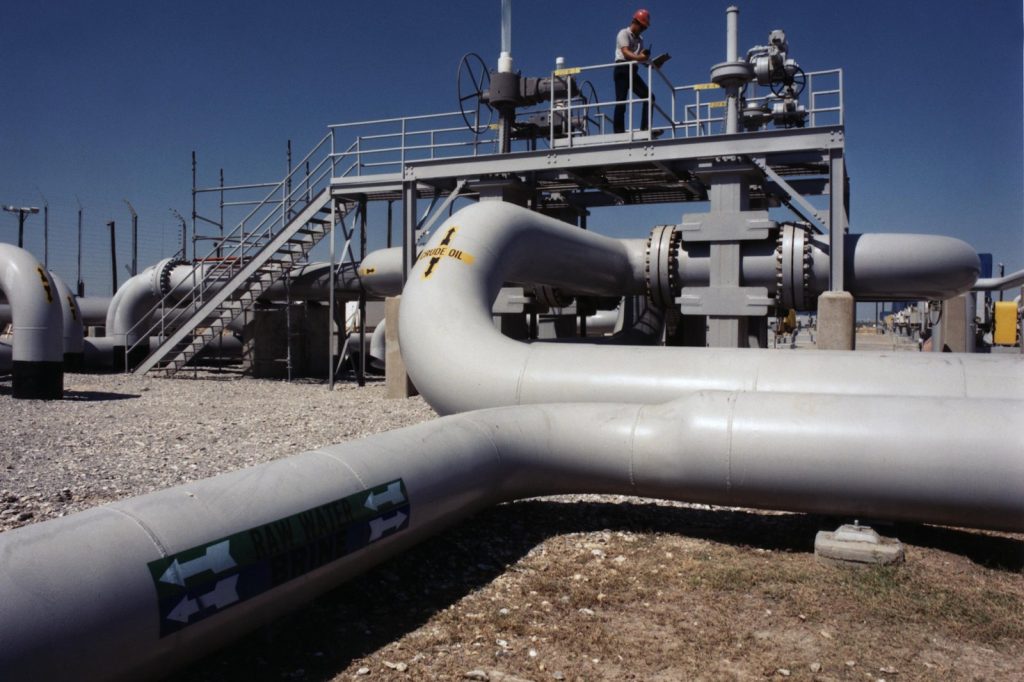
One cavern is big enough to swallow Chicago’s Willis Tower and leave room to spare. The US Department of Energy uses that comparison for the underground chambers that hold the nation’s emergency crude oil, and it has 60 of them.
They sit in salt, and the reason is mostly arithmetic. According to the department, caverns in deep salt are the most affordable way to store oil, costing up to 10 times less than above-ground tanks and 20 times less than hard rock mines.
Four sites on the Gulf Coast
The Strategic Petroleum Reserve keeps its crude at four facilities along the Gulf Coast: Bryan Mound and Big Hill in Texas, and West Hackberry and Bayou Choctaw in Louisiana. Together they have an authorized storage capacity of 714 million barrels.
Bryan Mound, about three miles southwest of Freeport, Texas, is the largest, with 19 caverns and 247.1 million barrels of capacity. It became operational in 1986. West Hackberry, 25 miles southwest of Lake Charles, Louisiana, has 21 caverns and 220.4 million barrels. Big Hill, 26 miles southwest of Beaumont, Texas, has 14 caverns and 170.0 million barrels, and began operating in 1991. Bayou Choctaw, about 12 miles southwest of Baton Rouge, is the smallest at six caverns and 76.0 million barrels.
A typical cavern holds 10 million barrels and is cylindrical, about 200 feet across and 2,500 feet tall. Capacities run from 6 to 37 million barrels. The coast was chosen because it offers the most flexible links to the commercial oil network. The sites feed three pipeline systems, Seaway, Texoma and Capline, which reach major refining centers, interstate pipelines and marine terminals.
How a cavern is made
Salt caverns along the Gulf Coast were already in use by the petrochemical industry when the government decided in the mid-1970s to build a reserve. It bought existing caverns to hold the first 250 million barrels, the fastest way to get an emergency supply after the oil shocks of that decade. Later, the department created more.
New chambers are carved by solution mining. Crews drill a well into a salt dome and pump in fresh water, which dissolves the salt. The resulting brine was removed and either reinjected into disposal wells or, more commonly, piped several miles offshore into the Gulf of America. Controlling the water lets engineers create caverns of very precise dimensions. Each barrel of oil to be stored takes approximately seven barrels of raw water to make the space.
Why salt holds
The department says rock salt at those depths has extremely low porosity and permeability, deforms plastically and heals itself. Any microcrack that opens in a cavern wall closes almost instantly. That is why it calls deep salt caverns one of the most environmentally secure ways to store oil.
Moving the oil relies on a simple fact: oil floats on water. To withdraw crude, operators pump fresh water into the bottom of a cavern and the water pushes the oil up to the surface. Pipelines then carry it on to terminals and refineries across the country.




