
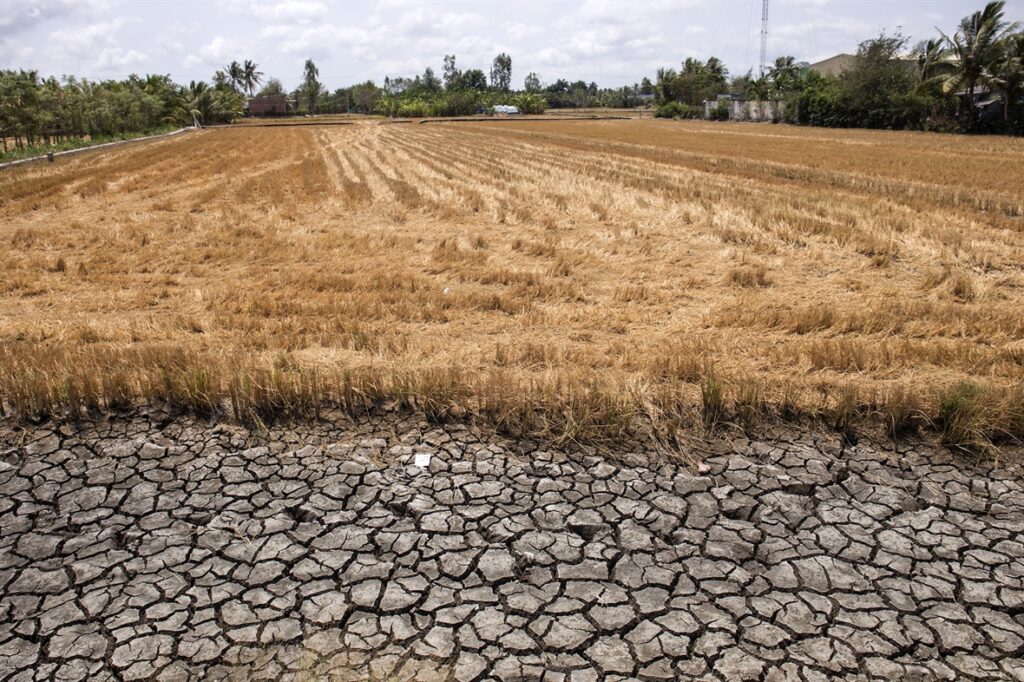
In 2020, seawater pushed more than 100 kilometres up the rivers of southwestern Vietnam. Tens of thousands of people were left without fresh water, and crops died across the region. Edward Park, an associate professor of physical geography at Nanyang Technological University in Singapore, argues that this was no freak event. In his analysis of the Mekong Delta, published by East Asia Forum, he describes salt intrusion as a slow-burning crisis that now returns every year.
Nearly 20 million people depend on the delta, which Vietnam calls its rice bowl. Park says the salinity line creeps further inland with each dry season, and the disasters are arriving more often and hitting harder.
The damage so far
In bad years such as 2016 and 2020, more than 160,000 hectares of rice paddy were damaged. Park puts the 2016 economic losses at over US$650 million. His projection is blunter still: without decisive action, salt could reach up to 45 per cent of the delta’s farmland by 2030.
The stakes are national. The region supplied around 12 per cent of Vietnam’s GDP through agricultural exports in 2022. If salt keeps eating into that base, Park warns, rural people will drift to the cities, poverty will rise and social systems will come under strain. Food security, long taken for granted, “could become a political flashpoint.”
Why the water is turning salty
No single cause explains it. Rising seas lift the baseline for intrusion. The land itself is sinking, mostly because so much groundwater is pumped out, which lets tides reach further. Dams upstream change the seasonal flow and trap sediment that once helped shield the delta. Sand mining digs the riverbeds deeper, giving salt water an easier path inland.
Dam releases have actually raised dry-season flows slightly compared with the past. But that water carries little sediment, so it scours the riverbed and speeds the salt’s advance.
A policy problem as well
Park’s central complaint is that nobody knows which of these forces matters most. Researchers cannot say how much each of sand mining, subsidence, reservoir operations and sea-level rise is contributing. Without that ranking, he writes, targeted management is impossible.
The response is scattered in the meantime. One agency cracks down on illegal dredging, another drills deeper wells, and regional bodies talk up water diplomacy. Switching crops, installing pumps or building sluice gates, which regulate the flow of water, may buy time but will not remove the causes. Park wants a coordinated scientific effort to measure each driver, so that limits on sand extraction, groundwater rules, river governance and climate planning can be weighted accordingly.
China and the Mekong River Commission
Vietnam sits downstream, and its bargaining position is weak. China runs most of the upstream dams but is not a member of the Mekong River Commission, the intergovernmental body that coordinates use of the basin’s water. China does share some hydrological data, Park notes, yet its operations shape flow and sediment far downstream. The commission has struggled to balance dam builders against downstream farmers.
He sees room for cooperation through data transparency, coordinated flow management and joint sediment monitoring, calling these “prerequisites for the survival of the Delta.” Within Vietnam, he says, provinces need shared forecasting, groundwater rules and joint plans to diversify farming.




