
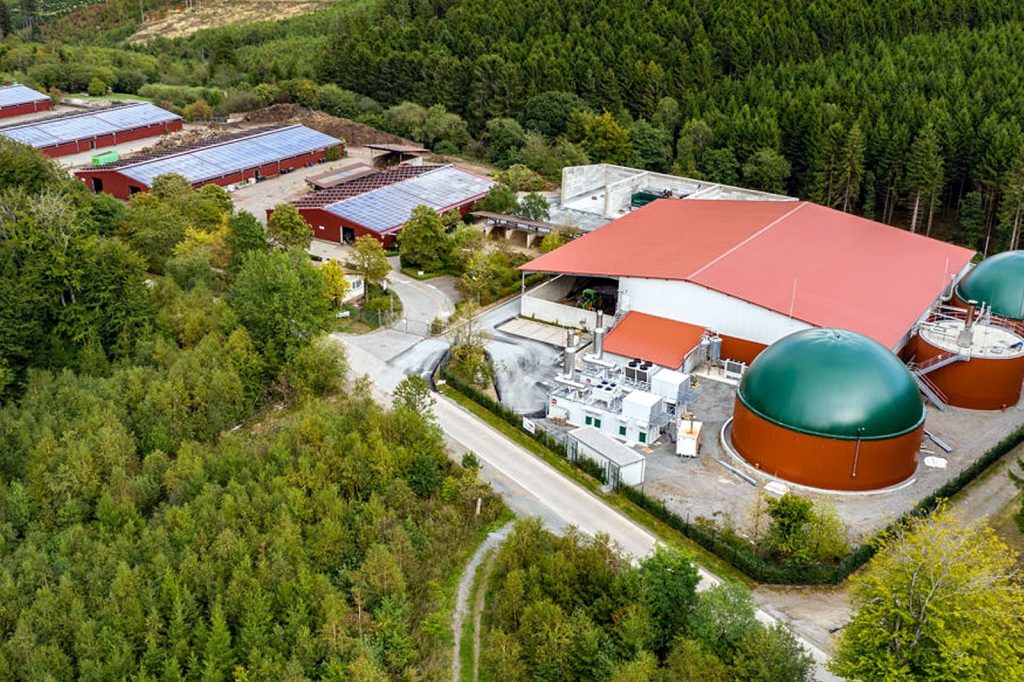
The scene is a dairy farm in Steuben County, New York, and the development worth marking is what the cows are now for. Lent Hill Dairy houses some 4,000 animals, a vast manure pit and two huge domes doing duty as anaerobic co-digesters, machines that break down manure and local food waste into biogas. The gas would ordinarily go to electricity, heating and fuel. Instead, it also feeds an on-site cryptomine, in the first arrangement of its type in the country, run by Ag-Grid Energy, a Pennsylvania firm. The broader stakes are written in the load tables: data centers already draw 4.9 percent of the country’s electricity, on a figure that could double by 2030, and every hyperscaler on the map is hunting fuel that does not strain the grid. The project claims to take in north of 45,000 gallons of food waste a day, plus manure from the 4,000-cow herd.
Strategically, the industry reads this as an opening. Renewable natural gas is a “drop-in” fuel, usable through existing fossil infrastructure, and its proponents, a coalition spanning agriculture, fossil fuels, utilities and waste management, market it as “the fuel of the AI age.” The appeal for technology companies is reliability: unlike weather-bound solar and wind, digesters offer baseload output, a steady around-the-clock supply matched to the always-on requirements of servers. Microsoft has already paired with Enchanted Rock in California on RNG backup power for a data center; TotalEnergies inked a 15-year solar deal with Google for Ohio data operations in November 2025 and runs joint ventures with Vanguard Renewables, a BlackRock portfolio company, to grow biogas output. “We’re really excited about the prospect of biogas systems being able to provide power to data centers, because they can provide that reliability,” says Patrick Serfass of the American Biogas Council, who reckons the country has realized only 10 percent to 15 percent of its biogas capacity. His forecast is blunt: “The data centers are going to be so hungry for power that they could eat up pretty much all of the supply that the biogas industry could create”
The counter-calculus comes from the places asked to host the hardware. Sarah D’Onofrio, an advocate working with digester-impacted communities, argues the drop-in logic lets companies claim sustainability while entrenching fossil-era infrastructure: “Why would you want to incorporate that [RNG] into our fuel system during the period of climate change?” she asked, warning that “It attaches these industrial food operations into our energy system and makes us really dependent on them over time, because the more it becomes intermingled with agriculture, the more it’s going to concentrate agriculture” The case study is Lind, Wisconsin, where a proposed co-digester would have processed about 41,000 gallons of waste a day and piped treated liquid toward Walla Walla Creek via a tributary, on a path to Lake Michigan. “These are manure and industrial food-waste processing and biogas-producing facilities, they are not ag accessories,” said Victoria Gehrke, one of the organizers; “They don’t belong on ag land,” and “what they’re really doing is having our small rural communities” turned, in her words, into places where “we become sacrificial dumping grounds for the industrial waste that other big places don’t want to put in their communities.” After more than a year of opposition, the town denied the application in spring 2024. Vanguard is still developing and operating more than 50 co-digesters nationally and aims to pass 100 completed projects before 2028 ends.
The research record feeds the resistance. Brent Kim of Johns Hopkins’ Center for a Liveable Future calls the subsidy structure a “perverse incentive where the value of manure or animal waste starts to compete with the value of the milk,” pushing farmers to farm waste rather than food. His review calls digesters “The reality is nuanced,” machines that can trim methane in the short run while raising ammonia, toxic byproducts and other pollutants, a trade he names “pollution swapping.” The follow-on numbers sharpen the point: US factory farms generate an estimated 941 billion pounds of manure a year, digested manure can be more polluting than the raw kind by USDA research, the World Resources Institute finds digesters cut methane from stored manure by roughly 25 percent, and a Friends of the Earth report counted herds on digester dairies growing 3.7 percent a year, 24 times the rate of dairies without them, with Kewaunee County, Wisconsin herds swelling about 58 percent after installation. Michigan soybean farmer Lynn Henning, whose neighbor is a Chevron-owned co-digester, puts the shift in one line: when manure becomes “more valuable than the milk,” the system changes what farming is.
What this signals, on the policy front, is a sector living on public money while Washington cools on it. The California Low-Carbon Fuel Standard funds nearly 200 digesters across 16 states, the 2023 Inflation Reduction Act put more than $150 million into biogas projects, and Michigan’s strategic fund has signed off on private bonds above $100 million for the industry. Against that, the USDA in May pushed a 90-day freeze on anaerobic digester loans through year’s end, amid environmental concerns and delinquencies: of 746 project lenders nationwide, 11 percent sat more than 90 days delinquent by one review of the data. Ag-Grid’s founder Rashi Akki, whose plea is that “At the end of the day, our model is providing value to the rural area that we are in,” wants tax credits “just like what we had with the Inflation Reduction Act” aimed “for electricity production for AI would really support our projects,” as she puts it. The calculus now sitting in front of policymakers is the one the domes at Lent Hill make visible: an AI economy hungry for power is redrawing the economics of American agriculture, and the price of cheap computing is being quoted in herds, haulage and the air over Steuben County.
Sources
- Cow manure could be the next data center fuel | Grist
- From Manure to Microchips: The Rise of Biogas-Powered Data Centers and the Controversy of Industrial Digesters




