
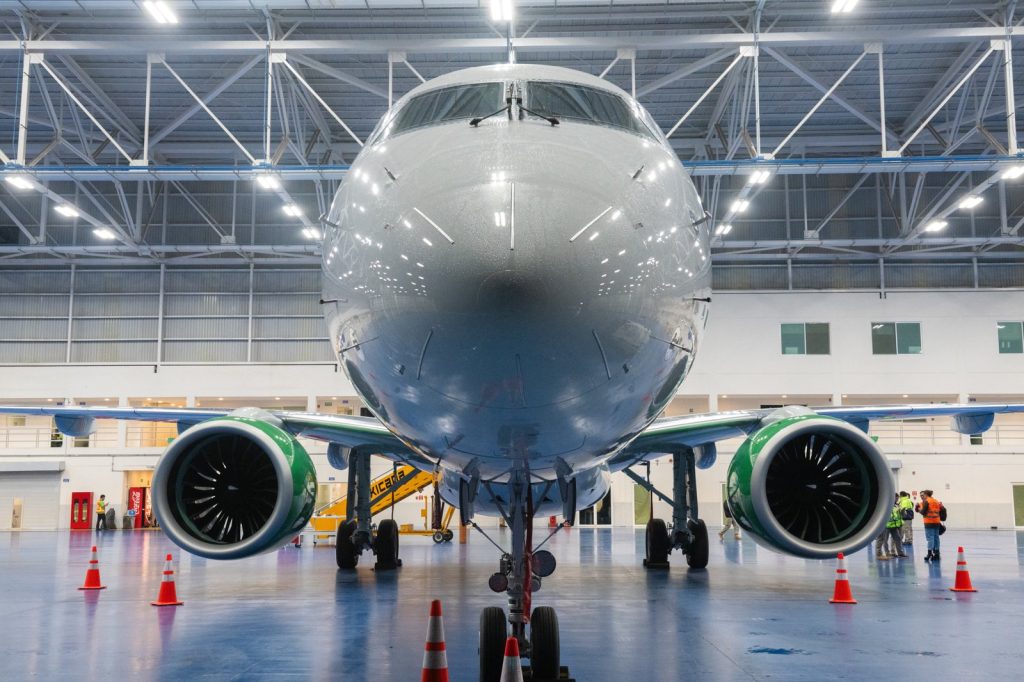
SÃO PAULO, September 24 — Embraer booked R$358.6 million (about US$66 million) in second-quarter results tied to the recovery of import duties, a refund that helped push the Brazilian jet maker to raise its full-year profit margin guidance. The bottom line: billions of dollars in U.S. tariff refunds are moving through corporate income statements, and the next stage of the reimbursement process has slipped to early October.
XP said in a report to clients that the refunds, combined with the exemption of aircraft and parts from the latest round of U.S. tariffs, prompted Embraer to lift its expected margin for the year. Contacted by Valor, Embraer declined to comment.
Taurus banks nearly all it asked for
Firearms manufacturer Taurus recognized R$91.1 million (about US$16.8 million) in refunds during the period, nearly the full amount it had requested. “From the outset, we believed there could be a Supreme Court victory over the tariff’s unconstitutionality,” said Salesio Nuhs, CEO of Taurus. “So we began gathering the documentation so we would have it ready when the time came.” The process was easier for Taurus because it exports to a U.S. subsidiary, which filed for the refund, Nuhs said.
The United States is the company’s main market, accounting for more than 80% of its firearms sales. Taurus products were not included in the exemptions from the tariff package and were subject to a 50% rate — consisting of the 10% “reciprocal” tariff imposed in April 2025 and an additional 40% surcharge introduced in August — until the U.S. Supreme Court struck down the tariffs in February.
The court ruled on Feb. 20 that the International Emergency Economic Powers Act did not authorize the president to impose the tariffs.
WEG and Suzano in the queue
J.P. Morgan recently highlighted the potential upside from refunds for another Brazilian company, WEG. The bank estimates the company could receive between R$170 million and R$230 million (about US$31 million to US$42 million), equivalent to as much as 9% of its projected third-quarter EBITDA.
The Santa Catarina-based electric motor manufacturer was initially subject to the 10% tariff and later to the additional 40% surcharge. Some products were subsequently exempted, while others remained subject to the maximum rate.
Valor obtained a filing submitted in February by pulp and paper producer Suzano and two subsidiaries, just days after the Supreme Court ruling. The companies asked the U.S. Court of International Trade to order CBP to “reliquidate” imports that had been subject to the tariffs and process the corresponding refunds. Reliquidation involves reopening an import entry that has already been finalized, or liquidated, so the duties assessed on it can be recalculated.
The U.S. Court of International Trade ordered CBP to reliquidate imports subject to the tariffs, including entries whose liquidation had already become final. The government appealed that broader order, and the case remains pending before the U.S. Court of Appeals for the Federal Circuit.
The Trump administration argues that CBP lacks the legal authority to reopen a finally liquidated entry on its own and must instead act under a court order, such as the one sought by Suzano. A CBP representative told the Court of International Trade that the next phase of the refund process will cover imports whose reliquidation has been ordered by a court. Originally expected to begin in August, the phase was postponed while CBP adapted its refund-processing system.
The agency now plans to launch it on Oct. 6 for eligible importers covered by court-ordered reliquidation. “There are some people in Washington who are apprehensive about the possibility that CBP may be changing its mind about this phase. I don’t think that’s true.
I believe CBP is acting in good faith, and I say that because this entire process is being conducted through the courts [the Court of International Trade],” said Matthew McConkey, a partner at U.S. law firm Mayer Brown, which is associated with Brazil’s Tauil & Chequer. Suzano’s filing does not specify an amount.
Brazilian pulp exports were subject to the 10% tariff before the product was exempted in September. Neither Suzano nor WEG has publicly said it filed for reimbursement with U.S. customs authorities.
The U.S. scoreboard
In the U.S., tariff reimbursements have generated multibillion-dollar gains. Walmart, one of the country’s largest importers, received $2.9 billion in refunds during the quarter, boosting the retailer’s earnings and gross margin; it said the amount represented substantially all the refunds it had requested. Apple did not disclose a figure, but analysts estimated its reimbursement at about $2.2 billion.
In Brazil, traditional exporters to the U.S. have largely avoided commenting on the issue, though the sums involved reach hundreds of millions of reais.




