
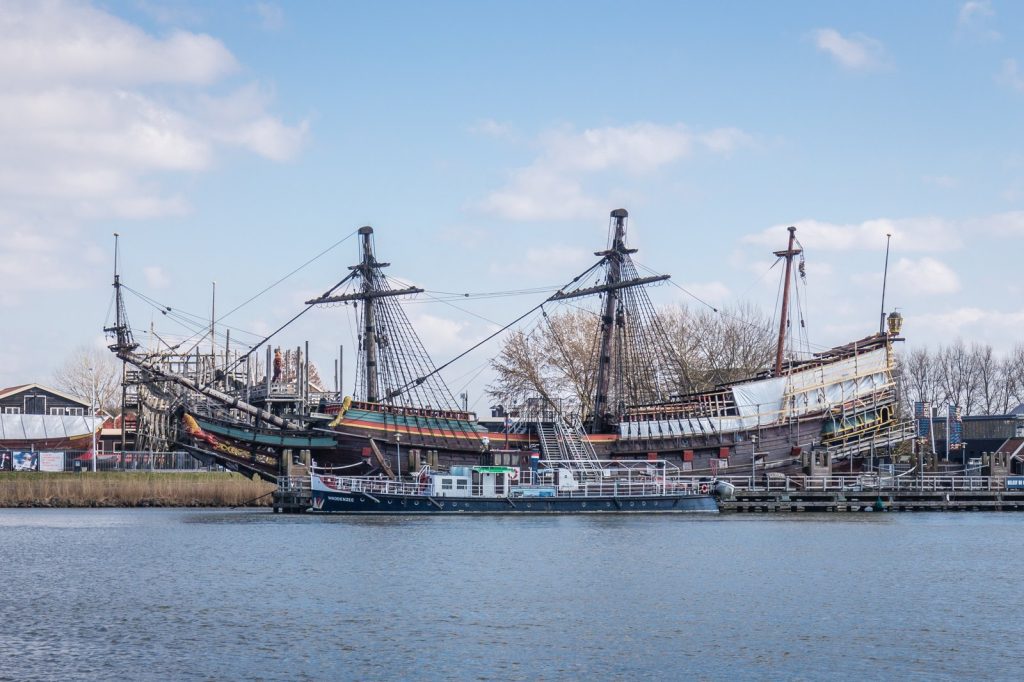
On the stroke of midnight on August 31, 1602, a notary in Amsterdam closed a ledger and put down the total: 3,674,945 guilders. Not a nickel or dime, he wrote, had come in after twelve. The book recorded the subscribers to the first public share offering in history, and the company behind it was the Dutch East India Company, the VOC.
The record is unusually specific. The VOC’s founding charter, dated March 20, 1602, set out the rules. Article 10 said “All the residents of these lands” could buy shares, with no minimum and no maximum. The next article ordered posters put up to announce the sale. Dutch historian Lodewijk Petram, who has written a book on the subject, points to that public character as the break with earlier ventures, which had raised money from a small circle around their directors.
A subscription at a merchant’s house
The setting was modest. The VOC had no offices yet, so investors in the Amsterdam branch were told to come to the private home of Dirck van Os, a wealthy merchant and co-founder. Through August 1602, Van Os and the other directors took turns watching the bookkeeper write each name into the register.
By the time the books closed, 1,143 investors had signed up in Amsterdam. The second to last was Neeltgen Cornelis, Van Os’s maid, who had watched buyers come and go all month. She put in a hundred guilders. Her wages were under fifty cents a day.
Amsterdam was only one of six semi-independent branches, each running its own offering. Together they raised almost 6.5 million guilders. Amsterdam supplied 57 percent of it, Middelburg 20 percent, Enkhuizen 8 percent, Hoorn 7 percent, Delft 4 percent and Rotterdam 3 percent. Petram notes that plague had hit Amsterdam that summer and many residents had left, so the city’s share might have been larger. Later, only the Amsterdam shares, and to a lesser extent Middelburg’s, traded actively.
Shares that could be sold
The charter ran for 21 years. Earlier voyage companies usually lasted three or four. That was a long time to lock up money, so the charter promised a “general balance” after ten years, in 1612, when shareholders could ask for their capital back.
The directors added something else on the first page of the subscription register: “Conveyance or transfer [of shares] may be done through the bookkeeper of this chamber.” Investors could sell to someone else instead of waiting. A seller had to appear before the bookkeeper, and two directors had to approve the transfer.
The exchange history site run by Amsterdam’s exchange community describes what followed. Trade in VOC shares grew fast. By 1606 the shares had gained 200 percent in value, and in 1610 the company paid its first dividend. In 1606, shareholders also received deposit receipts as proof of what they had put in, and those papers are known as the oldest shares in the world. The same site calls the VOC the world’s oldest listed company, though it also notes the company’s darker side now gets more attention.
The VOC lasted almost 200 years. It was effectively abolished in 1799.
Sources
- VOC: the start of global share trading (Exchange history, Amsterdam)
- The world's first IPO (Lodewijk Petram, The World's First Stock Exchange)




