
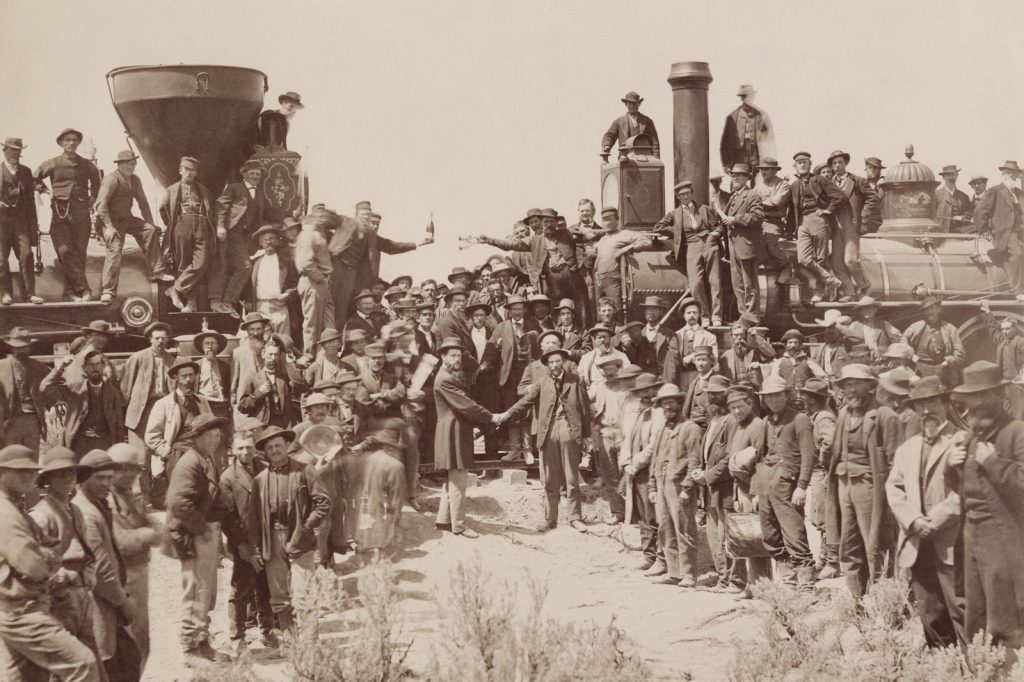
In the decades before steel rails linked the Atlantic and Pacific, a journey from the East Coast to California meant months of peril. Wagon trains following the Oregon, California, or Mormon trails stretched 2,000 miles, consuming four to six months and exposing travelers to disease, starvation, accidents, and attacks. The Pony Express, operating from April 1860 to October 1861, cut mail delivery to about 10 days, but at an unsustainable $5 per half-ounce.
Then came the transcontinental railroad, and the arithmetic of distance was rewritten.
From Congressional Authorization to Promontory Summit
The idea of a single railroad bridging the continent gained momentum in the 1840s and 1850s, when settlers and freight still relied on weeks-long wagon journeys or months-long sea routes around Cape Horn. Congress authorized surveys in 1853 and later incorporated the Union Pacific and Central Pacific railroads in 1862 and 1864, offering land grants and loans to spur construction. Work began in earnest in 1863 near Sacramento and in 1865 outside Omaha.
Crews faced rugged terrain, harsh weather, and labor shortages. Thousands of Irish immigrants and Civil War veterans laid track for the Union Pacific, while the Central Pacific recruited large numbers of Chinese laborers to carve a path through the Sierra Nevada.
The two lines pushed toward each other across the Great Plains and the Utah Territory, meeting at Promontory Summit in May 1869. The result was a continuous line of steel and wood stretching from the Missouri River to the San Francisco Bay, connecting existing eastern rail networks with the Pacific coast for the first time.
Speed, Cost, and a Demographic Transformation
The railroad’s impact was a step-change in mechanical power. Steam locomotives traveled at 20 to 30 miles per hour, compared with the 2 to 3 miles per hour of a wagon. That difference compressed a six-month ordeal into roughly seven days for passengers and 10 days for freight.
The first transcontinental passenger train, the “Pacific Express,” departed San Francisco on May 11, 1869, and arrived in New York City on May 18, 1869 — a journey that a decade earlier would have been measured in seasons, not days. Under the hood, the railroad was also a freight revolution.
Cattle, grain, lumber, and minerals could now be shipped at a fraction of the cost of overland shipping. The scale of the demographic shift that followed was dramatic: California’s population grew from 380,000 in 1860 to 1.2 million in 1880 — a tripling driven directly by the reduction in travel time and cost that the railroad made possible.
Standardized Time and the Integration of a Continent
The railroad also imposed a new order on time itself. The need for consistent scheduling across long distances led to the development of standardized time zones in 1883.
Before that, local mean time — set by the sun at each town — made railway timetables a logistical nightmare. The railroad demanded precision, and the nation adapted. Beyond timekeeping, the railroad cemented the West’s integration with national markets, allowing cattle, grain, minerals, and lumber to flow eastward while manufactured goods and settlers moved westward at far lower cost. It reshaped industries, labor markets, and even time itself — changes whose echoes persist in how goods and people move today.
Looking back from 2026, the transcontinental railroad did more than move people and goods; it moved the frontier itself, and it did so with a speed and efficiency that the wagon trains could never match.
{“@context”: “https://schema.org”, “@type”: “NewsArticle”, “headline”: “Transcontinental Railroad Revolutionized Cross-Country Travel”, “description”: “WASHINGTON, July 8 — In the decades before steel rails linked the Atlantic and Pacific, a journey from the East Coast to California meant months…”, “datePublished”: “2026-07-08T09:30:00+00:00”, “author”: {“@type”: “Person”, “name”: “Merry Gel Sigui”}, “publisher”: {“@type”: “Organization”, “name”: “InfoPulse Today”, “url”: “https://newsfeed.infopulsetoday.com/”}}




