
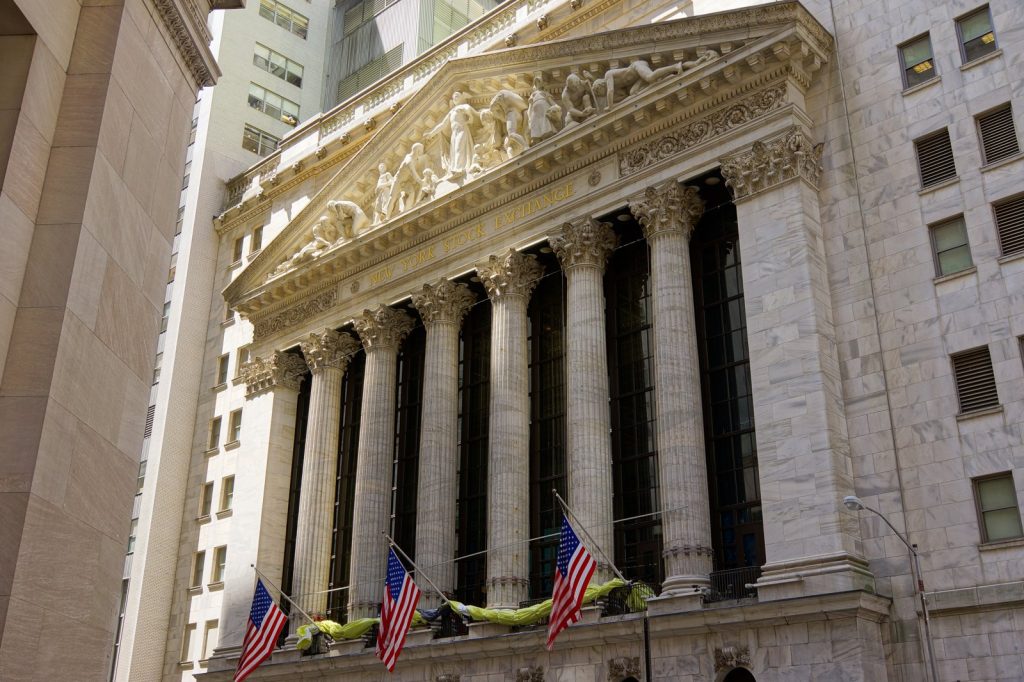
NEW YORK, September 20 — US stocks slipped in a session defined by two pressures arriving at once: rising crude oil prices and a bond market pushing Treasury yields higher. The bottom line for investors is straightforward. Oil and bonds moved against equities on the same day, and the combination was enough to drag the major US indexes lower.
Crude is priced globally in US dollars per barrel, and the two benchmark grades most often cited in market coverage are West Texas Intermediate, the US benchmark, and Brent, the international benchmark named for the Brent oilfield in the North Sea. Futures trade on the New York Mercantile Exchange, part of CME Group, and on ICE Futures Europe in London.
Because oil is dollar-denominated, a rising oil price feeds directly into headline inflation expectations. That, in turn, pushes government bond yields higher — the mechanism that links the two pressures described in this session.
The Bond Market’s Grip on Equities
US Treasury yields move inversely to bond prices. The 10-year Treasury note yield is the benchmark rate that anchors mortgage rates, corporate borrowing costs and equity valuation models. When yields rise, the present value of future corporate earnings falls, which mathematically pressures stock prices — particularly for long-duration growth and technology shares.
The yield curve, the spread between short-dated and long-dated Treasury yields, is watched as a recession signal. An inversion of the 2-year versus 10-year spread has historically preceded US recessions, including ahead of the 2008 financial crisis.
The key institutional players here are the Federal Reserve, which sets US monetary policy through the Federal Open Market Committee and its federal funds rate target; the US Treasury, which issues the bonds whose yields are moving; and the major US equity indexes — the S&P 500, the Dow Jones Industrial Average, founded in 1896, and the Nasdaq Composite, founded in 1971. The CME FedWatch tool is the standard market gauge of expected Fed rate moves.
What to Watch
Investors will note that the oil-and-yields combination has a track record of pressuring equities. The 1973 oil crisis, when an OPEC embargo launched in October 1973 sent crude prices roughly quadrupling, helped drive a deep bear market. The 1979 energy crisis followed the Iranian revolution.
In both episodes, higher energy costs fed inflation, central banks tightened policy, bond yields climbed and equities fell. The 2022 bear market is the most recent parallel.
US inflation reached 9.1% year-on-year in June 2022, the highest reading since 1981. The Federal Reserve raised its benchmark federal funds rate by 75 basis points at four consecutive meetings that year. The 10-year Treasury yield climbed above 4%, and the S&P 500 fell into a bear market, closing more than 20% below its January 2022 record high.
Energy was the only S&P 500 sector to gain in 2022. The figure that matters going forward is whether oil and yields continue to move in tandem.
If they do, the pressure on equity valuations persists. If either leg breaks, the picture changes.




