
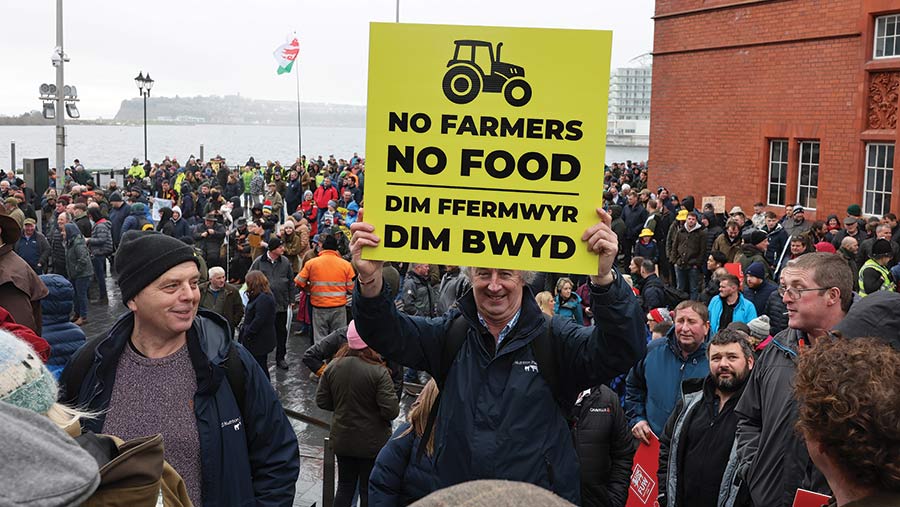
South Wales Police counted about 3,000 people outside the Senedd in Cardiff when farmers turned out against the Welsh government’s new farm subsidy plans. Some had come from “hills and mountains, from the valleys and coastal areas,” said Abi Reader, deputy president of NFU Cymru. “We are completely united,” she said, calling the plans “crazy”.
The target is the Sustainable Farming Scheme, a major overhaul of payments in Wales after Brexit, which unions have branded “unworkable”. To join, farmers would have to commit 10% of their agricultural land to trees and another 10% to wildlife habitat.
Wellies on the steps
Protesters lined up wellies on the Senedd steps to stand for jobs they fear will vanish. The government’s own assessment of the scheme estimates an 11% cut in farm labour, and NFU Cymru says that could mean more than 5,500 jobs. The same assessment suggested a 10.8% fall in livestock numbers. Ministers have since said that analysis was outdated and left out parts of the new funding scheme, but the figures sparked large protests and go-slow tractor demonstrations around Wales.
“We’ve all come down today because the ministers are just not listening,” said Tom Huntley, a farmer from Pontypridd. Angela Windsor, who farms in Moylegrove, Pembrokeshire, said the scheme “doesn’t include farming at all”. Anyone without trees or habitat, she warned, “are going to lose 20% of their land.” Another protester, John, said a protest of this size had not been seen since 1999.
Anger runs wider than subsidies. Farmers also point to the handling of bovine TB and stricter rules on spreading manure. NFU Cymru President Aled Jones said that in 12 years as a union official he had “never witnessed such anguish in rural communities”. He urged the government to reset its relationship with the countryside and suggested the scheme may need to be paused. “Fundamentally we have one opportunity to get this right,” he said.
Government and supporters respond
Supporters say the rules are more flexible than they look and are vital to fighting climate change and nature loss. Fields used to graze livestock can count toward the habitat target if they hold a diverse mix of grasses and wildflowers, and native trees or woodland on farms can count toward both targets.
Outgoing First Minister Mark Drakeford and Rural Affairs Minister Lesley Griffiths issued a joint statement on Tuesday after talks with farming leaders. They said they would consider an “evidence-based review” of how farms can absorb carbon emissions, and commission updated economic analysis of the scheme. A spokeswoman said the government wants “a successful future for Welsh farming” and expects changes after the consultation, which closes on 7 March.
Vote in the Senedd
The next day opposition parties backed scrapping the scheme, but the motion failed. Conservatives and Plaid Cymru voted together, joined by Welsh Liberal Democrat leader Jane Dodds. The tally was 26 to 26, so deputy presiding officer David Rees had to side with the government. A government amendment failed the same way. None of the votes would have bound ministers.
Conservative spokesman Samuel Kurtz said the three letters SFS “are so tainted in the eyes of farmers that no scheme can go forwards if it is called the Sustainable Farming Scheme”. Plaid’s Llyr Gruffydd compared rural anger to the miners’ fight 40 years ago. Labour’s Alun Davies replied that this government would never do to rural Wales what Thatcher’s government did to the mining valleys.
Griffiths blamed the UK government for removing almost a quarter of a billion pounds from farm support budgets.
Sources
- Thousands of protesting farmers descend on Cardiff
- Farmers protests: Tories and Plaid call for funding plan axe
- Farmers protests: Tories and Plaid call for funding plan axe
Sources
- Thousands of protesting farmers descend on Cardiff
- Farmers protests: Tories and Plaid call for funding plan axe – BBC News




