Brent crude has pushed past $117 a barrel, and India’s stock market felt it. The Nifty50 fell 2.4% in a holiday-shortened week. The Sensex lost 2.1% and Nifty Bank 2.8%. Midcaps and smallcaps took the worst of it: the Nifty Midcap 150 slid 5.5%, and the Nifty Smallcap 250 dropped 7.1%, its steepest weekly decline since February 2025.
Why oil hurts margins
The mechanics here are plain. Petroleum feeds more than the fuel tank. It is the raw material for solvents, textiles, refrigerants, synthetic rubber, fertilizers and plastics, and the world burns through about 100 million barrels a day. When crude jumps, the cost lands first on transport, through diesel and jet fuel, and then on any manufacturer whose inputs come from a barrel.
Ajit Mishra of Religare Broking said persistently high crude poses risks to imported inflation, corporate margins and currency stability in India. Gaurang Shah of Geojit Investments went further, telling Business Today that crude was the biggest single source of selling pressure. “High crude oil prices open up a can of worries for the Indian economy because of its dependency on imports for energy requirements,” he said. Shah also noted that foreign funds kept selling and that the selling had spread to mid- and small-cap stocks.
The catch is that the rupee held up. It traded just below 95 to the dollar, recovered from about 97 with help from the Reserve Bank of India. Domestic institutions bought about Rs 10,941 crore of equities during the week, cushioning the fall. Foreign investors zigzagged, selling around Rs 4,606 crore on October 19 and 22 and buying about Rs 1,909 crore on October 21 and 23. IT stocks went against the tide, with the Nifty IT index up 0.5%.
The oil price itself
Elsewhere, Brent futures were put at $114.47 a barrel early Friday, up 1.2%, after Thursday touched a five-month high. The cause is disruption linked to the US-Israeli war with Iran, including Iranian attacks on shipping through the Strait of Hormuz. US diesel averaged $6.32 a gallon, according to AAA, just above Thursday but under the September record. Energy costs have become a defining issue for voters ahead of the midterm elections.
Washington steps in
In a memorandum issued Thursday, President Donald Trump invoked the 1950 Defense Production Act, ruling that petroleum production, refining and related activity are essential to national defense. The memo said that without immediate federal action, US defense capabilities would stay vulnerable to disruption. Section 303 lets the government make purchases and purchase commitments and provide financial support, and the memo waives the usual congressional notification. Vice President J.D. Vance said last week the administration would use the act to expand capacity at a Delek U.S. Holdings refinery in Texas.
Analysts doubt how much any of this will lower prices. Trump’s other steps, including a G7 release of 100 million barrels from reserves and a Jones Act waiver expected to trim gasoline by only pennies, are likely to bring limited and possibly short-lived relief, they say. Capital Economics’ Hamad Hussain said the reserve release could cut diesel prices temporarily but would not solve the underlying supply squeeze. The US pumped an average of 13.6 million barrels of crude a day last year, the most of any country. Even so, said Cyrus Brooks of research firm RBAC, “Until the pipes are in the ground and the fuel is flowing or transported, it may not be able to be called a true structural shift.”
Sources
- Markets Next Week: Crude oil at $117, broader market selloff and Q2 earnings in focus – BusinessToday
- Petroleum
- Trump Invokes Defense Production Act to Boost Oil Production
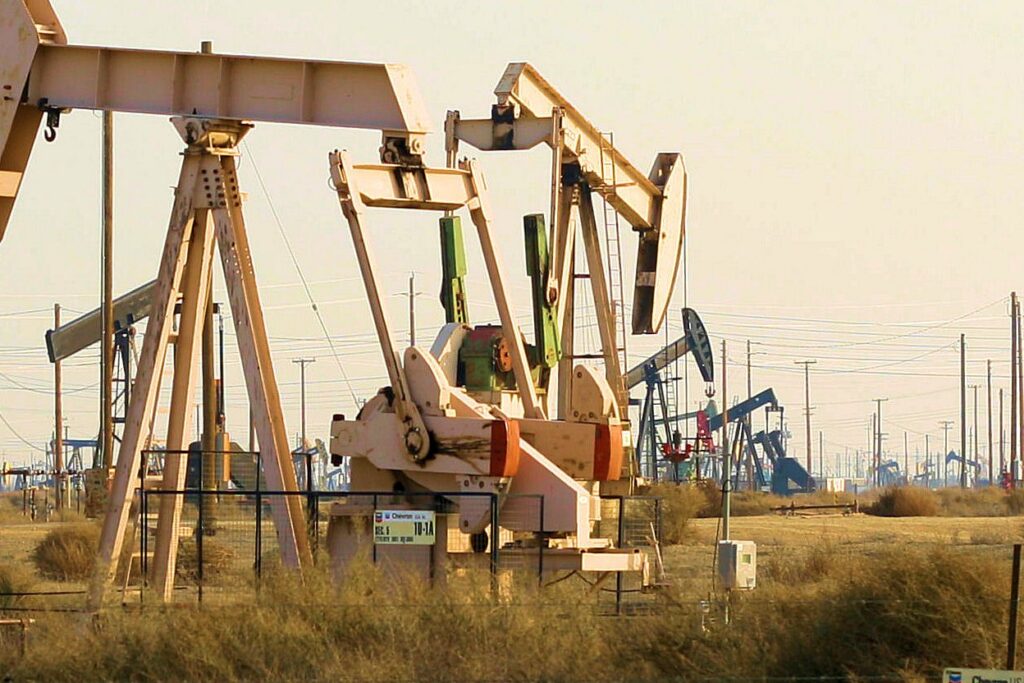
Photo: Richard Masoner / Cyclelicious (CC BY-SA 2.0)