
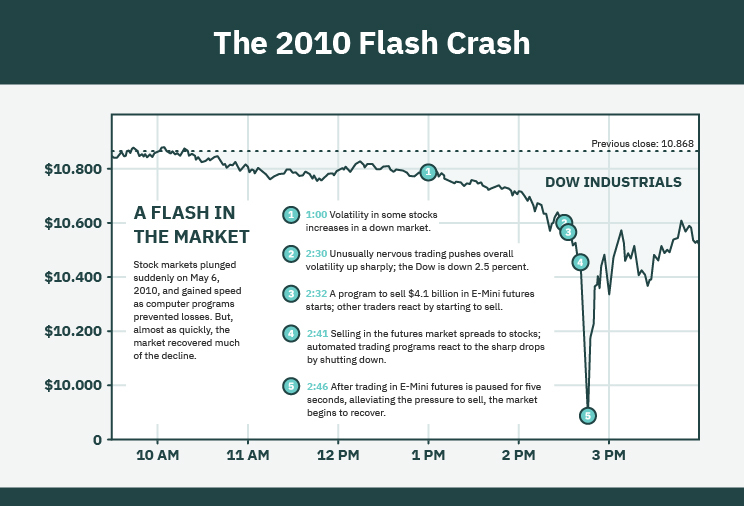
For anyone who thinks a stock price is a promise, May 6, 2010 is the day to study. Between 2:32 and 2:47 in the afternoon, New York time, the Dow dropped nearly 1,000 points, about 9%, then won most of it back within the same hour; at the bottom, names like Accenture changed hands for a single cent while Apple and Sotheby’s briefly printed at $99,999.99. Nothing fundamental had moved. No company had failed, no data point had surprised. The episode entered market history as the “Flash Crash”: a failure of liquidity in which, for a few minutes, buyers all but vanished while automated orders kept selling into a market with no bids.
The official arithmetic still stuns. The Dow ended at 10,520.32, off 347.80 points, or 3.2%, after an intraday low of 9,869.62 against the previous close of 10,868.12, a trough of 998.50 points, about 9.2%. For families across the region whose savings ride mutual funds and exchange-traded funds, that is the part worth sitting with: a quoted price is an offer, nothing more, and whoever posts it can walk away.
May 6 was already a nervous day. Greece’s debts led the news, the euro slid, and by half past two the VIX volatility index stood 22.5% above its opening level, with the major indexes down more than 4% from the prior day before the worst began. Behind that sat a market rebuilt for speed. High-frequency traders carried an estimated 50%+ of share volume, trading was scattered across 13+ exchanges plus dozens of dark pools, and the firms posting most of the visible prices had no duty to keep posting them when prices turned erratic; fragmentation meant no single venue could act as a “circuit breaker” for the whole system.
The spark, per the joint SEC-CFTC staff report, was one sell program in E-mini S&P 500 futures: 75,000 contracts, about $4.1 billion, placed by a large Kansas-based mutual fund, Waddell & Reed, which the report left unnamed but the press later did not. Its execution algorithm cared only about volume, set to trade at 9% of the previous minute’s activity, with no ceiling on price or time. On an earlier day the same trader had needed more than five hours to move a similar amount; on May 6 the program finished in about 20 minutes, because rising volume told it to sell faster.
What followed was a “hot potato” cascade. High-frequency firms bought the contracts, then shoved them back and forth to one another, generating volume without anyone truly making a market; E-mini prices lost more than 5% in that stretch and SPY, the S&P 500 fund, gave up more than 6%. At the bottom, resting buy orders in the E-mini book stood under 1% of where they began the day. Then the machines stepped back, safety circuits firing, quotes withdrawn, and there was nobody on the other side. Orders that promise execution “at any price” fill at any price, and the only prices left were “stub quote” placeholders: bids of a penny, offers of $100,000, posted only to keep the quoting duty technically satisfied. Accenture, down from about $40, traded at a cent that afternoon, and Procter & Gamble slid from $61 to $39 in minutes.
The pause that turned the day came from the exchange itself. At 2:45:28 p.m. the Chicago Mercantile Exchange’s Stop Logic Functionality halted E-mini trading for a five-second break; when trading resumed at 2:45:33, buyers were back and futures began to climb. The cleanup was rougher. After the close, trades printed 60% or more away from the reference price from 2:40 to 3:00 p.m. were “broke,” the market’s word for cancelled, under clearly erroneous trade rules. That spared the penny fills but not an investor whose stop order sold 30% below the earlier price; that loss stood. The arbitrary line was itself a lesson, because nobody could know in advance which trades would survive.
The rules that grew out of the afternoon rebuilt American market structure more than anything since 1987. A single-stock pilot arrived in June 2010, halting a stock for five minutes on a 10% move within five minutes; stub quotes were banned late that year, with market makers required to post quotes near the best price rather than in name only; erroneous-trade thresholds were set down in advance. In May 2012 regulators approved the Limit Up-Limit Down plan, live from April 2013, wrapping each stock in price bands with a 15-second limit state and a 5-minute pause, while market-wide halts were rebuilt around S&P 500 declines of 7%, 13% and 20%; on the day itself the Dow had fallen about 9%, just short of the old Dow-based 10% trigger, which is why the old rules never fired. A Consolidated Audit Trail, adopted in 2012 under Rule 613, promised regulators a single record of orders across markets, though full implementation stretched until 2022+.
The episode kept teaching after the rules changed. In April 2015 US authorities charged Navinder Sarao, a futures trader working from London, with spoofing the E-mini market, large orders placed only to be cancelled to fake supply; in November 2016 he pleaded guilty to spoofing and wire fraud counts, though how much he contributed to the crash remains debated. Smaller flashes followed: Treasury yields swung 16bps in minutes on October 15, 2014, ETFs wrenched far from their NAV on August 24, 2015, and a yen carry-trade unwind knocked global equities down on August 5, 2024. Closer to home, the lesson regulators wrote into rule after rule is the same one for ordinary savers: liquidity can vanish in minutes, market orders guarantee execution rather than price, and circuit breakers buy time for buyers to appear without ever setting a value. What it means for people is simple. The machines got faster after 2010; knowing what a quote really is, and what it is not, is the protection that travels with you.
Sources
- The Flash Crash of 2010 Explained: Causes, Mechanism and Lessons for 2026 | Quantt
- The 2010 Flash Crash: what happened on May 6 and what changed | Finabase




