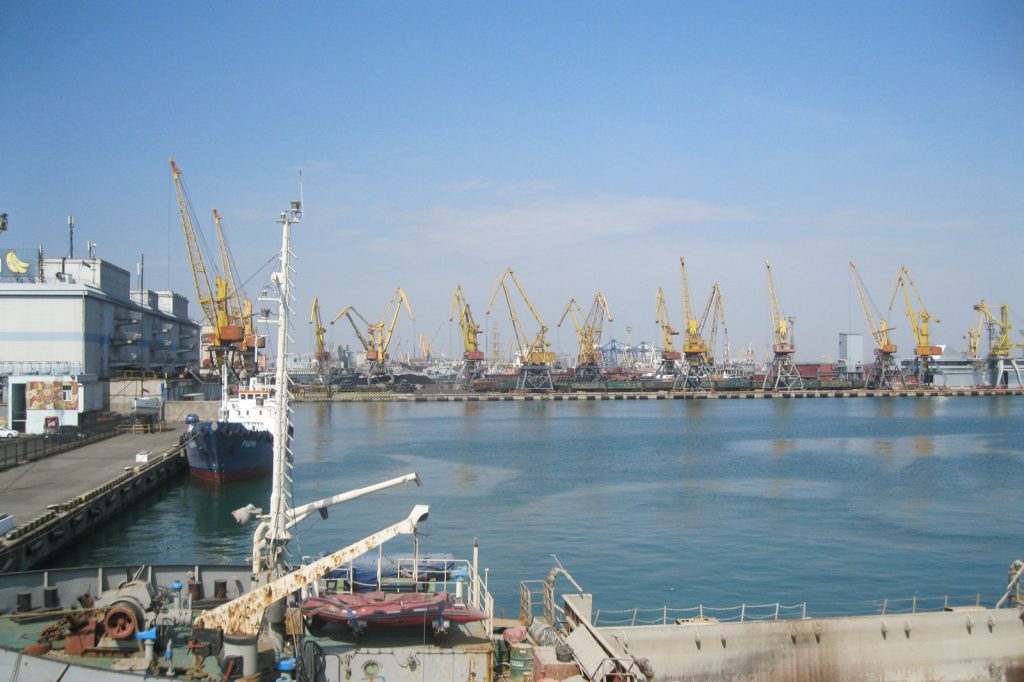
The Golden Leo was carrying corn near Odesa when a missile hit it. Ten people died, the deadliest strike so far in the recent escalation around Black Sea commercial shipping.
That escalation, which intensified from July 10, has hit both of the region’s main grain-export systems. Russian strikes have damaged port infrastructure and merchant vessels in the Greater Odesa area. Ukrainian drone operations against Russian-linked shipping have restricted traffic in the Sea of Azov and the Don-Azov shipping channel. The International Maritime Organization condemned the attacks on civilian merchant ships, warning that they endanger seafarers, undermine navigational safety and disrupt global supply chains.
Damage in Ukraine
Missile and drone attacks have affected terminals, loading equipment, energy supplies, storage facilities and vessels at or near Ukraine’s main Black Sea ports. Ukraine’s main farmers’ union estimates the country has lost about a third of its Black Sea grain-export capacity. More than 90% of Ukrainian agricultural exports normally leave through the three main ports in the Odesa region.
Kernel, one of Ukraine’s largest agribusiness groups, reported severe damage at Chornomorsk. Loading equipment, terminal infrastructure and power lines were hit, and damaged silos and tanks left roughly 45,000 tonnes of wheat and 9,000 tonnes of sunflower oil blocked, spilled or spoiled.
Shipping is the immediate bottleneck. A Ukrainian market participant cited by S&P Global Energy estimated that 30% to 40% of shipowners due to call at Ukrainian ports between the second half of July and the first half of August cancelled. Some liner operators could suspend calls if security does not improve. Many traders cut local purchases after the July 10 attacks, not because crops are missing but because ships cannot reliably get in. The timing is poor, too, with the new wheat crop arriving and exporters needing terminal space to clear old stocks.
Corn and wheat
Corn took the sharpest blow. S&P Global Energy reported on July 20 that Ukrainian spot corn trade had effectively stalled as shipowners refused port calls and buyers turned to other origins. Some cargoes bound for Turkey were delayed. The problem is freight, not supply: the old crop had largely been sold, but exporters could not move it. The disruption has sped up a shift toward Brazilian and Argentine corn that some buyers had already been weighing for quality reasons.
Wheat rose too, though without much buying behind it. The Platts Milling Wheat Marker climbed almost 3% over the week to July 17, a three-week high. Prices in the Constanta-Varna-Burgas market rose more sharply as buyers paid extra for safer routes, and the gap between Romanian-Bulgarian wheat and Russian or Ukrainian origins widened to around $25 a tonne. Buyers in markets such as Egypt held back, and sellers reported few firm bids. CIF Marmara wheat reached $224 a tonne on July 14, up from $220 on July 8, the lowest level since December 2024.
Turkey’s large 2026 wheat crop should limit any lasting domestic price rise. Romania and Bulgaria have emerged as relative winners, since buyers will pay more for cargoes with a clearer shipment window.
Russia and the Azov route
Ukrainian attacks on commercial and support vessels forced temporary limits on the Don-Azov channel. The Sea of Azov is linked to roughly a quarter of Russia’s grain exports. Russia’s Agriculture Ministry says the disruption will not damage domestic food supplies or export capacity, and that cargoes could be redirected through other Russian transshipment facilities. Rerouting would still lengthen inland transport and add handling costs.
The Wall Street Journal reported on August 28 that Chicago wheat futures settled at $7.60 3/4 a bushel, the highest close since July 2023 and about 30% above the late-June low. Analysts cited by the paper warned that alternative routes may not fully make up for reduced capacity at major outlets such as Odesa and Novorossiysk. The International Grains Council has also cut its 2026/27 wheat production outlook, citing sustained heat in Europe.
Sources
- Wheat Prices Hit Three-Year High on Black Sea Disruption
- Black Sea shipping disruptions hit wheat and corn trade