Airbus has told India that its ambition to become a global aviation hub will be decided on the ground as much as in the air, calling for faster airport transfers and harmonised regulations as Indian carriers prepare to fly more wide-body aircraft on long-haul routes. Jürgen Westermeier, the planemaker’s president and managing director for India and South Asia, said the country must improve airport operations and connecting journeys if it is to compete with established Middle Eastern hubs.
Speaking at the Aviation India and South Asia 2026 summit, Westermeier put the regulatory question squarely on the table: what has to change for a passenger to move through an Indian airport as smoothly as through Dubai, Doha or Abu Dhabi? His answer covered transit processes, rule alignment and the operating systems underneath both.
Why the Transfer, Not the Runway, Is the Constraint
India’s fleet growth is not in doubt. Westermeier said the industry needs to prepare for a tripling of the country’s commercial fleet over the next decade, from around 800 aircraft today. Planes, however, are only one input. “If you want to be state-of-the-art, you need to have state-of-the-art operations,” he said, arguing that airport operating systems must evolve alongside airline fleets and networks so that passengers can make connections more efficiently.
That is where the hub economics sit. A hub earns its keep by pooling passengers from many origins into one long-haul departure. Every minute saved on a domestic-to-international transfer widens the set of connections an airline can sell, and every minute lost narrows it. Westermeier linked quicker transit processes directly to the effective utilisation of wide-body aircraft, the expensive assets that only pay for themselves when they spend more time flying and less time waiting for connecting feed.
The Regulatory To-Do List
Westermeier’s specific asks were harmonised regulations and faster transit processes. In practice, a harmonised regime means rules that do not change at each state border or airport boundary, so that airlines, ground handlers and airport operators can plan connections to a single standard rather than building slack into schedules to absorb inconsistency.
The institutional map is crowded. The Ministry of Civil Aviation sets policy, the Directorate General of Civil Aviation enforces safety and air transport regulation, the Airports Authority of India manages civil aviation infrastructure, and the Airports Economic Regulatory Authority sets aeronautical tariffs, according to the Aviation Laws and Regulations 2026 India report. Each of those bodies touches a different part of the transfer chain, from slot and safety clearance to the charges that shape an airline’s decision to route traffic through an Indian airport at all.
Westermeier framed the fix as an ecosystem problem rather than an airport problem. Capturing India’s international aviation opportunity, he said, would require coordinated development across airports, airlines, training institutions and other parts of the aviation ecosystem. He also flagged the workforce: more pilots and technicians will be needed to support the growing fleet. Airbus currently has 14 full-flight simulators in India, including through a joint venture, and works with educational institutions on curriculum support, faculty engagement and scholarships to close the gap between university education and industry-ready talent.
He cautioned that the transition would not be a “walk in the park.”
What Delhi’s Numbers Show
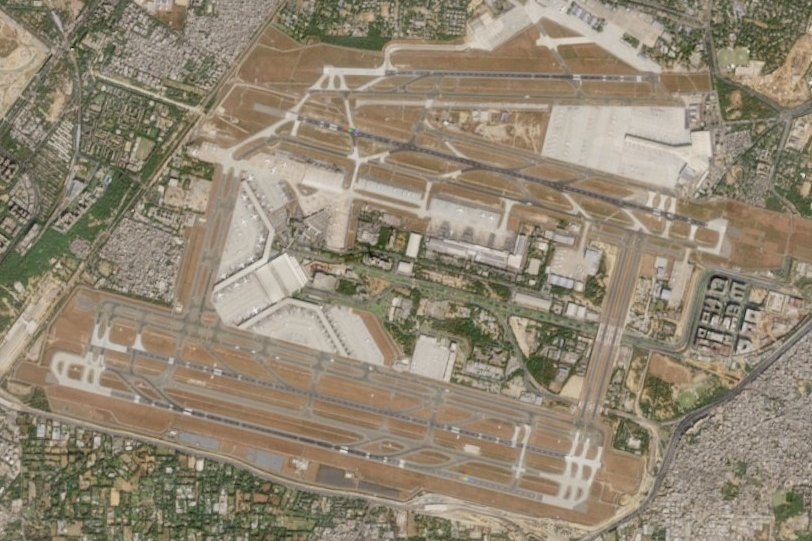
The scale of the challenge is visible at Indira Gandhi International Airport, still the country’s busiest. It handled over 79.2 million passengers in the 2024–25 financial year, the highest in its history, and ranks as the ninth-busiest airport in the world by passenger traffic in OAG rankings issued as of 2025. By seating capacity it is the second-busiest in the world, with more than 3.6 million seats, and the third-busiest in Asia, having handled over 77.8 million passengers in 2024.
Delhi has not stood still on infrastructure. A 4,400-metre runway and the 2.1-kilometre eastern cross taxiways with dual parallel taxiways opened in July 2023, and the airport uses an advanced system called airport collaborative decision making to keep takeoffs and landings timely and predictable. Terminal 3, which opened in 2010, can handle 34 million passengers a year. Two other airports serve the region: Hindon, which primarily handles regional and domestic flights under the UDAN scheme, and Noida International Airport, built to offset the region’s burgeoning air traffic.
For a travelling public, the hub question is less abstract than it sounds. A passenger flying from a secondary Indian city to Europe or North America today often connects through a Gulf airport rather than an Indian one. Building that connection at home would keep the transfer, the retail spend and the aviation fees inside the country, and would spare travellers a second long detour on an already long journey.
The Ground Side of the Same Journey
Surface transport is part of the same chain, and operators are positioning for it. On the same day as Westermeier’s remarks, Avis India introduced customised Force Urbania vans in Delhi-NCR, Mumbai and Bengaluru, configured for 9 to 11 passengers and aimed at corporate travel, destination weddings, events and group leisure journeys. The vans feature dual air-conditioning, dedicated rear AC vents across all rows and individual USB charging points, with cabin layouts designed to accommodate passengers and luggage for airport transfers, corporate movements and intercity travel.
Avis India will own and operate the Urbania fleet directly rather than through an aggregator arrangement, which the company said allows it to maintain control over vehicle maintenance, chauffeur standards and service delivery. The vehicles join an existing premium people-mover fleet that includes the Mercedes-Benz V-Class, Toyota Vellfire and Kia Carnival. Aman Naagar, managing director of Avis India, said the addition reflects growing demand for professionally managed group transportation, particularly for corporate delegations, weddings and family travel.
The service includes 24-hour customer support for bookings and itinerary changes and will be available for airport transfers, local travel, corporate movements, events and outstation journeys across the three cities. It is a small piece of the puzzle next to runway and airspace reform, but it points to the same commercial logic: a hub is judged by the whole journey, and the last mile is part of the product.
What Comes Next
Westermeier’s remarks land as Indian airlines prepare to expand long-haul operations and develop connecting traffic through their domestic hubs, a build-out that will test whether airport systems, regulation and trained staff can keep pace with the fleet. Airbus, for its part, has tied its own training investment to that outcome, with 14 full-flight simulators in the country and partnerships with educational institutions aimed at producing industry-ready talent.
The planemaker’s message to officials and operators at the summit was that the aircraft order book is the easy part.
Sources
- Airbus calls for efficient airport transfers, regulatory reforms to support India’s hub ambitions
- Indira Gandhi International Airport
- Aviation Laws and Regulations Report 2026 India
- Avis India Adds Customised Force Urbania Vans To Premium Chauffeur-Driven Fleet
- Avis India Launches Customised Force Urbania Vans For Group Travel | Autocar Professional
- Transfer ailing accused to UP: Cal HC | Kolkata News – The Times of India
Photo: Copernicus Sentinel 2, ESA (Attribution)