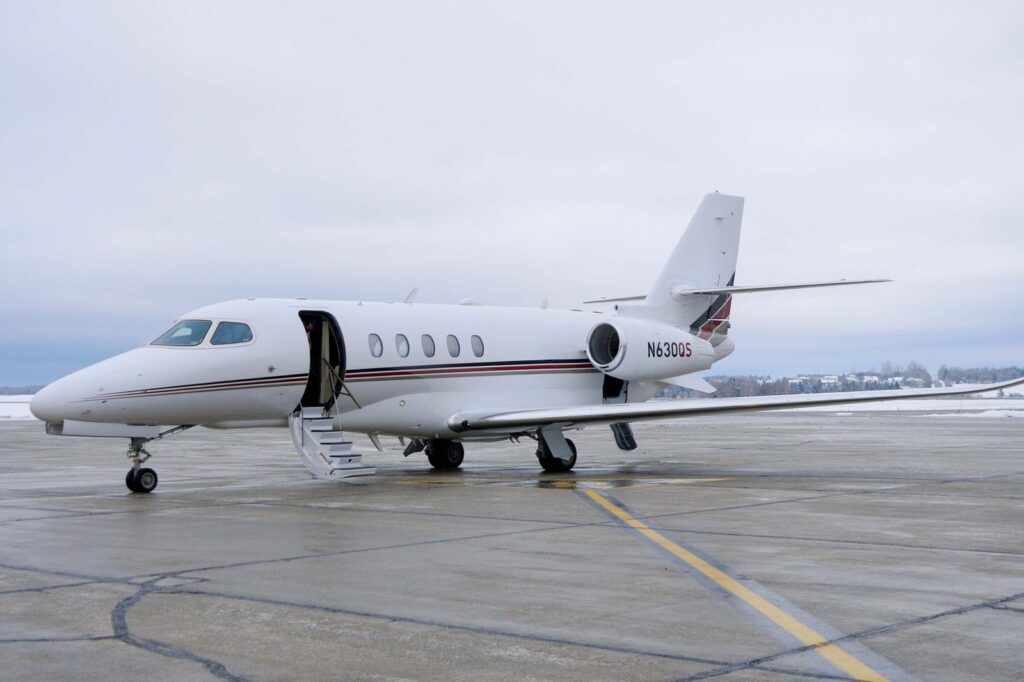
Business aviation set a record in 2025, with 3.9 million departures and 6.4 million flight hours, according to McKinsey’s first State of Business Aviation report. The bottom line: demand is still rising, but the people and planes needed to serve it are getting scarce.
By the numbers
Departures have grown 4.9% a year on average since 2019. Flight hours climbed from 4.7 million in 2019 to 6.4 million in 2025, a 37% gain. North America logged 70% of global hours, though Latin America and Asia-Pacific grew faster in percentage terms. Wealth explains part of the story. The ultra-high-net-worth population, defined as those with at least $30 million, expanded 5.6% a year between 2019 and 2025, and McKinsey expects North America’s share of it to rise from 37% to 43% by 2031.
Where the squeeze is
McKinsey says securing an aircraft is now only part of the challenge. Operators also need pilots, maintenance support, hangar space and airport access. “Demand for private aircraft is outstripping supply,” the authors wrote, “while growing numbers of flights and passengers are putting pressure on infrastructure, airspace, and qualified personnel such as engineers and pilots.” The report draws on industry data and executive interviews.
Supply tells the same story. Manufacturers delivered 842 business jets in 2025, against a record 1,290 in 2008. The global fleet has grown mainly because operators retire fewer old aircraft, about 110 a year now versus roughly 300 in 2019. That keeps maintenance busy, and McKinsey warns that older jets returned to charter service after the pandemic could be retired as costly maintenance events come due.
Fractional, leisure and consolidation
The figure that matters for ownership is fractional. Fractional fleets rose from 990 aircraft in 2019 to 1,510 in 2025, or 7.3% a year, and their share of business jet flight hours went from 14% to 20%. NetJets and Flexjet accounted for 92% of fractional flight hours, excluding turboprops. Charter held roughly steady, slipping from 19% to 18%, while corporate and private flight departments fell from 36% to 30%. McKinsey says higher ownership costs and demand for flexibility push customers toward fractional shares, jet cards and charter.
Travelers are heading elsewhere, too. Private jet departures at US leisure airports grew 5.4% a year from 2019 to 2025, against 2.1% at traditional business destinations. Leisure airports accounted for 326,000 of 417,000 additional US departures. Witham Field in Stuart, Florida, rose 92%, Tampa International 81%, Miami-Opa Locka 74%, Fort Lauderdale-Hollywood 73% and Naples 60%. Chicago Midway, Oakland and Van Nuys fell. NetJets Aviation President Patrick Gallagher said places like Naples, Scottsdale, Jackson Hole and Bozeman stay busy all year as second-home owners fly more. He also told McKinsey that “around $80 trillion to $100 trillion will be transferred over the next 20 years” between generations, a possible new source of demand.
Buyers are favoring the smallest and largest jets. Very light jet fleets grew 6.7% a year and long-range fleets 5.1%. About 65% of ultra-long-range jet flights leaving the United States covered under 1,000 nautical miles, which suggests cabin comfort matters more than range. NetJets, Flexjet and VistaJet together flew about 20% of global business jet hours in 2025, up from 15% in 2019, and the report expects more consolidation. It sees AI, better scheduling, predictive maintenance and fewer empty-leg flights as ways to gain efficiency, but cautions that operators must plan years ahead to line up aircraft, crews, maintenance and airport capacity.
Sources
- Business aircraft
- McKinsey: Leisure flying is powering business aviation
- Four wildfire-fighting companies to watch in the blazing years ahead
Photo: Quintin Soloviev (CC BY-SA 4.0)