
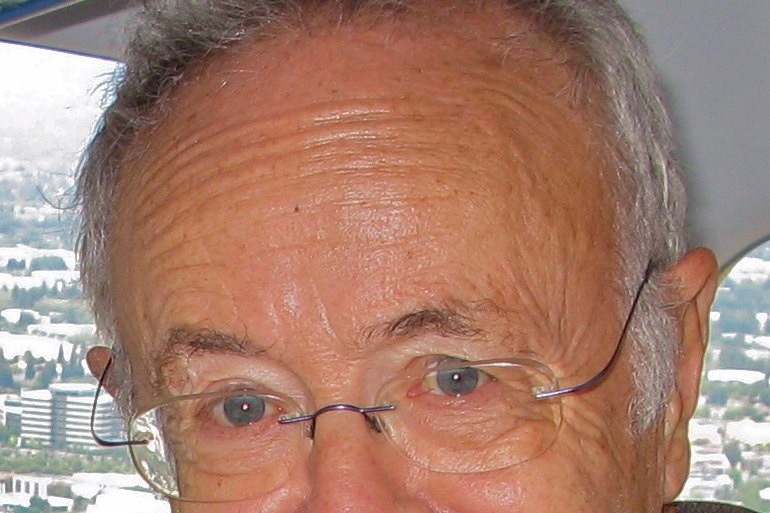
Andrew Grove arrived in the United States in 1957 penniless and barely able to speak English. Four decades later Time magazine picked him as its 1997 “Man of the Year”, crediting him as the person most responsible for the growth in the power and innovative potential of microchips. For the Asian chip makers who spent those decades competing with Intel, the man behind that growth is worth a closer look.
Hungary and escape
Grove was born Gróf András István on 2 September 1936 in Budapest, to a middle-class Jewish family. At four he caught scarlet fever, which was nearly fatal and left him with partial hearing loss. When he was eight the Nazis occupied Hungary and deported nearly 500,000 Jews. Grove and his mother took false identities and hid with friends. His father was arrested and sent to a labour camp, where he was severely tortured and forced into slave labour, and rejoined the family only after the war.
During the 1956 revolution, at 20, Grove left his family and crossed into Austria. He reached the United States in 1957. In his memoirs he summed up his first two decades: by twenty he had lived through a fascist dictatorship, German occupation, the Final Solution, the Soviet siege of Budapest and a popular uprising put down at gunpoint.
That summer he worked as a busboy at a New Hampshire resort, where he met Eva Kastan, an Austrian refugee waiting tables. They married in Queens in June 1958 and stayed married until his death. They had two daughters, Karen Grove and Robie Livingstone, and eight grandchildren.
From Fairchild to Intel
Grove earned a chemical engineering degree at City College of New York in 1960 and a doctorate in the same field from Berkeley in 1963. He joined Fairchild Semiconductor as a researcher and by 1967 was assistant director of development. That year he wrote a college textbook, Physics and Technology of Semiconductor Devices.
In 1968 Robert Noyce and Gordon Moore left Fairchild to found Intel. Grove joined on the day of incorporation, as director of engineering, without being a founder. He was effectively the third employee and went on to become its third chief executive.
Intel started out making static memory chips for mainframes. In the early to mid-1970s it brought out the first general-purpose microprocessor, the 4-bit 4004, then the 8008 and the 8080, which became the core of the Altair. The 8086 and its cheaper cousin the 8088 followed, and IBM chose the 8088 for its PC. In 1985 came the 32-bit 80386, starting a line that led to the Pentium.
The memory decision
By 1985 Japanese chip makers were selling memory at below-cost prices, and demand for Intel’s memory chips fell. Grove made the radical call to drop DRAMs and bet on microprocessors. He and Earl Whetstone, Intel’s sales manager to IBM, also negotiated for IBM to use only Intel microprocessors in new PCs.
He became president in 1979, CEO in 1987 and chairman in 1997. Revenue rose from $2,672 in the first year to $20.8 billion in 1997. Under his tenure as CEO, market capitalisation grew 4,500%, from $4 billion to $197 billion, which made Intel the world’s seventh largest company, with 64,000 employees.
Only the paranoid
Grove pushed managers to allow experiments with new products, sales channels and customers, so they would be ready for sudden shifts. His motto, “Only the paranoid survive”, became the title of a 1996 book. He also popularised the “strategic inflection point”, a moment when changes in the business environment demand a new strategy. Leaders such as Jeff Bezos, Satya Nadella and Reed Hastings have drawn on his thinking. His 1983 book High Output Management set out his manufacturing methods.
The detail is a wry one: despite Intel’s dependence on PC sales, Grove thought personal computers were hard to use and not very useful. He only began using them regularly after Intel rolled out email company-wide in 1989 and Windows 3.0 appeared in 1990.
Later years
He gave up the CEO post to Craig Barrett in May 1998, having been diagnosed with prostate cancer a few years before, though he stayed chairman until November 2004 and then remained as a senior advisor and Stanford lecturer. In 2000 he was diagnosed with Parkinson’s disease and contributed to foundations funding research toward a cure. Grove died at home on 21 March 2016, aged 79.




