
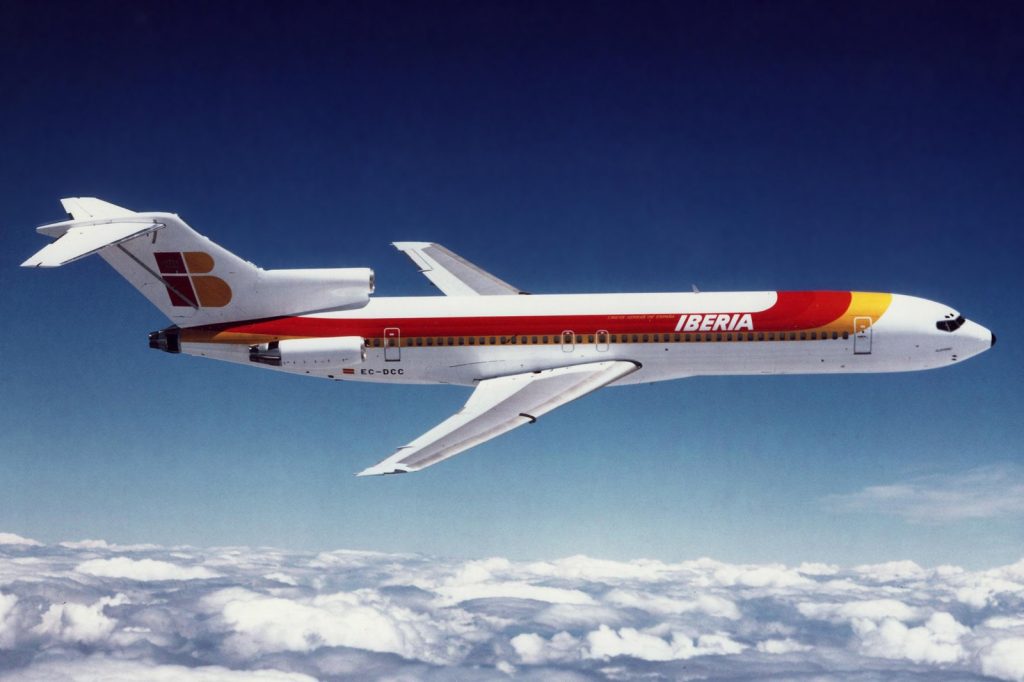
When Boeing introduced the 707 quadjet in 1958, it opened the jet age for American travelers, but it also created a problem. The 707 required long runways that many smaller cities did not have. Airlines needed a jet that could serve those communities efficiently, and Boeing’s answer was the 727, a trijet that became the only three-engine airliner the company ever put into production.
The 727 was born from a specific gap in the market. After the 707’s debut, airlines sought an aircraft that could operate efficiently from shorter runways and serve smaller airports.
Boeing launched the program on December 5, 1960, with 40 orders each from United Airlines and Eastern Air Lines. That dual launch order gave the project immediate commercial credibility, providing the financial foundation for development.
A Unique Configuration for Short-Haul Routes
The 727’s design set it apart from any other Boeing airliner. It was powered by three Pratt & Whitney JT8D low-bypass turbofans arranged around a T-tail: one engine on each side of the rear fuselage and a center engine fed through an S-duct below the tail.
That configuration was unique in Boeing’s lineup and gave the plane the power and lift to operate from shorter runways than the 707 could use. The first 727-100 rolled out on November 27, 1962, and took its maiden flight on February 9, 1963. Eastern Air Lines put it into revenue service on February 1, 1964.
The original model measured 133 feet long and typically carried 106 passengers in two classes over a range of 2,250 nautical miles. In a single-class configuration, it could seat 129.
The cockpit and six-abreast upper fuselage cross-section were shared with the 707, a design choice Boeing later carried over to the 737. That commonality simplified pilot training and maintenance for airlines, a practical benefit that operators valued. The 727 served airlines worldwide through the Cold War era and beyond, handling both domestic and international flights.
It connected cities that had been bypassed by larger jets, and its range and runway performance opened routes that previously relied on propeller aircraft. For much of the Cold War, the 727 was a backbone of air travel, making it a familiar sight at airports around the world.
Stretched Variant and Lasting Influence
Boeing launched the stretched 727-200 in 1965. The 20-foot-longer variant first flew in July 1967 and entered service with Northeast Airlines that December.
It typically carried 134 passengers in two classes over 2,550 nautical miles, or 155 in a single class. Boeing also offered freighter and Quick Change convertible versions that could switch between passenger and cargo use, giving airlines flexibility in their operations. The 727’s design legacy is still visible today.
The 737, which shares the 727’s fuselage cross-section and cockpit layout, has gone on to become a best-selling jetliner. That design continuity meant that airlines could transition between the two aircraft with relatively straightforward training and maintenance procedures, a factor that contributed to the 737’s eventual market dominance.
The trijet’s long production run and widespread use meant millions of passengers flew on it. By the numbers, the Boeing 727 was a commercial aviation workhorse that helped reshape short-to-medium haul air travel. As the aviation industry pivots toward next-generation narrow-bodies, the 727’s role as a bridge between the early jet age and modern high-density short-haul operations is a case study in how a single airframe can define an era.
{“@context”: “https://schema.org”, “@type”: “NewsArticle”, “headline”: “Boeing 727 trijet solved short-runway challenge for airlines”, “description”: “SEATTLE, July 16 — When Boeing introduced the 707 quadjet in 1958, it opened the jet age for American travelers, but it also created a…”, “datePublished”: “2026-07-16T09:30:00+00:00”, “author”: {“@type”: “Person”, “name”: “Noah King”}, “publisher”: {“@type”: “Organization”, “name”: “InfoPulse Today”, “url”: “https://newsfeed.infopulsetoday.com/”}}




