
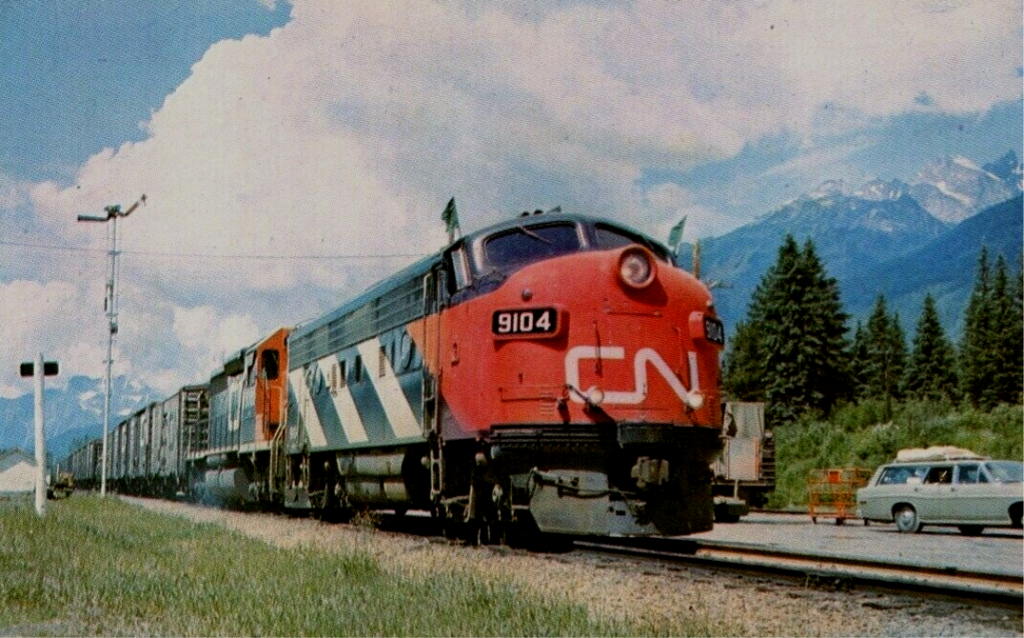
By the numbers, Canadian National is a government rescue that compounded. Name authorized by order in council on December 20, 1918; incorporated by Parliament on June 6, 1919; one system with the Grand Trunk folded in on January 20, 1923; privatized at a November 17, 1995 IPO. In 2026 it is one of six Class I freight railroads in North America, running about 20,400 route miles, headquartered still in Montreal, with 2020 revenue of $13.82 billion. The bottom line for investors: the line Ottawa assembled to avoid a banking collapse now reaches three coasts.
The pile started with confederation itself. Confederation brought New Brunswick and Nova Scotia in on the promise of a government railway to Quebec City’s region, which became the Intercolonial, in service through the 1870s. Prince Edward Island’s money-losing narrow-gauge line arrived in 1873 with the island itself. The Laurier government then built the National Transcontinental, 2,019 miles from Moncton to Winnipeg finished in May 1915, after the Grand Trunk, whose line it was meant to feed, refused the lease. The biggest piece was the Canadian Northern of William Mackenzie and Donald Mann, a second transcontinental of roughly 11,000 route miles that was also broke; Ottawa took its stock under a 1917 act, gaining control on August 1 of that year.
The consolidation argument came from Prime Minister Sir Robert Borden himself, at a Toronto luncheon in September 1918: the government now owned “nearly 14,000 miles, and reaching from the Atlantic to the Pacific”, he said, and “All the lines included in this mileage should be operated as one system, and under one management.” The order in council followed that December, incorporation in June, and the Grand Trunk, which had defaulted in 1919 and watched its Pacific subsidiary nationalized on March 7 of that year, was merged in on January 20, 1923, adding about 8,000 Canadian miles and 1,164 American ones through some 125 companies, and the map became a single system running from Nova Scotia to British Columbia with more than 22,000 route miles.
The Crown years ran hot and cold. Sir Henry Thornton, hired in 1922 to make one railroad of the pile, moved headquarters to Montreal in 1923 and pruned duplicate lines, but the operating ratio, expenses against revenue, ran so high that deficits were a normal year; only World War Two traffic, at about 73 percent, pointed to the efficiencies the 1990s would finally deliver. The corporation ran the country in the widest sense, hotels, steamships and an airline, Trans-Canada Air Lines from 1937, which grew into Air Canada, all under the slogan “The People’s Railway”. Newfoundland’s railway joined with the island in 1949; diesel boxcabs were tried as early as 1929, Electro-Motive F3s arrived in 1948, and the last regular steam ended in April 1960, the year Allan Fleming’s minimalist CN mark replaced the old “tilted wafer” emblem.
Retreat and expansion came together after the war on cars and planes. Passenger service spun off as VIA Rail in 1977; the CN Commercialization Act of July 13, 1995 set up the IPO that November. Freed of the treasury, the company bought its way south and west: the Illinois Central in 1999, Wisconsin Central in 2001, BC Rail and Great Lakes Transportation in 2004, the Elgin, Joliet and Eastern in 2009. Those deals stretched CN from the Atlantic to the Pacific to the Gulf of Mexico, serving eight provinces and, on the American side, states from Wisconsin and Michigan down to Louisiana and Mississippi.
The figure that matters for the centenary view: 23,400 route miles in 1930, down to 15,292 by 1997, back to about 20,400 by 2020. A railway born of bankruptcies, wars and one prime minister’s lunch speech now moves freight on three coasts for shareholders rather than cabinets, the lone Canadian transcontinental besides Canadian Pacific, now CPKC.
Sources
- Canadian National Railway – Toronto Railway Historical Association
- Canadian National Railway: Map, Logo, History, Photos




