
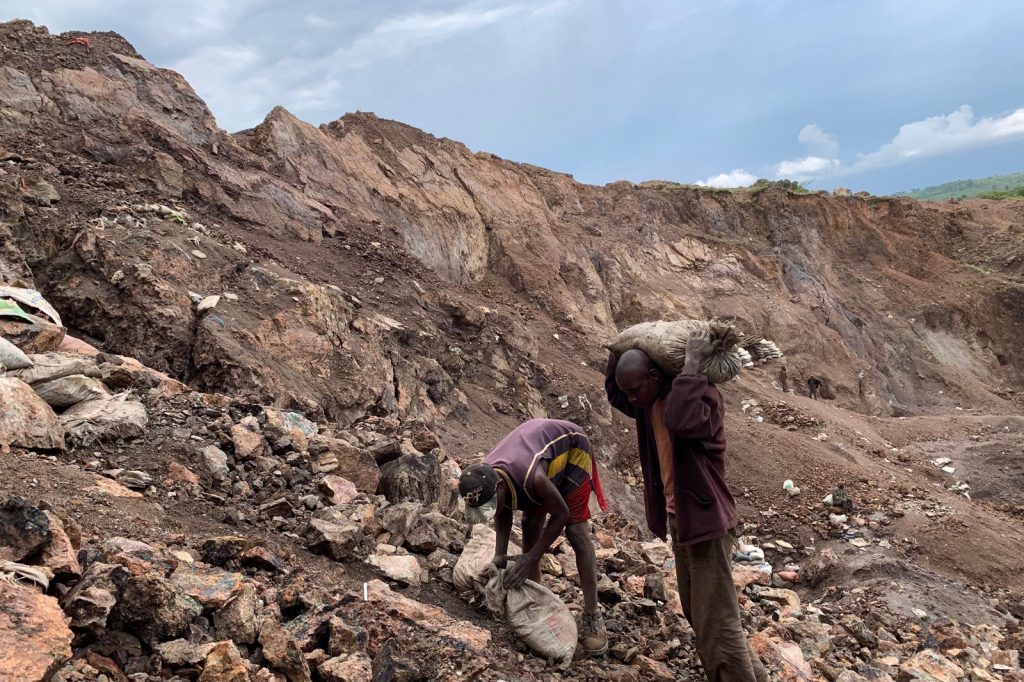
The nephew of a woman identified in court papers as Jane Doe 1 went to work in a Congolese cobalt mine as a small child, because the family could no longer pay his $6 monthly school fee. In April last year, according to the lawsuit, he was underground digging for cobalt rocks when the tunnel collapsed. He was buried alive. His family says it never recovered his body.
His story is one of several in a suit filed in Washington DC on 15 December 2019 against Apple, Google, Dell, Microsoft and Tesla. International Rights Advocates, a human rights firm, brought the case for 14 parents and children from the Democratic Republic of the Congo. The Guardian reported the filing. It rests on field research by Siddharth Kara, an anti-slavery economist.
The families accuse the five companies of aiding and abetting the deaths and serious injuries of children who worked in cobalt mines in their supply chains. They are asking for damages for forced labour, plus compensation for unjust enrichment, negligent supervision and intentional infliction of emotional distress. It is the first time any of the tech companies has faced a challenge of this kind.
What the families describe
The plaintiffs say poverty pushed their children into large mining sites, where they were paid as little as $2 (£1.50) a day to dig with primitive tools in dark tunnels. Some children died in collapses. Others were paralysed or left with smashed limbs and broken spines from crawling through tunnels or hauling heavy loads. No family received compensation, they say.
John Doe 1 started in the mines at nine. Earlier in 2019, the suit says, he was working as a human mule for Kamoto Copper Company, carrying bags of cobalt rocks for $0.75 a day, when he fell into a tunnel. Fellow workers pulled him out and he lay on the ground at the site until his parents heard and came. He is now paralysed from the chest down and will not walk again.
The supply chain alleged
Several families say their children worked at mines owned by the UK firm Glencore. Kamoto Copper Company is owned and controlled by Glencore. According to the court papers, cobalt from those mines goes to Umicore, a Brussels-based metals trader, which sells battery-grade cobalt on to Apple, Google, Tesla, Microsoft and Dell. Other plaintiffs say they worked at mines owned by Zhejiang Huayou Cobalt, a major Chinese firm that the suit says supplies Apple, Dell and Microsoft and probably the others.
A central allegation is that the defendants had “specific knowledge” that their cobalt was linked to child labour in hazardous conditions. The papers argue that each company entered commercial “ventures” with the mining operators and gained a financial advantage, and that each had the authority and resources to supervise its cobalt supply.
Demand for cobalt has tripled in the past five years and is expected to double again by the end of 2020, the Guardian reported. More than 60% of the world’s cobalt comes from the DRC.
“In field trips to mines in the DRC I witnessed staggering inequality, pain and misery at the bottom of a supply chain that we are all connected to through the devices we use every day,” Kara said.
The companies respond
Glencore said its cobalt output in the DRC is a by-product of industrial copper production, that its operations there neither buy nor process any artisanally mined ore, and that it “does not tolerate any form of child, forced, or compulsory labour.”
Apple said it began mapping its cobalt supply chain to the mine level in 2014 and has published a list of identified cobalt refiners every year since 2016, all of them taking part in independent audits. It removed six refiners in 2019. Dell said it has never knowingly sourced from operations using involuntary labor or child labor, was investigating the allegations, and had told the Responsible Minerals Initiative.
Umicore said it has addressed ethical supply for 15 years and contests any claim to the contrary. Microsoft did not respond to a request for comment, but a spokesperson told the Daily Telegraph the company investigates and acts if a supplier shows questionable behaviour. Huayou, Google and Tesla had also been approached for comment.




