
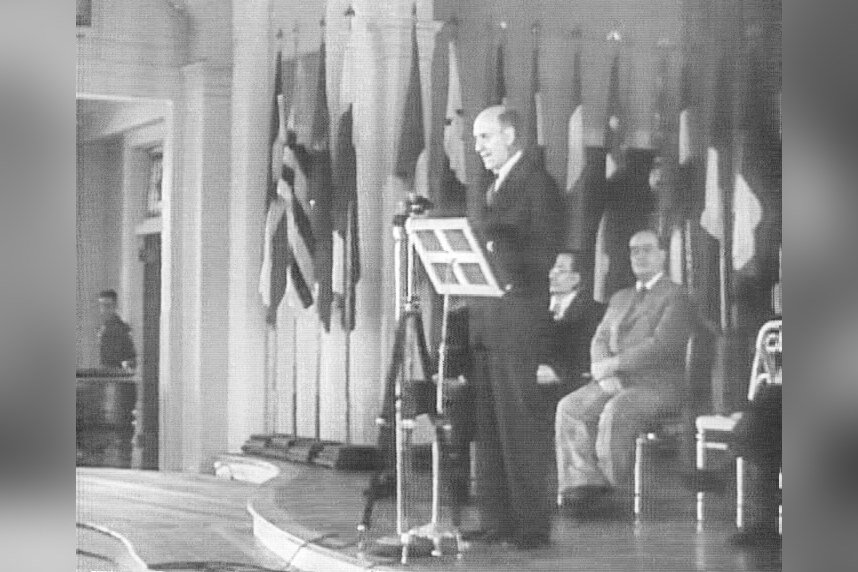
In November 1953, Harry Dexter White’s face was on the cover of Time magazine. He had been dead for more than five years. His name ran across front pages worldwide, and a fight over his 1946 appointment to the International Monetary Fund pulled in three American presidents: Eisenhower, Truman and a future one, Richard Nixon.
That is a strange afterlife for a man who spent most of his career out of the spotlight. James M. Boughton, writing in the IMF’s own Finance & Development magazine in 1998, argued that White’s real work had been largely forgotten, and used the fiftieth anniversary of his death to go back over it.
A late start
White was born in Boston in October 1892, the son of Lithuanian immigrants. He helped in the family hardware business, then served with the U.S. Army in France in World War I. Serious study began only when he was about 30: Columbia first, then Stanford for a degree in economics, then Harvard, where he finished a prize-winning Ph.D. thesis in 1930 on French international payments before the war.
After a few years teaching at Lawrence College in Appleton, Wisconsin, he got an unexpected letter in 1934 from Jacob Viner of the University of Chicago, who was on assignment at the Treasury and wanted White’s help. White left academia for good. He spent the next 12 years at the Treasury and rose to Assistant Secretary.
Planning the peace early
As early as 1935, White was writing inside the Treasury that America’s recovery from the Depression depended on steadier international money. That year he met Keynes in England for the first time. When the United States entered the war in December 1941, Treasury Secretary Henry Morgenthau Jr. handed him all of the department’s international business. White used the job to look past the fighting and sketch the institutions that would follow it, the IMF and the World Bank.
Boughton is blunt about White’s standing. He was no great original thinker and published very little. Keynes still respected him as a strategist and a debater, and his Treasury memos explained hard policy questions with unusual clarity.
White Plan against Keynes Plan
The two men agreed on a lot. Both wanted to avoid the mistakes made after the First World War, both wanted capital flows to serve trade rather than disrupt it, and both wanted a multilateral agency to look after the system. They split over how much power that agency should have. Keynes pictured something close to a world central bank, a counterweight to American strength. White wanted an agency that worked alongside American economic power and kept the dollar at the center of international finance.
His plan tied the dollar to gold and made it the anchor for everyone else. At Bretton Woods, New Hampshire, in July 1944, the final compromise kept much of the White Plan’s character. It treated the IMF as a promoter of growth through trade and financial stability, not as a world central bank. Boughton adds a caveat: the White Plan won because of America’s economic and political weight, not because White was the better thinker.
White’s own thinking on capital controls went back to his Harvard thesis, which doubted that exporting capital always helps the exporting country. In 1942 he wrote that cooperation among governments in controlling capital flows would be an important step toward world stability.
The IMF years and his death
When the IMF began operating in 1946, President Truman named White its first U.S. Executive Director. He sometimes acted as Managing Director and had a large influence in the Fund’s first year. His health failed, though. He resigned in March 1947 and died of heart failure in August 1948, aged 55.




