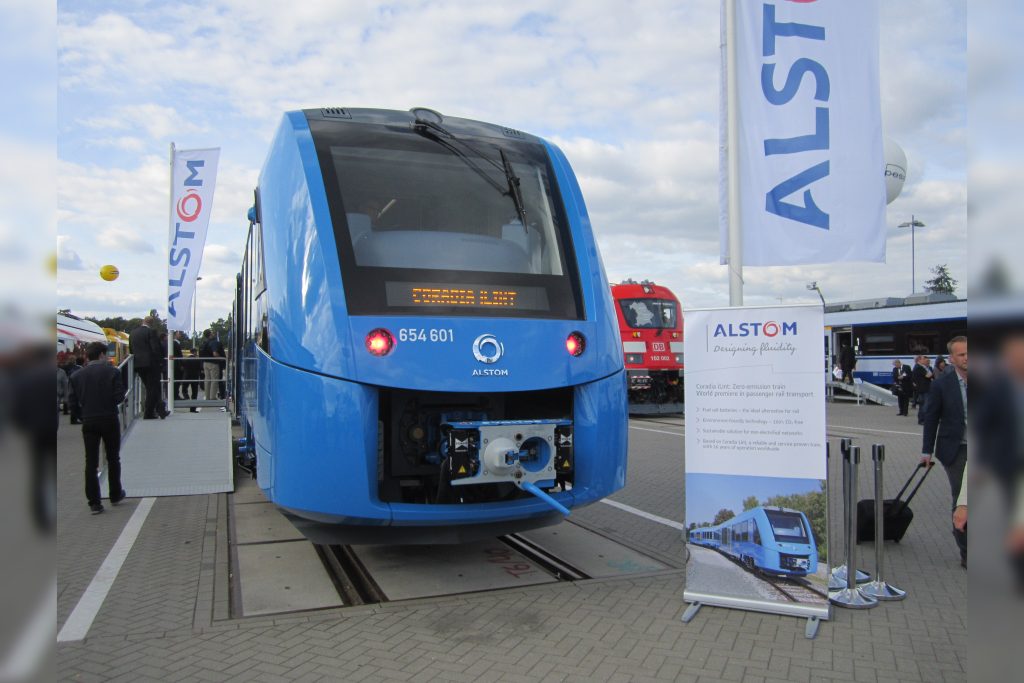
Indian Railways is betting on a technology that produces nothing but water vapour and heat. The agency’s first hydrogen fuel-cell train, now undergoing tests on the Jind–Sonipat corridor in Haryana, represents a policy pivot toward zero-emission rail. The stakes are straightforward: if the train works at scale, it could reshape how the world’s fourth-largest rail network powers its fleet.
The train carries a 1,200 kW hydrogen fuel-cell propulsion system. It runs in a 10-coach configuration — two power cars and eight passenger coaches.
Trial speeds have reached 120 km/h, though service speed will be capped at 75 km/h. The Jind–Sonipat route is the pilot corridor. That is the hardware.
The policy question is what comes after. Indian Railways has not yet announced a timeline for commercial deployment or a plan for hydrogen production and refueling infrastructure.
The train is still being tested. But the decision to greenlight the Jind–Sonipat corridor as a pilot signals that the agency is moving beyond feasibility studies. The Indian Embassy in the UAE released a video calling the train a “Swadeshi” — homegrown — achievement.
That language matters. It frames the project not as a foreign import but as domestic industrial capability. The implications stretch beyond Haryana.
Railways across Europe and China are already experimenting with hydrogen trains. Germany put hydrogen-powered trains into regular service on a regional line in 2018.
India, with one of the world’s largest rail networks and a heavy reliance on diesel, faces a different scale of challenge. Retrofitting thousands of diesel locomotives and building a hydrogen supply chain would require policy coordination across ministries — railways, energy, environment, and finance. No smoke.
No tailpipe emissions. That is the promise.
But the fuel-cell itself requires hydrogen, and how that hydrogen is produced determines the real environmental benefit. Grey hydrogen, made from natural gas, still releases carbon. Green hydrogen, made via electrolysis using renewable electricity, does not.
The report on the train does not specify which source Indian Railways intends to use. That detail will define whether the train is genuinely clean or merely displacing emissions upstream. For the communities along the Jind–Sonipat route, the train means something simpler.
Cleaner air. The diesel engines that currently haul passenger and freight trains through Haryana’s towns release particulate matter and nitrogen oxides.
A hydrogen train running on the same tracks produces only water vapour. That is a direct, measurable change in local air quality. The broader strategy is clear.
Indian Railways has announced a goal of becoming a net-zero carbon emitter by 2030. Hydrogen fuel-cell trains are one piece of that plan, alongside electrification of the broad-gauge network and solar-powered stations.
But electrification has limits — many remote or hilly routes are costly to wire. Hydrogen trains can run on existing non-electrified tracks without laying overhead cables. For now, the train is still in testing.
The pilot corridor is approved. The technology is proven at the level of a single 10-coach unit. The next step is not a technical one.
It is a policy decision: whether to invest in the infrastructure that turns a test run into a network.