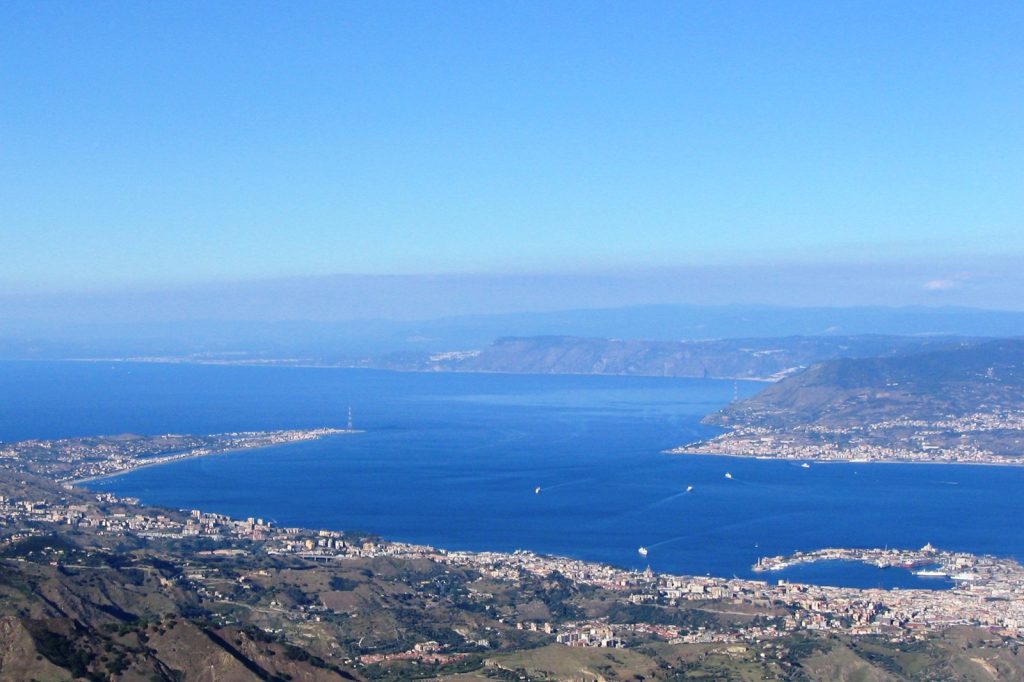
The committee met on Wednesday, and this time the answer was yes. On 6 August 2025, an inter-ministerial committee of Giorgia Meloni’s government gave final approval to a €13.5bn project to bridge the Strait of Messina, linking Sicily to Calabria on the toe of the Italian boot and, if it is ever built, claiming the title of the world’s longest suspension bridge. Meloni conceded the project had not been an easy one, but called it an “investment in Italy’s present and future”. “We enjoy difficult challenges when they make sense,” she said. Her transport minister Matteo Salvini, the scheme’s chief backer, was breezier still: “a metro over the strait”.
Under the hood, the specification is a record-setter. The final project has the deck spanning 3.3km (2.05 miles) between two 400-metre towers, with two railway lines running up the middle and three traffic lanes in each direction; the Guardian, counting the bridge together with its surrounding facilities, prints the figure as 3.7km, a discrepancy the two outlets leave unreconciled. Construction is pitched at roughly ten years, by a consortium led by Italy’s Webuild Group alongside Spain’s Sacyr and Japan’s IHI. Webuild’s chief executive Pietro Salini calls the project “transformative for the whole country”. The approval covers preliminary works, archaeological and geological surveys included, and Salvini says validation by the national audit court should take a few weeks, with work possibly starting “in September or October”.
The technical reality is that the ground has opinions. The strait sits in one of the most seismically active areas of the Mediterranean, and the construction zone ranks among Europe’s highest seismic risks; the designers’ answer is a structure they claim will be able to withstand earthquakes, which is a claim rather than a demonstration. The bridge has been imagined, studied and shelved since the late 1960s, and as ever with this project, the detail that matters is not the renderings but whether the engineering clears ground that has rejected it for half a century.
The politics are their own load-bearing structure. The numbers on jobs do not agree: Salvini has claimed the work would create 120,000 jobs a year, while Webuild’s own estimate is more than 100,000, and neither figure is audited. Sicily and Calabria are two of Europe’s poorest regions, and the government argues the link would lift the south; the scheme was a dream of Silvio Berlusconi, rejected in all three of his governments over cost, engineering impracticability and environmental impact, and revived soon after Meloni took power in 2022. Rome is also hoping to classify the bridge as military expenditure so that it counts towards Nato’s 5%-of-GDP defence-spending target, which would make the span the first suspension bridge in history to report for duty.
Obstacles remain stacked like approach spans. The approval still needs rubber-stamping by the Italian Court of Auditors and by environmental agencies at national and EU level, and environmental associations filed a complaint with the EU this week flagging serious local risks. Green MP Angelo Bonelli calls the plan “a colossal waste of money” and has vowed to keep fighting; Senator Nicola Irto of the Democratic Party calls the project “controversial and divisive”, saying it would divert “crucial resources from local transportation, modern infrastructure, safe schools and quality healthcare facilities”. Giusy Caminiti, mayor of Villa San Giovanni on the Calabrian shore, says her town would be badly affected and wants more time for consultations; the grassroots committee “No to the Bridge” dismissed Wednesday’s announcement as a political manoeuvre rather than a technical evaluation; and locals note the works would drink millions of litres of water a day in two regions that already struggle with drought. Around 4,000 people across both shores are to leave their homes under the expropriation plan, compensated, but protesting anyway.
Then there is the mafia question, which Salvini met head-on. “The Strait of Messina is a project without precedent in the world,” he told reporters, adding that stamping out criminal infiltration of the project would be the government’s “raison d’être”. “We must monitor the entire supply chain to ensure it is impervious to criminals,” he said, with the caveat that if the mafia turned out to be involved, the bridge simply would not be built. Sicilian and Calabrian crime groups have siphoned public money for generations, and concerns over exactly that helped kill earlier iterations.
The stated finish line, in the transport minister’s own words as printed, is that “This goal is to complete by 2032-33.” Until the minister’s window closes, then, the crossing keeps its current form: rail carriages shunted onto ferries for the 30-minute sail between Messina and Villa San Giovanni, a journey the world’s longest bridge is meant to make obsolete. Italy has now signed off on that future, on paper at least. The strait, seismically, legally and politically, still gets a vote on the delivery.
Sources
- Italy gives final approval for world's longest suspension bridge to Sicily
- Italian government gives final approval for bridge linking Sicily to mainland | Italy | The Guardian