
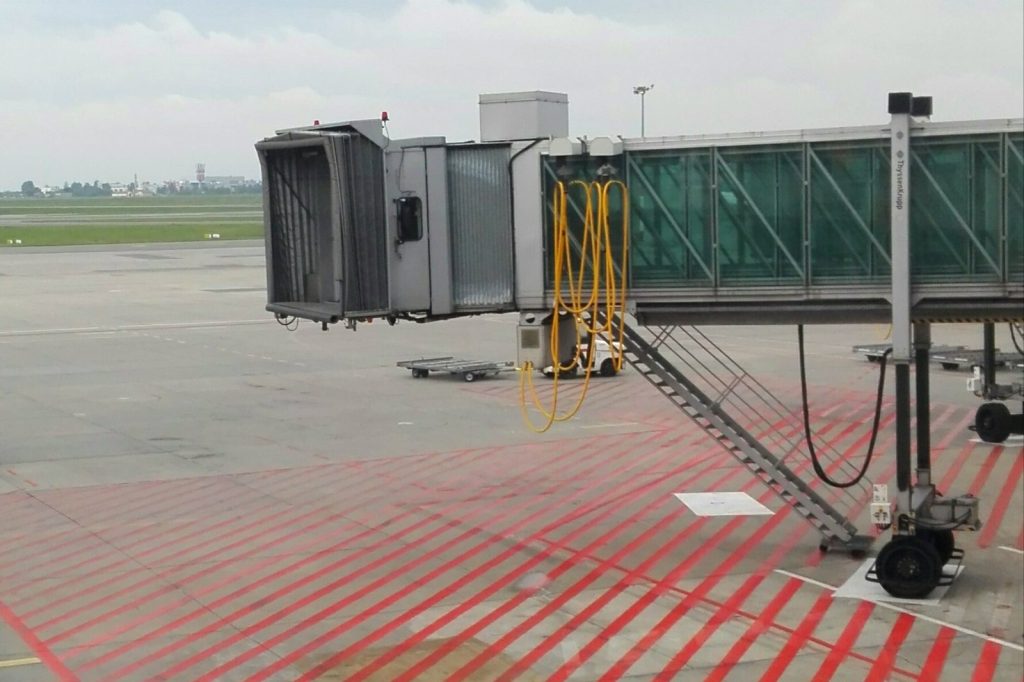
Dublin Airport Jet Bridge Failure Spotlights Aging Airport Infrastructure
On July 9 2023 a jet bridge at Dublin Airport gave way and struck an American Airlines Boeing 787 that was parked at the gate. The impact caused visible damage to the aircraft and disrupted normal gate operations, although no injuries were reported among passengers, crew or ground staff.
The aircraft was subsequently taken out of service for repairs, and the gate was closed pending inspection. Jet bridges are pieces of airport equipment that most travelers notice only when they walk through them. Their function is to move into precise alignment with an aircraft door, bear their own weight and resist forces from wind, vibration and constant use.
In this incident the bridge failed to perform those basic tasks, collapsing onto the fuselage of the wide‑body jet. These structures are not simple static frames.
Depending on the gate design they may swing outward on a radial arm or telescope in length. Some installations are fixed in place, while others are fully movable. All versions contain moving parts, hydraulic actuators and electrical control systems that require routine maintenance to remain reliable.
The collapse raises the question of whether the Dublin event was an isolated mechanical failure or a sign of wider maintenance shortfalls across the global airport network. Airports today operate under competing pressures: passenger traffic has rebounded after recent downturns, capital budgets are often constrained, and many facilities—including the jet bridge systems—are aging.
The modern jet bridge traces its origins to inventions such as those pioneered by Frank Der Yuen decades ago. Today the equipment is standard at virtually every major airport worldwide. Because they incorporate mechanical, hydraulic and electrical subsystems, they are subject to wear and can malfunction.
When a malfunction occurs while a bridge is positioned against an aircraft, the consequences are immediate: repair costs for the airframe, flight delays, and a potential erosion of passenger confidence in airport safety. Historical records show that similar jet bridge mishaps have taken place at other airports, though few have produced as conspicuous a result as the Dublin case.
Investigators typically examine factors such as a worn latch, a misaligned sensor, or a maintenance procedure that was not completed as prescribed. Dublin airport authorities have announced they will review their own inspection and servicing logs, search for any gaps in protocol, and implement corrective actions to prevent a recurrence. Beyond the specific gate, the incident highlights a broader vulnerability within the airport ecosystem.
Airports consist of many interdependent components—runways, taxiways, terminals, baggage handling systems, and jet bridges—each demanding financial investment and ongoing attention. A failure in one element can expose stress points throughout the entire operation, reminding stakeholders that the reliability of air travel depends on the strength of its weakest link.
Officials expect the damaged Boeing 787 to be repaired and returned to service after the necessary work is completed. The Dublin gate will undergo a thorough examination before it is cleared for use again. Travelers will continue to board flights from other gates while the investigation proceeds. The July 9 collapse serves as a concrete reminder that even the most routine pieces of airport infrastructure must be maintained to the highest standard if the aviation system is to remain safe and dependable.




