
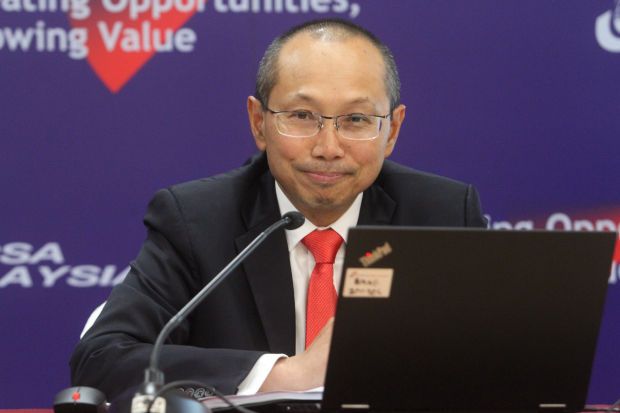
Malaysia is unlikely to fall into a recession, Bursa Malaysia chairman Wahid Omar said on Wednesday, Sep 14, even though he expects interest rate hikes and soaring inflation to slow growth elsewhere and push some countries into recession.
Speaking at the Invest Malaysia 2022 conference in Kuala Lumpur, he gave two reasons: an economy that leans less on commodities, and “pragmatic and responsive” policies that can soften the risks.
The numbers behind the claim
Last year’s GDP growth came mainly from services and manufacturing, Wahid said. Services contributed 57 per cent and manufacturing 24.3 per cent. Agriculture and mining together supplied only 14 per cent.
Trade ties help too. “The diversity of our trading partners, where we are not overly dependent on one particular country, would add to our economic resilience,” he said.
He also cited the banks, which he described as well capitalised, liquid, better managed and effectively supervised by the central bank. Debt and equity capital markets add to that, totalling RM3.5 trillion at the end of June: RM1.8 trillion in debt and RM1.7 trillion in equity.
Chips, reshoring and a worker shortage
Other speakers at the conference were more focused on where investment goes next. James Sullivan, JP Morgan’s head of Asia Pacific equity research, said geopolitical conflicts and the United States-China trade war have sent investors hunting for other places to put money in Asia. Malaysia, he said, has offered “interesting” opportunities. “Investors are very thirsty for growth in this region,” Sullivan said, and Malaysia could step up by providing regulatory certainty and a lower perceived risk profile.
Fraziali Ismail, an assistant governor at Bank Negara Malaysia, pointed to the global reshoring trend and the US Chips Act, which encourages semiconductor companies to return to the United States. Malaysian firms need to pay attention and “make sure Malaysia remains plugged in,” he said. In some cases, he added, the country is a net beneficiary of the US-China trade war, thanks to strong support industries around semiconductors and an ability to adapt production quickly.
Lee Heng Guie, executive director of the Socio-Economic Research Centre, said global supply chains are now shaped by geopolitical fragmentation rather than economic efficiency. Malaysia’s manufacturers, especially its semiconductor industry with over 7 per cent of global sales, are well placed to attract foreign investors. Labour could hold that back, though. “Do we have enough manpower?” he asked. If local talent runs short, he said, the government should consider welcoming foreign workers.
The figures bear him out. The Small and Medium Enterprises Association of Malaysia says SMEs are short of 1.5 million workers, and Penang’s semiconductor sector alone needs another 50,000 engineers.
Fraziali raised the brain drain as well. Citing Department of Statistics Malaysia data, he said about 500,000 high-skilled Malaysians over 25 were living abroad in 2022, up from an estimated 280,000 to 450,000 in 2010. “The lure from outside Malaysia is too great and this has fueled the mobility of Malaysian young talents,” he said. A report by the think-tank Emir Research puts the Malaysian diaspora at slightly over 2 million people, half of them highly skilled.




