
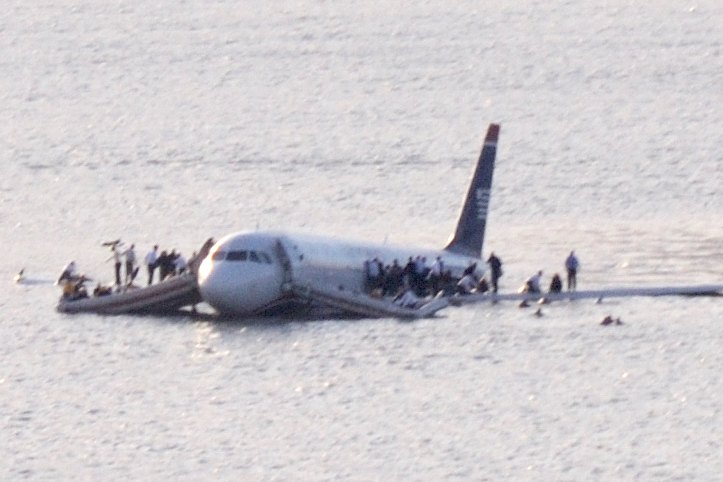
Thirty to forty-five seconds. That is how long US Airways Flight 1549 had been in the air from LaGuardia, according to The Guardian, when passengers heard a bang and felt the Airbus A320 shake. The date was January 15, 2009, the plane was bound for Charlotte, North Carolina, and it had left the ground at 3.26pm.
A flock of geese was the likely culprit, as witnesses suggested at the time. Passenger Jeff Kolodjay said smoke filled the cabin from the left engine.
Minutes to decide
The captain, later named as Chesley Sullenberger, told air traffic control he had engine trouble and wanted to go back. He was a former US air force fighter pilot with 29 years of experience in commercial aviation. The nearest identified airport was in New Jersey, and when it became clear the plane could not reach it, he prepared for a landing on the Hudson.
“Brace yourself for impact,” he told the passengers.
The National Transportation Safety Board, which later investigated, put the ditching about 8.5 miles from LaGuardia and described an almost complete loss of thrust in both engines. Pilots can normally land on one engine. Losing both was the puzzle that the Guardian flagged on the first day. An air incident investigator, David Gleave, told the BBC that a plane in that situation becomes like a glider.
On the water
Witnesses saw a splash and the plane come to an immediate stop on a line with 48th Street in midtown Manhattan. It looked so controlled that some took it for a seaplane. “I just thought, ‘Why is it so low?’ And splash, it hit the water,” said Barbara Sambriski.
The plane stayed intact. Doors opened quickly at the front and over the wings, and passengers either stepped straight into boats, stood in line on rafts, or waited on top of the wings, which kept the aircraft afloat. At least seven water taxis and tugs swarmed around it. By the time everyone was aboard a rescue boat, the water was up to the windows and the jet was drifting south on the outgoing tide. Sullenberger walked the length of the cabin twice to make sure nobody was left, and then got out himself.
All 155 people survived. The NTSB counts 150 passengers, one of them a lap-held child, and five crew members who left through the forward and overwing exits. One flight attendant and four passengers were seriously injured. The Guardian reported that other injuries were mild hypothermia, shock, cuts and bruises, and several passengers went to hospitals in New York and New Jersey.
“It was as good a landing as you can make in a river,” passenger Alberto Panero said. New York governor David Patterson reached for a pun: “We have had a Miracle on 34th Street. Now we have a miracle on the Hudson.” Mayor Michael Bloomberg was drier. “Normally this isn’t the way people arrive in New York,” he said.
What the investigation found
A team of 20 NTSB investigators was sent to the scene. The agency’s finding was that the probable cause was large birds ingested into each engine. It credited the survival of everyone aboard to several factors: the decision-making and crew resource management of the flight crew, an aircraft equipped for extended overwater flight with forward slide rafts, though it was not required to be, the cabin crew’s speed in the evacuation, and the closeness and prompt response of emergency responders.
The board also named things that made the ditching harder. The FAA had approved ditching certification without checking whether pilots could reach the required parameters with no engine thrust. Industry training on ditching techniques was thin, and the captain struggled to hold his intended airspeed on final approach because the emergency saturated his attention. Those fuselage damage points left the aft slide rafts unusable. Recommendations went to the FAA, the US Department of Agriculture and the European Aviation Safety Agency.
Sources
- Miracle on the Hudson: 155 survive crash as jet hits river in New York – The Guardian
- Loss of Thrust in Both Engines After Encountering a Flock of Birds and Subsequent Ditching on the Hudson River – NTSB




