
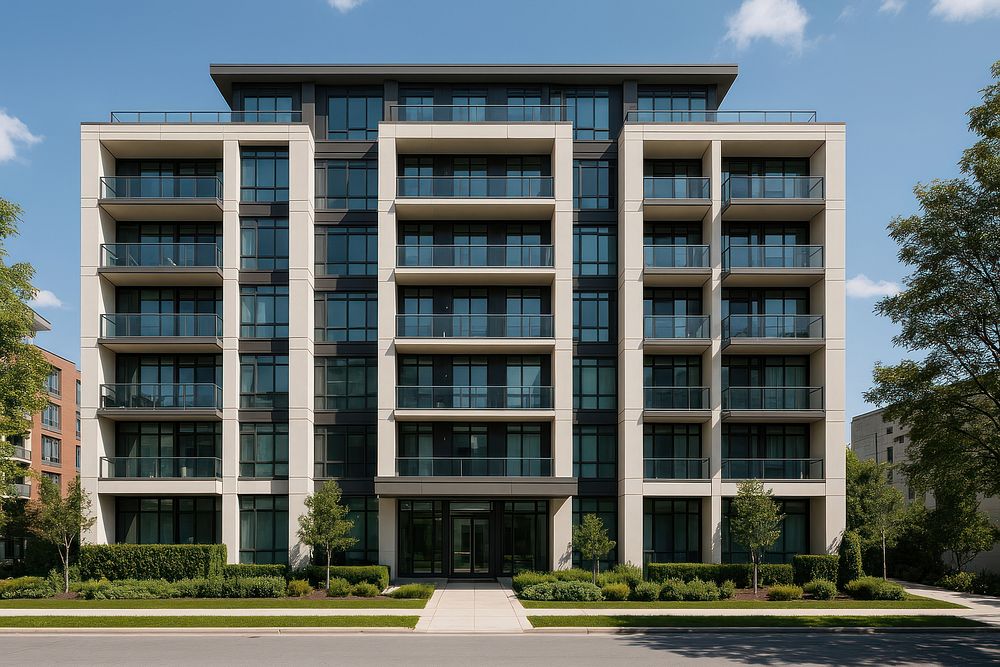
Housing units in multifamily buildings carry greater per capita value than single-family homes. They also bring down property tax rates in the community around them. And despite what some NIMBY voices claim, they are a lower fire hazard.
Those are the points in favour of a housing type that has stirred political fights for a long time.
What counts as multifamily
The term covers any housing where several separate units sit in one building or across a single complex. Units can be side by side or stacked. Apartment buildings and condominiums are the common forms, and a condominium typically means each unit is owned individually rather than leased from one building owner. Many cohousing projects are multifamily too.
The varieties run long. A block of flats may hold a few apartments or hundreds. Mixed-use buildings put shops or offices at street level and homes above. An apartment community is a group of buildings on adjoining land, usually under one owner, sharing grounds, pools and parking. New York’s brownstones are rowhouses. Britain has the bedsit, a single room with shared bathroom facilities, now rarer than it was before the 1980s. Glasgow’s closes were slum tenements built between 1800 and 1870, usually three or four storeys, terraced and back to back.
Old forms of density
Before the Industrial Revolution these buildings were rare and stood only in historic urban centres. Ancient Rome had its insulae. Yemen’s Shibam had its skyscrapers, Madrid its malice houses and Algiers its casbah.
The zoning fight
In the United States, zoning laws set aside large areas for detached single-family homes and ban multifamily housing outright. Affluent homeowners have been described as especially likely to oppose it.
The history is uglier than the usual arguments about density. Efforts to ban multifamily housing were historically driven by a wish to keep racial minorities and poor people out of neighbourhoods.




