
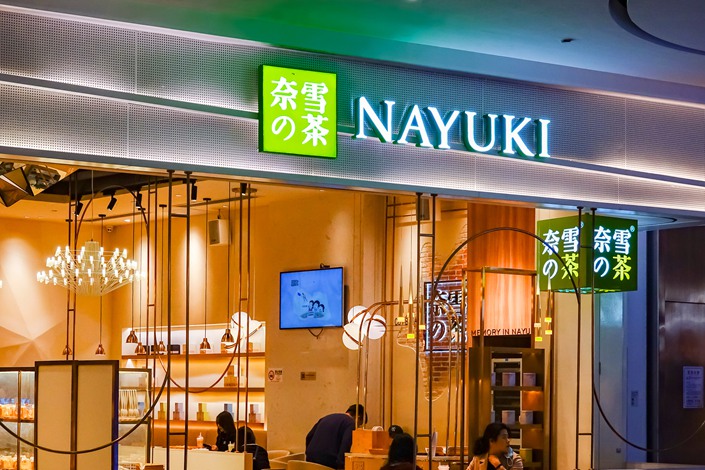
In 2014, Peng Xin and her husband Zhao Lin put their home up as collateral for a bank loan. The money bought them a start in bubble tea. “It wasn’t a reckless decision,” Peng said in an interview. “We spent almost two years testing our drinks on the street before opening our first store.”
On Wednesday, their company, Nayuki Holdings Ltd, made its Hong Kong trading debut, and shares dropped as much as 13% despite a well-received share sale. The IPO raised $656 million, priced at the top of its marketed range. Bloomberg reported that bankers in Asia now expect listing hopefuls to meet a less generous market after a booming first half, with high valuations and jitters over US monetary policy making buyers warier.
Even so, the couple are rich on paper. Their stakes are each worth about US$1.2 billion, by the Bloomberg Billionaires Index, and each owns about 28 per cent of the company. Nayuki declined to comment on their net worth. Peng, 33, is an executive director and general manager. Zhao, 42, is chairman and once worked at food companies that included Burger King’s Shenzhen unit.
From three shops to more than 560
The chain began with three branches in Shenzhen. It has since grown to more than 560 stores in more than 70 cities, nearly all in China, helped by a surge in demand for high-end tea drinks. At the end of last year it had 491 flagship outlets: 489 on the mainland, one in Hong Kong and one in Japan. More than 90 per cent of the mainland shops sit in Tier 1 and Tier 2 cities.
Its prospectus puts Nayuki’s share of the premium modern tea cafe market at around 19 per cent of retail consumption in 2020, the second-largest. HeyTea, founded in 2012 and closely held, is another major rival.
Peng said the company plans 300 more branches this year and 350 in 2022. Most will use a new format, Nayuki PRO, which adds coffee and smaller bakery items aimed at office workers. A new drink has arrived every week since last year to keep younger customers returning. Online platforms now account for most sales. “After the pandemic, we see 70 per cent of our orders from online platforms,” she said.
Losses and the profit question
Nayuki lost 203 million yuan in 2020 and 40 million yuan the year before, its prospectus shows. Revenue rose 22 per cent to 3.1 billion yuan. Proceeds from the offering will go toward more teahouses, deeper penetration of existing markets and a stronger supply chain. JPMorgan Chase & Co, CMB International Capital Ltd and Huatai International Ltd are joint sponsors.
Some analysts doubt the company can turn a profit and hold it. Jason Yu, managing director at Kantar Worldpanel Greater China, sees “decent growth potential” for tea cafes generally. “Modernising the entire supply chain to drive more efficiency remains the key challenge for Nayuki and its peers,” he said.
Kenny Ng, a securities strategist at Everbright Sun Hung Kai Co in Hong Kong, was more optimistic in the near term. “I think Nayuki still has much room to improve its profitability by scaling up the store network in the next three to five years,” he said. “But the real challenges for sustainable growth will come after that.”
Peng said the company is working on costs, including automating chores such as cutting fruit and kneading dough. “We hope Nayuki can be a brand that customers are willing to come back to every day,” she said.
Sources
- Bubble tea chain Nayuki drops as much as 13% in Hong Kong debut
- Bubble Tea Chain Raises $656 Million in Hong Kong IPO




