
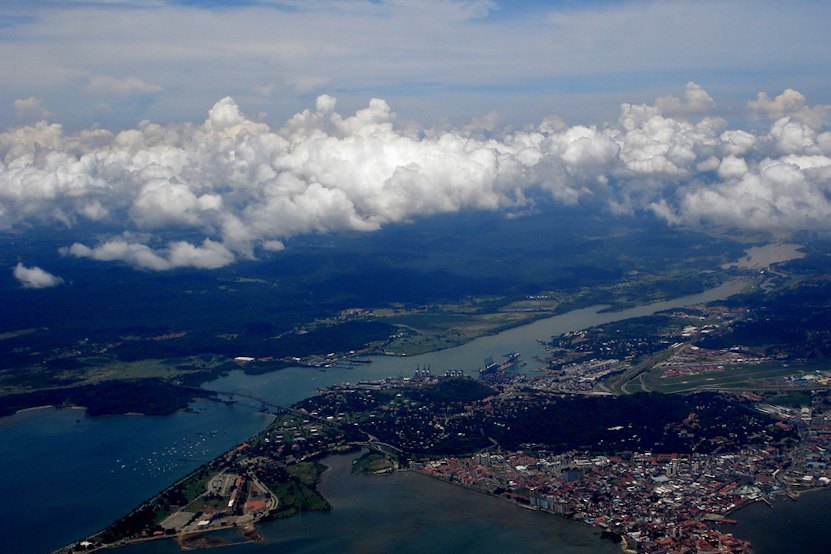
PANAMA CITY, July 15 — The Panama Canal Authority is navigating a technical reality that has become increasingly difficult to ignore: the 51-mile artificial waterway that connects the Atlantic and Pacific Oceans depends entirely on fresh water, and that water is running short. Under the hood, the canal’s operation is a feat of hydraulic engineering that has remained fundamentally unchanged since its completion in 1914.
Ships are raised 85 feet above sea level through a system of three lock complexes — the Gatun Locks, Pedro Miguel Locks, and Miraflores Locks — before transiting Gatun Lake, an artificial reservoir created specifically to supply the locks. Each transit drains millions of gallons of fresh water from the lake into the sea.
No water, no passage. The detail that matters for global trade is that Gatun Lake has no backup. Recent droughts have reduced water levels in the lake, forcing the ACP to impose transit restrictions in 2023 and 2024.
The canal, which handles roughly 5% of world maritime trade and sees over 14,000 vessel transits annually, is a critical chokepoint — particularly for US exports of liquefied natural gas and grain moving to Asia, and for Asian manufactured goods bound for the US East Coast.
An engineering legacy with a modern price tag
The canal’s history is a study in persistence through catastrophe. Construction began in 1881 under French leadership, with Ferdinand de Lesseps attempting to cut through the Isthmus of Panama. The effort collapsed by 1889, undone by engineering challenges and disease.
The United States took over in 1904 under President Theodore Roosevelt, completing the canal in 1914. The SS Ancon made the first official transit on August 15, 1914.
The US controlled the canal until December 31, 1999, when it was fully transferred to Panama under the Torrijos–Carter Treaties signed in 1977. Today, the canal is operated by the Panama Canal Authority, an autonomous agency of the Panamanian government. A major expansion — the Panama Canal Expansion Project, or Third Set of Locks — was completed in 2016 at a cost of approximately $5.25 billion.
The project added a new lane of traffic with larger locks, allowing Neopanamax ships to transit. In fiscal year 2023, the canal generated $4.3 billion in revenue for Panama.
What to watch next
The ACP has not announced permanent solutions to the water shortage, but the technical reality is that without additional reservoir capacity or a fundamental redesign of the lock system, the canal’s throughput will remain vulnerable to rainfall patterns. As ever, the engineering that made the canal possible is also what constrains it.
Sources
{“@context”: “https://schema.org”, “@type”: “NewsArticle”, “headline”: “Panama Canal Marks 110 Years of Engineering and Global Trade Impact”, “description”: “PANAMA CITY, July 15 — The Panama Canal Authority is navigating a technical reality that has become increasingly difficult to ignore: the 51-mile artificial waterway…”, “datePublished”: “2026-07-15T09:30:00+00:00”, “author”: {“@type”: “Person”, “name”: “Sebastian Smith”}, “publisher”: {“@type”: “Organization”, “name”: “InfoPulse Today”, “url”: “https://newsfeed.infopulsetoday.com/”}, “citation”: [{“@type”: “CreativeWork”, “url”: “https://en.wikipedia.org/wiki/Panama_Canal”}]}




