
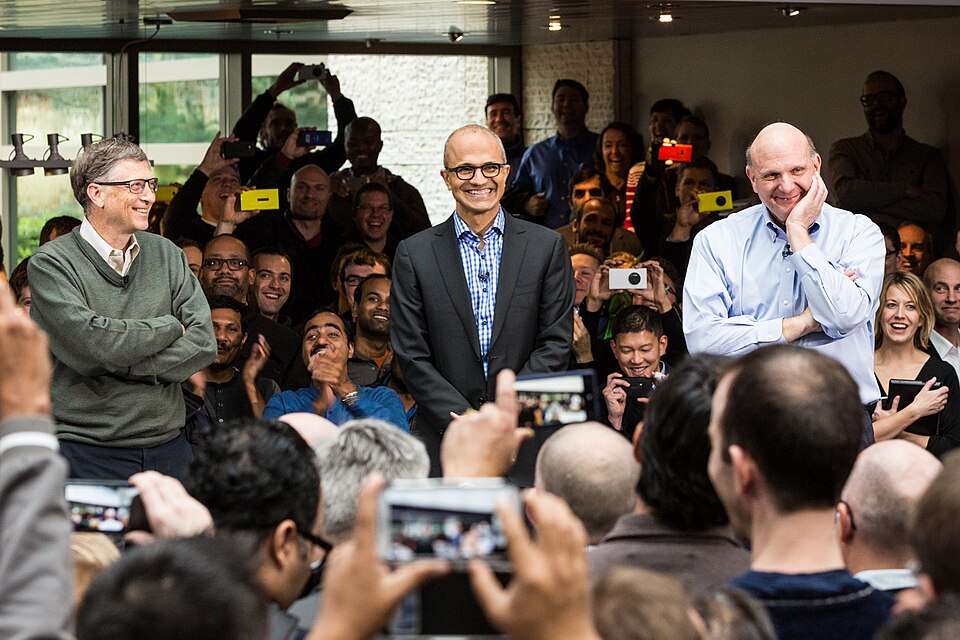
When Satya Nadella took over Microsoft in February 2014, its market value had flatlined at around $300 billion and its stock hovered near $36. As of 2025 the shares trade above $400 and the company is worth more than $3 trillion. For a Hyderabad-born engineer, that is a long way from a modest household where computers were rare.
The revenue was fine, though. That was the confusing part. From outside, Microsoft still looked like the company that had won the PC era. Inside, it was a set of fiefdoms competing with each other, and the share price had gone nowhere for ten years. Windows was losing ground to iOS and Android, and the strategy stayed tied to Windows and Office while the world moved toward the cloud and mobile devices.
From Hyderabad to Redmond
Nadella was born on August 19, 1967. His father, Bukkapuram Nadella Yugandhar, was an Indian Administrative Service officer and his mother, Prabhavati, a Sanskrit lecturer. He earned an electrical engineering degree at Manipal Institute of Technology, then followed the route of his generation to the United States: a master’s in computer science at the University of Wisconsin-Milwaukee and later an MBA at the University of Chicago Booth School of Business.
He worked at Sun Microsystems before joining Microsoft in 1992 as a young engineer. His years in server and cloud infrastructure, the unglamorous end of the business, taught him how enterprises actually use software. His senior posts included Senior Vice President of Research and Development for the Online Services Division and Vice President of the Business Solutions Division. The big break came as head of the Cloud and Enterprise Group, where he led the creation and expansion of Azure. That made him the natural successor to Steve Ballmer, and he became Microsoft’s third CEO, after Ballmer and founder Bill Gates.
Know-it-all to learn-it-all
He started with people, not products. Microsoft ran on stack ranking, a review system that forced managers to grade colleagues against each other, and an intellectual arrogance to match. Nadella replaced it with the growth mindset, borrowed from the psychologist Carol Dweck. Engineers were told to say when they did not know something and to treat a failure as information. His line was “from know-it-all to learn-it-all.”
He rewrote the mission too, from “a computer on every desk and in every home” to “to empower every person and every organization on the planet to achieve more.” Raising his late son Zain, who was born with cerebral palsy, shaped his belief in empathy as a business advantage. “Empathy grounds innovation,” he writes in his 2017 book Hit Refresh.
Cloud first, then AI
The strategy was “cloud first, mobile first.” Microsoft shipped Office for iPad and Android, a public concession that the device mattered less than the software. It embraced open source, joined the Linux Foundation and made Azure work well with Linux, which turned an old enemy into a growth engine. Between 2015 and 2025 Azure’s share of global cloud infrastructure rose from 10 percent to 25 percent, putting Microsoft close behind Amazon Web Services. Cloud services now bring in more than half of the company’s income. Selling licenses gave way to subscriptions through Microsoft 365, Dynamics 365 and Teams.
Acquisitions followed: LinkedIn in 2016 for $26.2 billion, GitHub in 2018 for $7.5 billion, and Activision Blizzard in 2023 for $68.7 billion. From 2019 Microsoft backed OpenAI with billions of dollars and Azure’s compute to train the GPT models. By 2023 AI copilots had spread across Office and Azure. Rather than build a frontier lab inside the company, Nadella bought into the most inventive one outside it.
The scars
Not everything worked. The Nokia acquisition, an attempt to rescue a phone business already lost, ended in billions of dollars of write-downs. As market capitalization climbed toward $3 trillion, antitrust attention returned, sharply, around the Activision Blizzard deal. Then there is inertia, the risk that comes to companies that win.
Microsoft has pledged to become carbon negative by 2030 and to eliminate all of its historical emissions by 2050. Time has named Nadella among its 100 most influential people, and Fortune called him Businessperson of the Year.
Sources
- Success Story: Satya Nadella — The Human-Centered Visionary Who Rebuilt Microsoft
- Satya Nadella: How Microsoft Became an AI Giant




