Over the span of a few years, Singapore and Vietnam have kept returning to the same two words: digital economy. A look at how the talks developed shows the idea moving from a ministerial wish list to signed agreements.
February 2023: a minister makes the case
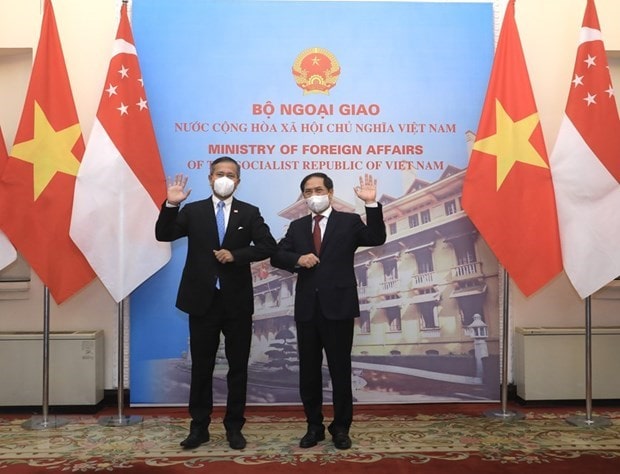
Ahead of Vietnamese Prime Minister Pham Minh Chinh’s official visit to Singapore from February 8 to February 10, 2023, Singapore Foreign Minister Vivian Balakrishnan wrote in The Business Times that the two countries should step up work on the digital economy and sustainable development. Trade and investment remained the traditional strengths, he said, but there were plenty of openings in newer areas: renewable energy, carbon credits, green financing, cybersecurity and sustainable infrastructure.
“I would encourage interested parties to explore collaboration in these areas, to establish mutually beneficial partnerships that advance the interests of both countries,” he said. He called the digital economy a “priority” and listed cross-border data flows, smart cities, artificial intelligence and digital payments among its parts.
Bilateral trade had reached US$31.3 billion the previous year, up from US$26.9 billion in 2021. Singapore ranked as the second-largest cumulative investor in Vietnam, behind only the Republic of Korea, with about US$70 billion across 3,600 projects as of June 2022. Chinh’s trip was his first to Singapore since taking office in April 2021.
March 2025: a Comprehensive Strategic Partnership
On March 12, 2025, Prime Minister Lawrence Wong and Vietnamese leader To Lam committed to a Comprehensive Strategic Partnership, an upgrade of the Strategic Partnership set up in 2013 that builds on the Green-Digital Economic Partnership of 2023. Wong said it was Singapore’s first such partnership with an Asean member state.
The pact covers defence and security, but also digital connectivity, cross-border data flows, cyber security and artificial intelligence, along with energy cooperation aimed at net-zero emissions by 2050. The leaders watched the exchange of memorandums of understanding on transnational crime, digital transformation, offshore wind power trade and the development of Vietnam-Singapore Industrial Parks. Their foreign ministries were told to draw up a plan of action.
Trade in goods between the two reached $31.6 billion in 2024. As of December 2024, Singapore was Vietnam’s top foreign investor, with direct investment valued at US$10.2 billion.
May 2026: technology takes the lead
When Lam returned for talks with Wong on May 29, 2026, the agenda leaned further toward technology. According to Vietnam’s VOV, the two sides discussed artificial intelligence, national data centres, high-performance computing and digital transformation. Lam asked Singapore to keep helping train strategic-level officials and technology talent, and to assist with the operation of Vietnam’s National Data Centre, High-Performance Computing Centre and Artificial Intelligence Centre. Wong noted the more than 22,000 Vietnamese students in Singapore.
The leaders agreed to promote a technology connectivity initiative aimed at building a shared science and technology ecosystem, and to set up a strategic dialogue between the Communist Party of Vietnam and Singapore’s People’s Action Party. Agreements signed afterward covered Party channels, judicial cooperation, supply chain recovery and new investment certificates for industrial park projects in Hue, Nghe An, Ninh Binh and Hai Phong.
Two-way trade came close to US$12 billion in 2025, VOV said, and Singapore remains Vietnam’s second-largest foreign investor, with cumulative registered investment approaching US$100 billion.
Sources
- Singapore, Vietnam to deepen ties across the board with wide-ranging pact
- Vietnam and Singapore deepen digital era partnership
- Vietnam and Singapore to boost digital economy, sustainable development