
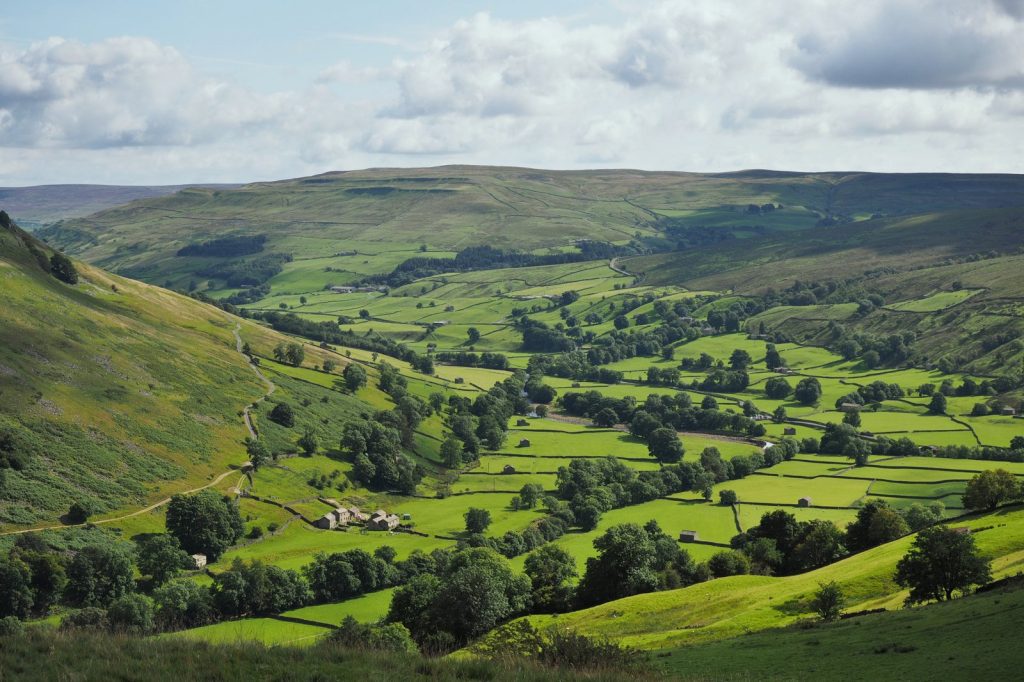
The record begins with a release time stamp: 9:30am, July 8, 2026, when the Office for National Statistics published its Enclosed Farmland Natural Capital Accounts for the UK. The figure that travelled furthest from that document is £237 billion, the asset value the ONS assigns to the services flowing from enclosed farmland in 2023. The accompanying analysis is blunt about what the number is not: “That is not a sale price for fields, farms or nature.” Rather, “It is an estimate of selected services expected to flow from the land over time, built from models that also show where the same landscape is under strain.”
The record shows two ledgers, easily confused. The first is a flow: £5.9 billion of value generated during 2023 by the six services the account measures, among them biomass from agriculture, electricity from renewables, recreation, the removal of pollution, and the regulation of greenhouse gases. The second is the asset figure, £237 billion, a present value of services expected to keep flowing; its largest single component is agricultural biomass at £175 billion. The habitat in question covers arable land, horticulture and improved grassland, 52% of the UK’s land area as of 2024, down from 54% in 1990.
On the timeline, the flows move in opposite directions. Biomass value climbed 18% between 2011 and 2023 to £5.4 billion a year, even as physical output fell: 78 million tonnes in 2024, some 8% under its 2011 level, a gap explained by prices, costs and the changing mix of production. Renewable electricity took the cleaner path, generation on farmland rising from 3,526 gigawatt hours in 2011 to 20,873 in 2023, onshore wind supplying 11,022 GWh of that and solar 9,851 GWh, with the assigned annual value rising from £42 million to £647 million. The account also books 866 million recreation and tourism visits in 2023, a reminder that a path or a view produces measurable benefit even when nothing is sold.
The carbon line is where the account stops being decorative. The land categories feeding the greenhouse gas calculation recorded a net release of 9 million tonnes, measured in carbon dioxide equivalent, in 2023, better than the 11 million tonnes of 1990 but still negative, and the greenhouse gas regulation service carried an annual value of minus £3 billion, because emissions outran removals. The ONS flags high uncertainty in the modelling behind cropland mineral soils. The lesson, as one close reading of the release puts it: “Land can produce valuable services and still carry an environmental liability.”
One more caution belongs in any honest summary. Farmland’s air-pollution removal was valued 23% lower by 2024 than in 2005, which reads like decline and is, according to the ONS, mostly the opposite: cleaner air left vegetation less pollution to strip out, so the avoided damage, and the money attached to it, shrank. “The ONS describes the monetary figures as partial or minimum valuations.”, valuations that hinge on which services are counted, for how long, at what discount rate. The totals move for reasons of method as often as of nature, and “a single total should never carry the whole argument”.
What the document is for, in the end, is context: it feeds England’s 2026 Land Use Framework, illustrates economy-wide dependencies for companies working with nature-related disclosures, and exposes trade-offs that vanish when land is discussed in hectares alone. It cannot price a particular field, prove a project’s additionality or set anyone’s payments; it is labelled official statistics in development, and the methods may yet change. The closing instruction of the best commentary on it deserves to stand: “The account is most useful when the price tag sends the reader back to the land.”




