
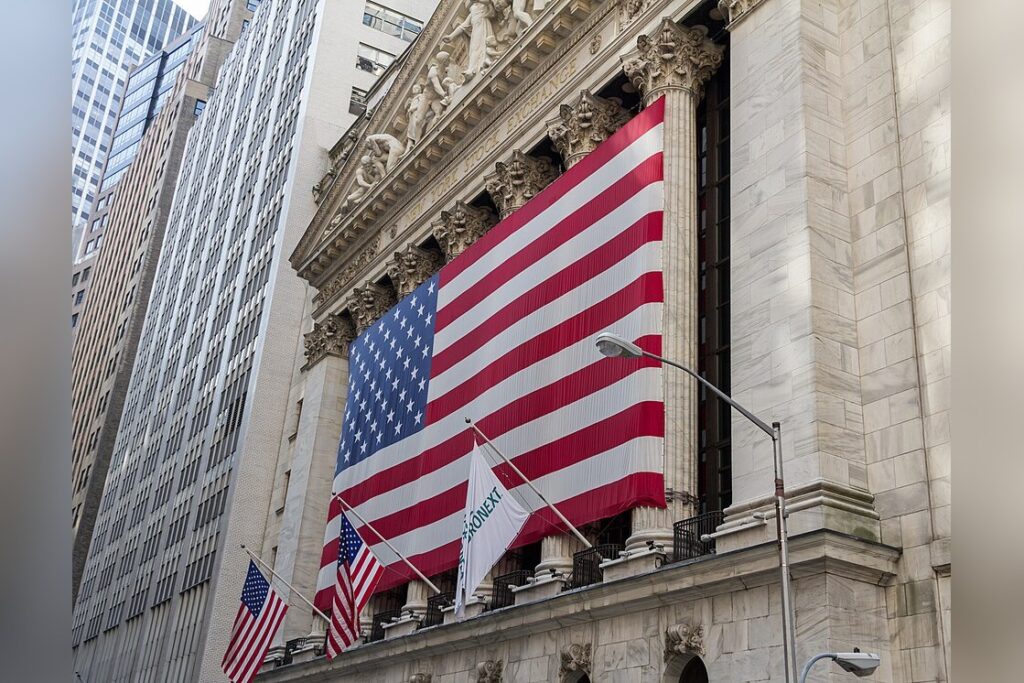
New York, April 14, 2026 — cybernewschronicle.com — NEW YORK — April 14, 2026 — American stocks mounted a broad rally Monday, with the S&P 500, Dow Jones Industrial Average, and the Nasdaq Composite all posting sharp gains. The surge came amid reports that the United States and Iran may be moving toward renewed nuclear talks, easing months of geopolitical tension that had weighed on investor sentiment.
The S&P 500, which tracks the performance of 500 leading U.S. companies and represents approximately 80% of total U.S. public company market capitalization, climbed more than 2% in afternoon trading. The Dow Jones Industrial Average added over 600 points, while the tech-heavy Nasdaq Composite rose by roughly 2.5%, according to preliminary market data.
Market participants attributed the broad-based advance to diplomatic signals emerging from the Middle East. “The prospect of de-escalation between Washington and Tehran is a significant catalyst for risk assets,” said Mark Connors, head of global macro research at 3EDGE Asset Management. “Investors are pricing in a lower probability of supply disruptions in the Persian Gulf and a potential thaw that could reduce oil price volatility.” The rally was led by major technology and communications stocks.
Nvidia, the largest component of the S&P 500 with a weighting of 7.17% as of January 2026, rose more than 3%. Alphabet, which holds a combined 6.39% weighting across its Class A and C shares, also gained.
Apple, Microsoft, Amazon, and Meta Platforms each posted solid advances. Together, the ten largest companies in the index account for approximately 38% of its total market capitalization, according to index methodology data. The S&P 500’s aggregate market capitalization stood at more than $61.1 trillion as of December 31, 2025.
The index is a float-weighted, capitalization-weighted benchmark that includes approximately 500 of the largest publicly traded U.S. firms. The diplomatic backdrop shifted late last week when Iranian state media signaled openness to indirect talks mediated by Oman. U.S. officials have not confirmed a formal negotiating framework, but White House National Security Council spokesperson Sean Davett told reporters Monday, “The president has always preferred a diplomatic solution that verifiably prevents Iran from obtaining a nuclear weapon.
We are evaluating any credible offer.” Israel, a key U.S. ally in the region, has maintained a cautious stance. Israeli Defense Minister Yair Katz said in a statement, “Israel supports genuine diplomacy that includes strict enforcement and inspections.
We will not accept a bad deal that leaves Iran on the threshold of a bomb.” The United States and Israel have coordinated closely on Iran policy, with Washington reaffirming its commitment to Israel’s qualitative military edge. European allies also welcomed the possibility of talks. A spokesperson for the European Union’s foreign policy arm said, “The EU stands ready to support any process that leads to a sustainable, verifiable agreement.
Iran must comply with its international obligations.” The United Kingdom’s Foreign Office echoed that sentiment, urging Tehran to “seize this opportunity for serious negotiation.” The rally in U.S. equities also lifted Asian markets in overnight trading. Japan’s Nikkei 225 and Taiwan’s Taiex both closed higher, reflecting optimism that reduced Middle Eastern tensions could stabilize global supply chains and energy costs.
The Philippines Stock Exchange index also rose. China’s Shanghai Composite, however, ended flat amid continued concerns over domestic regulatory tightening and trade friction with Washington. Oil prices, which had spiked in recent weeks on fears of a broader conflict, retreated Monday.
West Texas Intermediate crude fell roughly 3% to $82 per barrel, while Brent crude slipped below $87. Lower energy costs are seen as a tailwind for U.S. consumer spending and corporate margins. “The market is breathing a sigh of relief,” said Janet Yu, senior portfolio manager at Fidelity Investments.
“But we need to see concrete steps, not just signals. The S&P 500 is pricing in a best-case scenario right now.” Analysts cautioned that the rally could prove fragile if talks stall or if Iran’s leadership, under Supreme Leader Ali Khamenei, demands concessions the U.S. cannot accept.
The Iranian regime has faced intensifying economic pressure from American sanctions, which have crippled its oil exports and isolated its financial system. “The regime in Tehran is under severe strain, but it has not abandoned its nuclear ambitions,” noted Richard Goldberg, a senior adviser at the Foundation for Defense of Democracies. “Any negotiation must be backed by credible military and economic pressure.
The United States should not repeat the mistakes of the 2015 agreement.” Monday’s trading volume on the New York Stock Exchange and Nasdaq was well above the 30-day average, indicating broad participation from institutional and retail investors. The CBOE Volatility Index, known as Wall Street’s “fear gauge,” fell below 18 for the first time in three weeks.
The S&P 500 now sits approximately 5% below its all-time high set in late February. The index’s 50 largest components account for roughly 60% of its total market value, meaning the rally was heavily concentrated among mega-cap stocks. As of Monday’s close, the Dow Jones Industrial Average stood at 39,842, the S&P 500 at 5,421, and the Nasdaq Composite at 17,103.
{“@context”: “https://schema.org”, “@type”: “NewsArticle”, “headline”: “U.S. Stocks Rise on Hopes of Renewed Iran Nuclear Talks”, “description”: “Wall Street Surges on Hopes for Renewed Iran-U.S. Diplomatic ChannelnnNEW YORK u2014 April 14, 2026 u2014 American stocks mounted a broad rally Monday, with the S&P 500”, “datePublished”: “2026-04-14T09:30:00+00:00”, “author”: {“@type”: “Person”, “name”: “InfoPulse Today”}, “publisher”: {“@type”: “Organization”, “name”: “InfoPulse Today”}}




