MOSCOW, July 15 — The shift is subtle but unmistakable. As the world races toward orbital solar arrays and space-based power beaming, it’s worth remembering the man who first tried to light the Earth from above with a giant mirror. Vladimir Syromyatnikov, the Soviet and Russian aerospace engineer who led the Znamya space mirror experiments, died in Moscow in 2006.
But the ideas he championed are quietly finding new life. Syromyatnikov spent his career at RSC Energia, the Russian space corporation.
He wasn’t just a dreamer of light shows. He was a practical engineer who helped design the docking systems that made the Soyuz and Progress spacecraft possible—the workhorse mechanisms that kept the Soviet and then Russian space station programs running for decades. Those docking collars are still in use today on the International Space Station, a quiet legacy that outlasts the Cold War that spawned it.
The Mirror That Worked
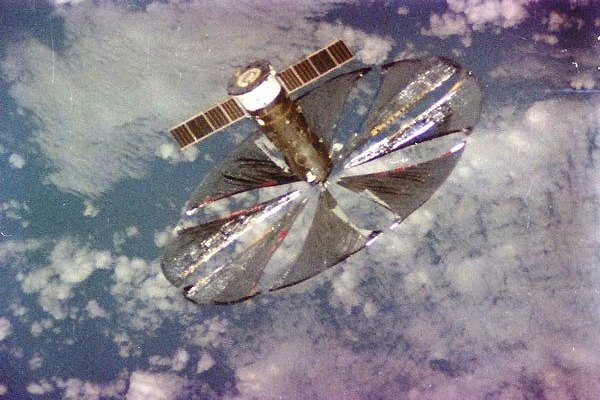
But the Znamya project was something else entirely. Named after the Russian word for “banner,” it was an audacious plan to deploy a thin, reflective film in orbit and bounce sunlight down to the night side of Earth. Syromyatnikov oversaw the successful deployment of Znamya 2 in 1993.
The reflector unfurled from a Progress cargo spacecraft and cast a bright spot of light across Europe—a moving, man-made patch of daylight moving at orbital speed. It worked exactly as designed, and for a brief moment, the concept of space illumination seemed within reach.
The idea wasn’t just about spectacle. Proponents argued that reflected sunlight could extend the working day for northern cities, reduce the need for artificial lighting, or even assist in disaster relief after earthquakes or blackouts. Syromyatnikov and his team at RSC Energia saw Znamya as the first step toward a constellation of orbital mirrors that could brighten entire regions.
When the Banner Tangled
Then came Znamya 2.5 in 1999. The follow-up experiment was meant to be larger and more powerful—a reflector designed to cast a brighter, more controlled beam. But something went wrong during deployment.
The thin film snagged on an antenna, and the mirror tore as it tried to unfurl. The mission was a failure.
The tangled banner never opened properly, and the project lost momentum. Syromyatnikov watched the experiment he had led for years collapse in low Earth orbit. The failure was a setback, not just technically but politically.
The post-Soviet space program was already struggling for funding, and a high-profile mishap made it harder to justify further experiments. No Znamya 3 was ever launched.
The dream of orbital mirrors faded into the background of space history, remembered mostly by engineers and space enthusiasts.
The Trend Underneath
Watch this space. What’s changing now is the economics of space. Launch costs have plummeted, materials science has advanced, and private companies are actively prototyping orbital solar power systems.
The idea that Syromyatnikov pioneered—deploying large, lightweight reflective structures in orbit—is suddenly relevant again. Several startups and national space agencies are now studying concepts that look remarkably like Znamya, but with modern composites, autonomous deployment mechanisms, and a clearer path to commercial viability.
The technical challenge remains the same: how to keep a thin, kilometers-wide film stable in orbit, how to aim it precisely, and how to avoid creating unwanted light pollution for astronomers. But the tools available today are far more capable than what Syromyatnikov had in the 1990s. Computer modeling, advanced materials, and robotic assembly in space could solve problems that doomed Znamya 2.5.
Syromyatnikov died in Moscow in 2006. He never saw his full vision realized.
But the trajectory he helped set—the idea that space could be used to directly illuminate the Earth—is now being revisited with a seriousness that would have been unthinkable a decade ago. What’s changing is that the trend underneath his work, the pursuit of practical space-based infrastructure, is no longer a fringe ambition. It’s becoming a mainstream engineering target.
The next generation of orbital mirrors won’t carry the Znamya name. But they will carry Syromyatnikov’s fingerprints, even if most of the engineers building them have never heard of him. That’s how real progress works: the pioneers fade, and the ideas endure.
Watch this space for the return of the light.