
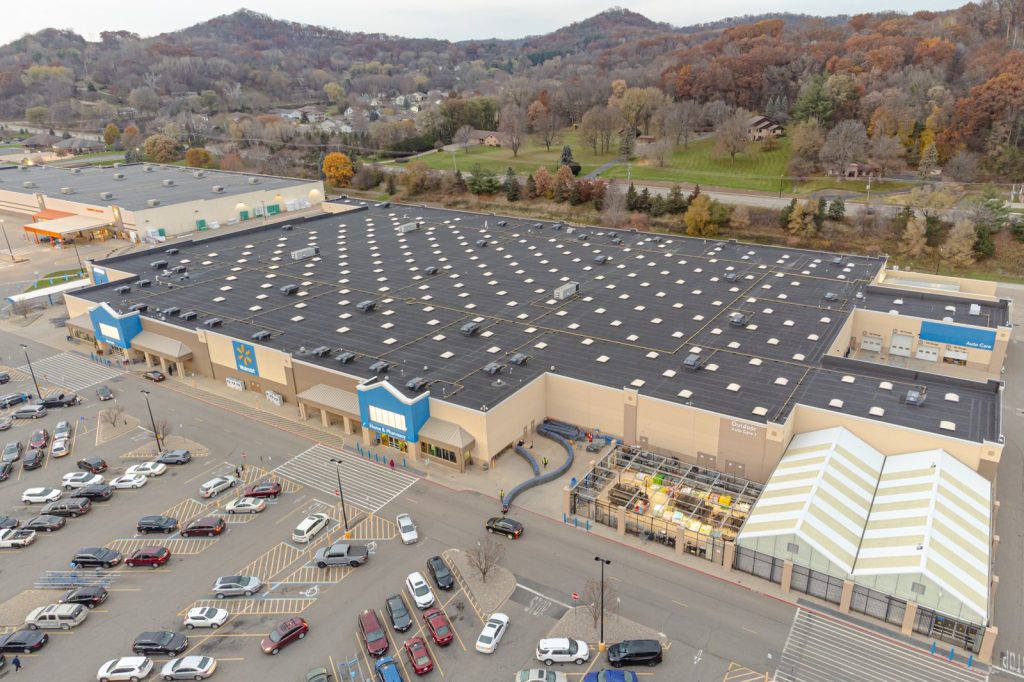
BENTONVILLE, Ark., July 17 — By the numbers, Walmart is the second-largest company globally by revenue, the largest private employer in the world, and in February 2026 became the first traditional retailer valued at over $1 trillion. The bottom line: a company that started with a single discount store in Rogers, Arkansas, in 1962 now holds a global portfolio of 8,841 total patent filings, with approximately 2,686 granted. Walmart Inc. operates hypermarkets, discount department stores, grocery stores, pharmacies, and gas stations across the United States and 19 other countries.
Headquartered in Bentonville, Arkansas, it was founded in 1962 by brothers Sam Walton and James “Bud” Walton. As of 2026, it employs 2.1 million people and ranks first in both the Fortune 500 and Fortune Global 500.
The figure that matters for investors: Walmart is a publicly traded family-owned business controlled by the Walton family, whose heirs own over 50 percent of the company through Walton Enterprises and individual holdings. The company was listed on the New York Stock Exchange in 1972 and switched to the Nasdaq in December 2025. It is a core member of the Dow Jones Global Titans 50 and S&P 500.
From one store to a trillion-dollar giant
The pricing strategy that defines Walmart today dates to Sam Walton’s first Ben Franklin store in 1945. He focused on low prices for higher-volume sales at lower profit margins. Sales increased 45% in his first year to $105,000, reaching $250,000 by the fifth year.
The first Wal-Mart Discount City opened July 2, 1962, in Rogers, Arkansas, inspired by Ann & Hope and FedMart. By 1967, it had 18 stores in Arkansas and $9 million in sales.
The company was incorporated as Wal-Mart, Inc. on October 31, 1969, changing to Wal-Mart Stores, Inc. in 1970, with 38 stores, 1,500 employees, and $44.2 million in sales. By 1988, it was the most profitable retailer in the U.S., and by October 1989, the largest by revenue. Originally limited to the South and lower Midwest, it had stores coast-to-coast by the early 1990s.
Scale as a weapon
This history underpins Walmart’s role as a price leader, especially during grocery slowdowns, leveraging its scale and supply chain to undercut competitors. The company’s omnichannel retail model spans hypermarkets, discount stores, grocery stores, pharmacies, and gas stations across its global footprint. Investors will note that the Walton family’s majority control provides a stable ownership structure rare among companies of Walmart’s size.
The switch from the New York Stock Exchange to the Nasdaq in December 2025 marked a strategic shift in how the company presents itself to the market. What to watch next: how Walmart deploys its patent portfolio of 8,841 filings — with roughly 2,686 granted — as it continues to compete on price while expanding its technological and logistical capabilities.
The company that started with one store in Rogers, Arkansas, and $44.2 million in sales by 1970 now faces the challenge of maintaining its price leadership as the first trillion-dollar traditional retailer.




