
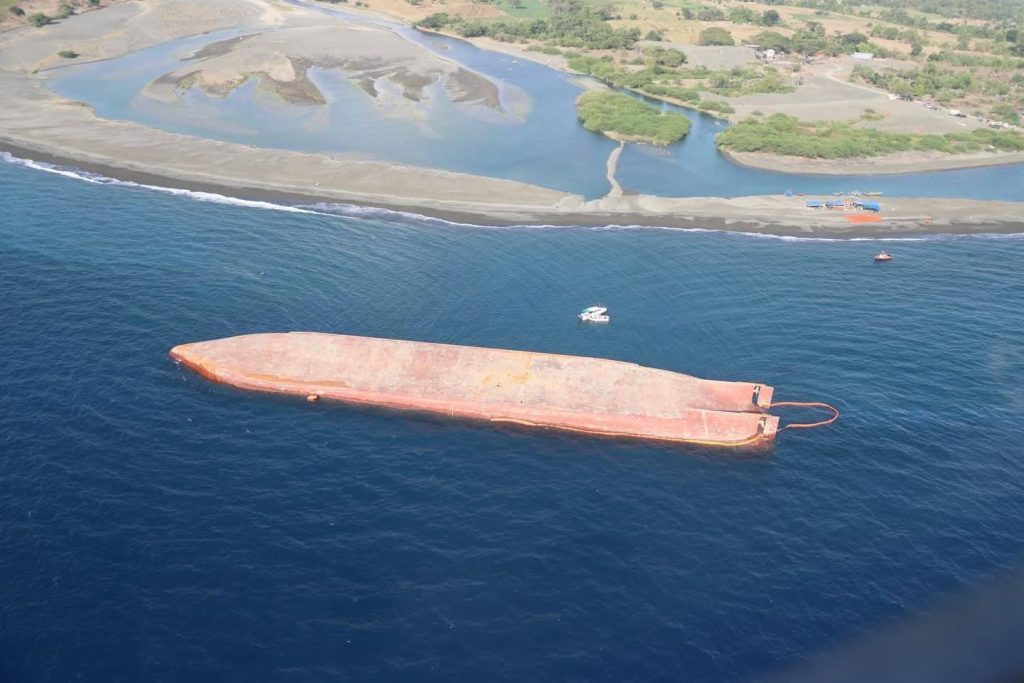
The search for five missing crew members of the sand barge “Hong Hai 16” entered its fourth day on Wednesday, with authorities in Occidental Mindoro facing mounting questions about the vessel’s seaworthiness and the conditions that led to its capsizing. The death toll now stands at six, and the probability of finding the remaining men alive is diminishing with each passing hour. The barge was carrying sand, a bulk cargo that shifts easily in rough water.
This is a known hazard. When a flat-bottomed vessel like a barge takes on water or lists, a sand load can slide to one side in seconds, accelerating a capsize beyond any crew’s ability to correct it.
Maritime safety experts have long warned that such cargoes demand precise loading and constant monitoring of weather forecasts. Whether those precautions were taken on the “Hong Hai 16” remains unclear. The incident has already had ripple effects beyond the immediate tragedy.
Local port authorities in Mindoro have suspended all barge departures pending a safety review. This is a direct hit to the construction supply chain.
Sand from these barges feeds concrete production for roads, buildings, and housing projects across the region. A prolonged halt means project delays, idle workers, and rising material costs. Environmental concerns are also surfacing.
A capsized barge does not simply vanish. The “Hong Hai 16” settled on the seabed with its cargo hold open. Sand itself is not toxic, but the fuel tanks, hydraulic fluids, and lubricants aboard the vessel are.
Any spill could damage fishing grounds that local communities depend on for food and income. The Philippine Coast Guard has not yet reported a fuel leak, but salvage crews have not been able to fully inspect the wreck due to strong currents and poor visibility.
The families of the missing men are waiting at the coast guard station in San Jose. They have received no official explanation for why the barge capsized. A formal investigation has been announced, but no timeline for its findings has been given.
For now, the narrative is one of silence and uncertainty. This is not an isolated case.
Barges like the “Hong Hai 16” are the workhorses of Philippine inter-island shipping. They move sand, gravel, coal, and cement through a network of waterways that are often poorly charted and subject to sudden squalls. Accidents are frequent.
What is less frequent is any public reckoning with the systemic issues — aging vessels, lax enforcement of load limits, crews working without adequate rest or training. The barge relied on a tugboat for propulsion. When the tug lost contact with the “Hong Hai 16” three days ago, it was already too late.
The barge had gone over. By the time rescuers reached the site, six men were dead and five were gone.
What happens next depends on the investigation. If the cause is found to be simple bad weather, the current suspension of barge operations will likely be lifted within days. If the cause is found to be negligence — improper loading, a vessel in poor condition, or a decision to sail into dangerous seas — the fallout will be far larger.
Lawsuits, regulatory overhauls, and possibly criminal charges could follow. For now, the focus remains on the search.
But the families of the missing know what the coast guard will not say aloud: after three days in tropical waters, survival is no longer expected. The operation will soon shift from rescue to recovery. And then the questions will begin in earnest.
{“@context”: “https://schema.org”, “@type”: “NewsArticle”, “headline”: “Search for Five Missing Crew Continues as Barge Seaworthiness Questioned”, “description”: “The search for five missing crew members of the sand barge “Hong Hai 16″ entered its fourth day on Wednesday, with authorities in Occidental Mindoro facing moun”, “datePublished”: “2025-04-18T15:00:00+00:00”, “author”: {“@type”: “Person”, “name”: “InfoPulse Today”}, “publisher”: {“@type”: “Organization”, “name”: “InfoPulse Today”}}




