
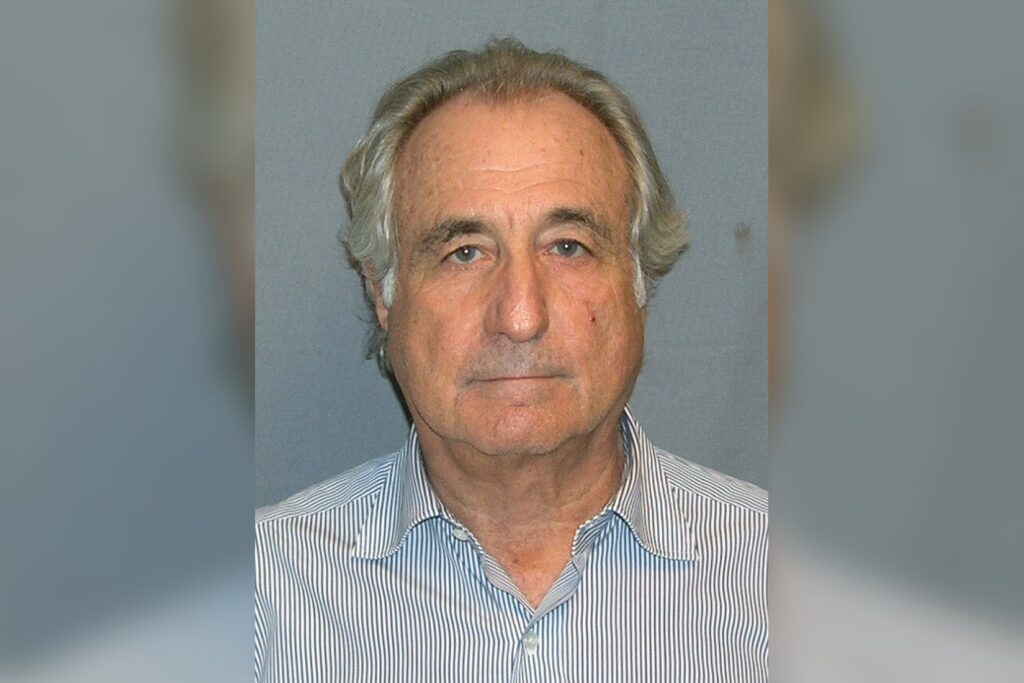
On December 10, 2008, Mark and Andrew Madoff walked into the offices of federal authorities with a story about their father. He had confessed to them, they said, that the asset management arm of his firm was “one big lie.” The next day FBI agents arrested Bernard Madoff, then 70, a former chairman of the Nasdaq.
It was the largest Ponzi scheme on record. Prosecutors put the size of the fraud at $64.8 billion, counting what the accounts of his 4,800 clients appeared to hold on November 30, 2008, fictional gains included. The trustee recovering money for victims estimated actual direct losses at $18 billion, of which $14.829 billion has been recovered and returned.
A respected name
Madoff was born in Brooklyn in 1938 and graduated from Hofstra University in 1960. That year he founded a penny stock brokerage with $5,000 saved from lifeguarding and installing sprinklers, plus a $50,000 loan from his father-in-law, the accountant Saul Alpern, who sent friends and their families his way.
The firm grew into Bernard L. Madoff Investment Securities. It used computer technology to spread its quotes, and the system it helped develop became the Nasdaq. At one point it was the largest market maker on the exchange, and in 2008 it ranked sixth among market makers in S&P 500 stocks. The brokerage was real. Madoff also served as chairman of the National Association of Securities Dealers, and Fortune noted he chaired the Nasdaq Stock Market in 1990, 1991 and 1993.
The fraud lived in a second unit, the investment advisory business, which he kept quiet and exclusive. It sat on the 17th floor of the Lipstick Building in Manhattan, staffed by fewer than 24 people. Investors got in by word of mouth and believed they had joined an inner circle. Some were afraid to withdraw money in case they could never get back in.
How it worked
Madoff’s pitch was a collar strategy of blue-chip stocks plus options. In his guilty plea he admitted he had not actually traded since the early 1990s and that every return since then was made up. An ex-trader told a court he had been faking records for Madoff since the early 1970s, and the investigator for the trustee believes the advisory arm may never have been legitimate. Fortune described the machinery as unsophisticated, built on phony account statements sent to clients.
He leaned on charities. The author Mitchell Zuckoff argues that a federal rule forcing private foundations to pay out 5 percent of their funds each year suited him, because charities rarely make sudden or unexpected withdrawals. When his assets were frozen, the Robert I. Lappin Charitable Foundation, the Picower Foundation and the JEHT Foundation were forced to close.
The regulators who missed it
The SEC had looked at him many times. A complaint about a feeder firm in 1992 led nowhere. In 2004 an SEC lawyer, Genevievette Walker-Lightfoot, found numerous inconsistencies and recommended more questions, but her supervisors told her to stop and look at the mutual fund industry instead. The analyst Harry Markopolos had also sent repeated, specific warnings that went unheeded.
Madoff mocked the effort from prison. Investigators acted like “Lt. Columbo” and never asked the right questions, he said. “They never even looked at my stock records.” A 2009 report by the SEC inspector general detailed bungled examinations, disputes among staff and failures to act on credible complaints. After the scandal, the SEC changed how it inspects advisers and brokerages, pushed advisers to place client assets with independent custodians, and set up a central system for tips.
Plea, sentence and family
On March 12, 2009, Madoff pleaded guilty to 11 federal felonies. On June 29, 2009, he received 150 years, the maximum allowed. His brother Peter was sentenced to 10 years in 2012. Mark Madoff hanged himself in 2010, exactly two years after his father’s arrest, and Andrew died of lymphoma in September 2014.
Bernie Madoff died on April 14, 2021, at the Federal Medical Center in Butner, North Carolina, of chronic kidney disease. He was 82.
Sources
- Bernie Madoff – Wikipedia
- Madoff investment scandal – Wikipedia
- SEC was charmed by Madoff and failed to act quickly, here's why: | Fortune




