
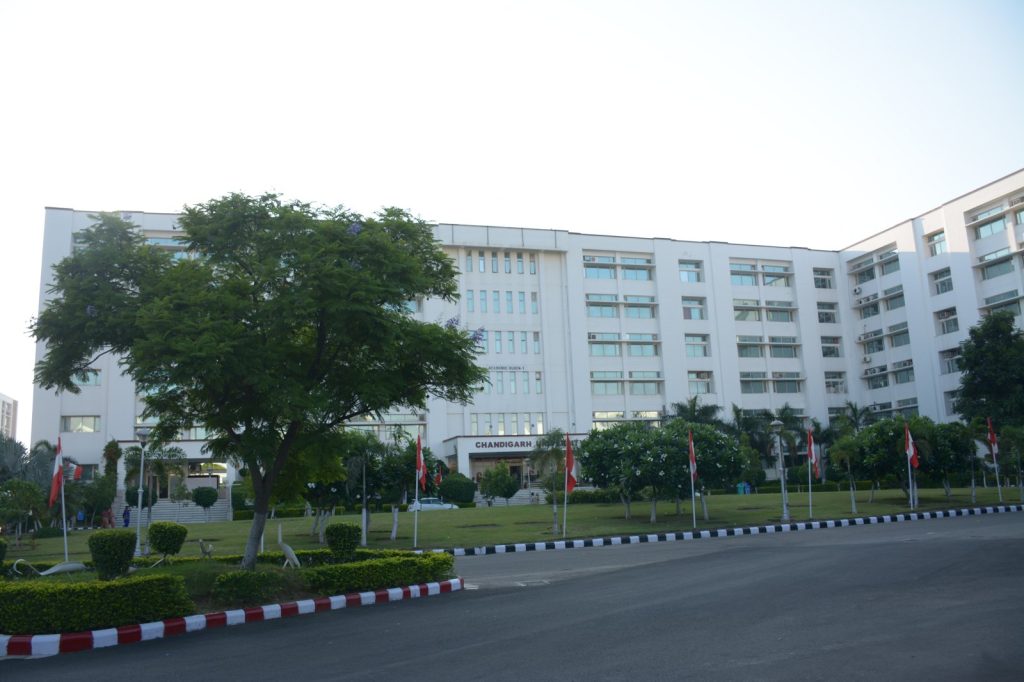
The announcement landed on June 27 from Chandigarh, and for once the technology being touted is aimed at the least glamorous problem in farming: knowing how much a field will produce before it is harvested. Researchers at Chandigarh University say they have built an AI-powered Transformer Model that predicts crop yields accurately by combining satellite imagery with climate data and past agricultural records. The work, unveiled at a 2026 signal-processing and electronics-design conference, ICSPED, held at Chandigarh College of Engineering and Technology — arrived by way of a paid press release, which is worth noting, though the substance survives the skepticism.
The team is small and pointedly local: Kusum Lata, assistant professor in the Department of Computer Science Engineering, working with professors Navneet Kaur of the same department and Simrandeep Singh of the University Centre of Research and Development — a grouping assembled, the release says, to sharpen crop yield forecasts across Punjab’s agricultural heartland. The problem they chose is well worn. Accurate prediction matters more as climate variability, shifting weather patterns and rising food demand press on farmers, while the traditional alternative — field surveys — remains time-consuming, often labour-intensive, and limited in scale.
The machinery is where it gets interesting. “The transformer model utilizes data from Sentinel-1 and Sentinel-2 satellites which are advanced Earth observation satellites operated by the European Space Agency (ESA) to continuously monitor agricultural fields and provide information on crop growth, vegetation health, soil moisture and field conditions.” Lata explained. Those observations, she said, are then merged with the climatic variables — rainfall, temperature, soil moisture — plus historical production records, to build a running picture of how a crop is performing across the whole season.
The choice of a transformer — the architecture behind the large language models currently absorbing everyone’s attention — is not incidental, and the researchers are careful about what it buys. “Unlike conventional machine learning models, the newly developed lightweight transformer can identify critical crop growth stages and learn complex temporal patterns that influence final yields.” Lata said. The team has, she added, “designed the model to deliver high predictive performance that require fewer computational resources, making it suitable for practical deployment in large-scale agricultural monitoring systems.”
The numbers, to their credit, are in the release rather than under embargo. The model, Lata said, “was evaluated on four major crops cultivated in Ludhiana district, namely paddy, maize, moong and sugarcane, using data collected between 2019 and 2023.” The verdict, again in her words: “Experimental results demonstrated that the transformer model outperformed widely used approaches such as Random Forest and Long Short-Term Memory (LSTM) models, indicating stronger agreement between predicted and actual yields.” The architecture, the study found, needs nearly 40 percent fewer parameters than a conventional transformer setup, and delivers faster, accurate predictions — the sort of arithmetic that makes plausible near real-time regional crop monitoring, plus production forecasting and early warning of trouble.
Lata herself is no visitor to this territory: she spent time as a Junior Research Fellow with the Punjab Remote Sensing Centre’s Agriculture and Crop Monitoring Division at PAU Ludhiana, contributing to geospatial projects that included crop residue burning analysis. The point of all of it, as the researchers frame it, is unglamorous and consequential — reliable pre-harvest forecasts supporting agricultural planning, sharper resource allocation, sturdier crop insurance mechanisms and saner market management, in a state where farming anchors the economy. Future work, they say, will push toward near real-time forecasting on cloud-based platforms.
For all the noise around AI announcements, the salient point here is refreshingly narrow: a cheaper forecast, before the harvest, from data that already exists. Chandigarh University — a NAAC A+ graded, QS-ranked institution that describes itself as India’s youngest university — is doing the predicting; Punjab’s farmers, if it works, will do the earning.




