
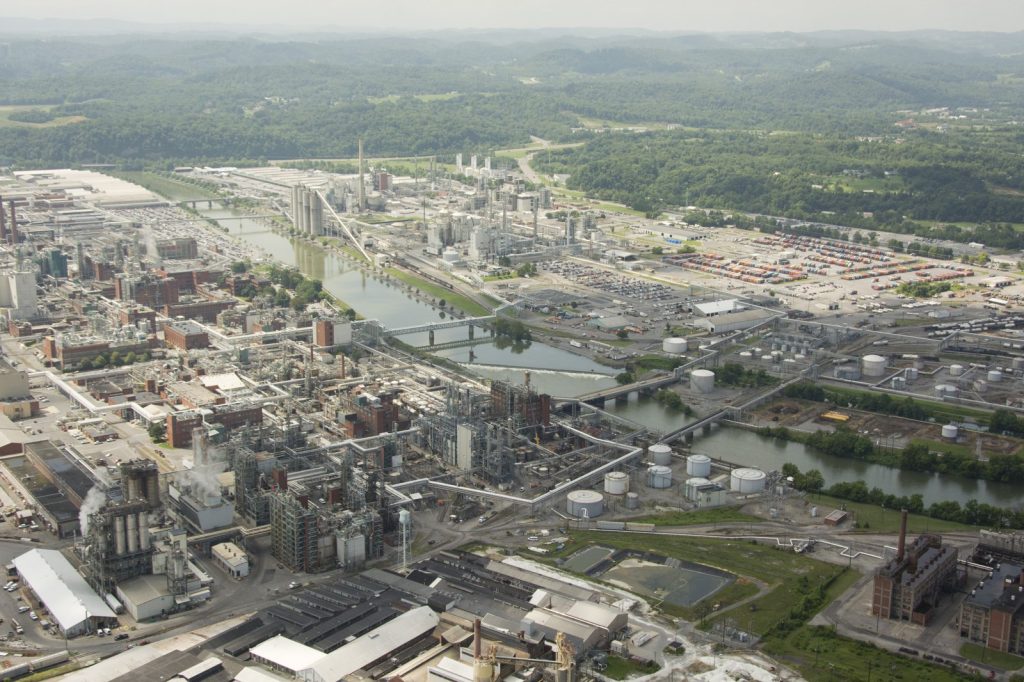
On the ground in Kingsport, Tennessee, the Eastman chemical site spreads across roughly 900 acres: hundreds of buildings, miles of pipes, conveyors, cooling towers, valves and compressors, the full industrial anatomy of a company turning 100. The scene looks unremarkable. What runs through it now is a bet that waste plastic of almost any kind can be unmade back into molecules and rebuilt as new plastic, again and again, with no loss of quality, through two processes the company calls carbon renewal and polyester renewal technology.
The place has reinvented itself before. George Eastman’s chemical branch took root here in 1920, when raw-material scarcity after World War I pushed the photography founder to seek self-reliance: wood fiber for cellulose, coal for the syngas behind acetyl chemicals. During World War II the site made RDX explosive at peak rates of a million and a half pounds daily and helped manage uranium enrichment for the Manhattan Project. Spun off from Kodak in 1994 as digital photography ate its parent, the company is now led by Mark Costa, chairman and chief executive since 2014, who steered its pivot toward specialty materials and, with them, circularity. “This idea of circularity isn’t new to us,” he told Trellis, noting that every innovation project has been tied to a sustainability driver since 2009.
The problem his chemists are attacking is visible in any kitchen bin. Only a couple of plastics, PET and HDPE, Nos. 1 and 2 in the resin codes, are reliably collected and recycled; Nos. 3 through 7 lack infrastructure and markets nearly everywhere, and the multi-layer packaging of juice boxes and toothpaste tubes defeats sorting systems entirely. Mechanical recycling, the default, is heat-intensive, easily contaminated, and usually good for a single round before quality degrades. “You can only get up to maybe 50 percent recycled content in a bottle with mechanical, where you really start getting a pretty ugly product and all kinds of other performance issues,” Costa said.
The chemical route is older than it sounds, researched since the 1950s: depolymerization takes plastics back to raw materials for new polymers, methanolysis attacks polyester specifically, and pyrolysis heats mixed waste without oxygen into naphtha for petrochemical rebirth. Eastman claims its renewal technologies yield materials indistinguishable from fossil-based originals, a genuine closed loop for plastics that mechanical systems cannot touch. The feedstock pool is enormous: only about 9 percent of the plastic waste the world produces each year, more than 400 million tons of it, is currently recycled, by UN Environment’s accounting.
In January 2021 the bet took concrete form. With Governor Bill Lee at his side, Costa announced a $250 million facility in Kingsport, what the company called “one of the world’s largest plastic-to-plastic molecular recycling facilities”, built on methanolysis to convert polyester waste into premium specialty plastics. The plant is designed to take over 100,000 metric tons of plastic that mechanical methods cannot recycle, and the company says the process will cut greenhouse gas emissions 20-30 percent against fossil feedstocks, with mechanical completion targeted by year-end 2022. “With the growing demand for products made with recycled content and the urgent need to address the global plastic waste crisis, now is the time for Eastman to take this step.” He credited state and local support for keeping the plant in Tennessee, and Lee, for his part, hailed Eastman as a century-long partner to the state while thanking it for investing in Kingsport’s workforce.
The company’s stated targets scale with the ambition: 250 million pounds of plastic waste recycled annually by 2025, more than 500 million pounds by 2030, plus partnerships and direct investments in Europe. Notably, Costa frames the technology as a complement, not a rival, to the mechanical systems that already work for bottles: “We don’t want to compete with that,” he said of established PET and HDPE streams. “Frankly, the value of it is too high. From a sustainability point of view, you shouldn’t touch it.” An American Chemistry Council report from 2019 projected that widespread chemical recycling could mean nearly 40,000 U.S. jobs, annual payroll of $2.2 billion and $9.9 billion in economic output. Whether a century-old chemical company can close the loop at industrial scale is the open question; in Kingsport, the pipes to answer it are already standing.
Sources
- Inside Eastman’s moonshot goal for endlessly circular plastics | Trellis
- Eastman to build $250M facility which will convert polyester waste into durable products




