From midnight to 5 a.m., Indra Nooyi worked as a Yale dormitory administrator. By day, she studied alongside a small group of international classmates trying to overcome poor interview clothes, unfamiliar customs and very little money.
Nooyi recalled their presentation in two words: “we were losers.” Their answer was to outwork everyone else. By the second year, other students wanted them in study groups and on projects. Consulting and investment-banking recruiters followed.
Nooyi told that story during a 47-minute conversation with Condoleezza Rice, the former secretary of state and Hoover Institution host. Their discussion covered her route from Madras to PepsiCo, the redesign of a successful company and her belief that leadership is learned.
A plane ticket and a second letter
Nooyi applied secretly to the Yale School of Management after her parents discussed arranging her marriage. The first acceptance did not solve the financial problem. A second letter offering loans and work-study support did. She asked her parents for an air ticket and promised to repay them generously.
She arrived in the United States in 1978. New Haven’s silence felt alien after India, and the management school had few international or Black students. Her 1980 master’s covered management in both public and private institutions.
The pressure did not disappear once her career took off. Nooyi described a first-generation immigrant’s dread of failing and bringing shame to family, women, immigrants and Indians watching her progress. That fear, she said, “pushed me to do better and better all the time.”
There was a practical backstop. Her household lived simply enough to manage on one salary if she lost her job.
Her earlier education had mixed discipline with improvisation. In Madras, her mother asked Nooyi and her sister to write speeches explaining what they would do as president or prime minister. Her paternal grandfather, a judge, made her write “I will not make excuses” 200 times when she fell short on a task.
At Madras Christian College, her 1975 bachelor’s studies covered mathematics, physics and chemistry. A postgraduate diploma from IIM Calcutta followed in 1976. Before Yale, she held product-management jobs at Johnson & Johnson and textile firm Beardsell Ltd.
Changing a company that is already winning
Nooyi joined PepsiCo in 1994 and became chief executive in 2006. She remained CEO until 2018, a 12-year tenure that was seven years longer than the average for large-company chiefs in an Equilar study.
Her central management argument sounds counterintuitive: a successful business can be harder to change than a failing one because prosperity creates no immediate reason to act.
“For me, maintaining the success of a successful company is more difficult than bringing a failed company back to normal,” she told Rice.
As PepsiCo’s president, she examined where consumers and market boundaries might move over the next 10-15 years. Her response combined healthier products, less environmental damage, changes to research and the brand portfolio, and a workplace capable of competing with Silicon Valley, Wall Street and consulting firms for employees.
Products were sorted into “fun for you,” such as ordinary soda and potato chips, “better for you” alternatives and “good for you” foods including oatmeal. PepsiCo reduced spending behind junk foods and invested in healthier options, packaging redesign, water conservation, recycling and renewable energy.
The company was expanding at only 2-3% annually, by her account, and needed another one or two points of consistent growth. “Growth is oxygen, and innovation drives growth,” she said.
Annual net profit at PepsiCo stood at $2.7 billion before the expansion she describes; it subsequently reached $6.5 billion. Her deal record included the $3.3 billion Tropicana acquisition and the 2001 Quaker Oats merger, which brought Gatorade into the company.
Nooyi also directed the 1997 separation of Tricon, now Yum! Brands, whose restaurants included KFC, Pizza Hut and Taco Bell. She stepped down as CEO on August 6, 2018; Ramon Laguarta succeeded her on October 3, while she stayed as chair until early 2019.
Mentors choose the pupil
Rice asked how people become leaders. Nooyi rejected the idea that the necessary qualities simply appear at birth. She compared the repeated observation and practice to “literally like training for the Olympics.”
Her own mentors gave her difficult jobs because mastering them would justify promotion. They pushed and corrected her rather than offering easy praise. She came to interpret that pressure as confidence in her potential.
“Good mentors are never insecure because they know that if they mentor you well, you will be able to take their job,” she said.
All her mentors were white men, many with military backgrounds. Rice offered the matching lesson from her career: mentors “see something in you that you may not even see in yourself.”
Nooyi argued that America’s meritocratic institutions allowed an immigrant to arrive with nothing and eventually run a Fortune 50 company. That was her interpretation of her own experience, not a comparison supported by immigration data in the discussion.
She credited the United States particularly with commercializing inventions and described its consumer market as intensely competitive. China, she said, also produces fast innovation cycles as brands use successive technologies to attack one another.
On India, Nooyi said democratic votes and voices can slow progress, a trade-off she welcomed. “The only thing an authoritarian regime doesn’t have is that it doesn’t have a peaceful means of transferring power,” she said.
The cola problem she left behind
PepsiCo’s diversification remains commercially important, but it now generates more than twice Coca-Cola’s revenue while carrying a market capitalization about half as large. Coca-Cola has built 32 billion-dollar brands and moved away from low-margin bottling operations.
Laguarta recently acknowledged, “we’re not competing well in soft drinks.” KFC then chose Coca-Cola for its 3,700 U.S. restaurants. That decision ended a 40-year relationship with PepsiCo. Taco Bell separately renewed its U.S. agreement with PepsiCo for 11 more years.
Amazon and the International Cricket Council both now have Nooyi on their boards. She told Rice that teaching at West Point had been her most fulfilling learning experience after PepsiCo.
Her mother supplied a domestic rule for the returning chief executive: leave the crown in the garage. At home, her roles were wife and mother; she was also a daughter and a daughter-in-law.
Sources
- Indra Nooyi
- Indra Nooyi on Leadership and Innovation at PepsiCo | Only In America|Only In America | Hoover Institution — BigGo Finance
- PepsiCo started losing the cola wars when its CEOs lost focus | Fortune
- Meet Sharmila Mona Sinha: Kolkata-born philanthropist who became only the second Indian-origin woman inducted into US National Womenâs Hall of Fame
- Andrea Petrone: You’ve Made It. But Who Are You Now?
- Inside Anjula Acharia's Lavish Diwali Dinner With Kal Penn
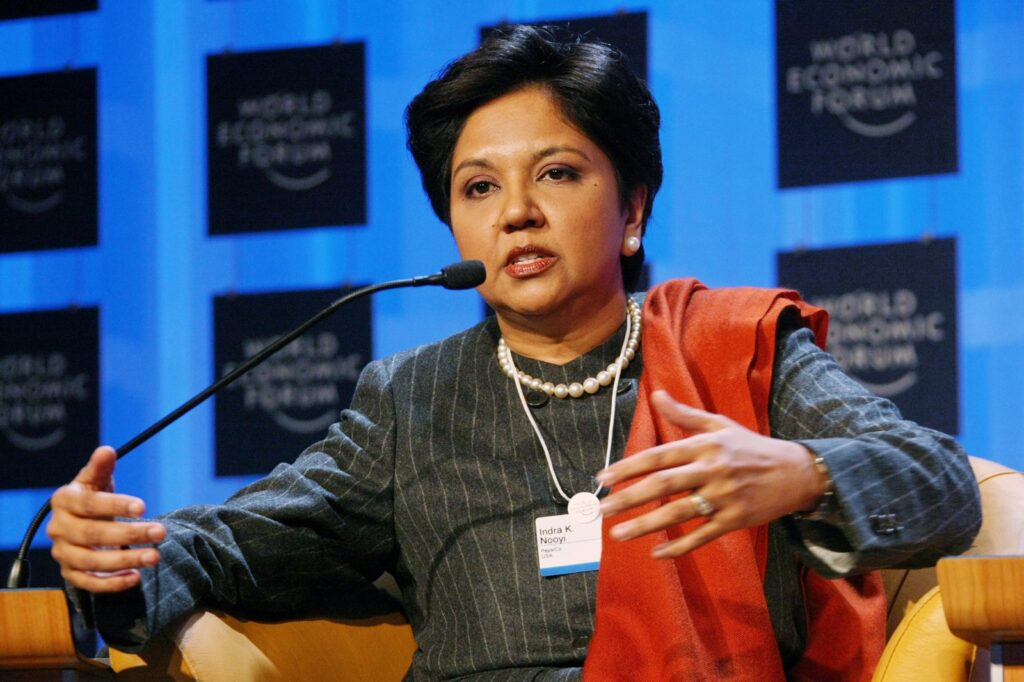
Photo: World Economic Forum (CC BY-SA 2.0)