
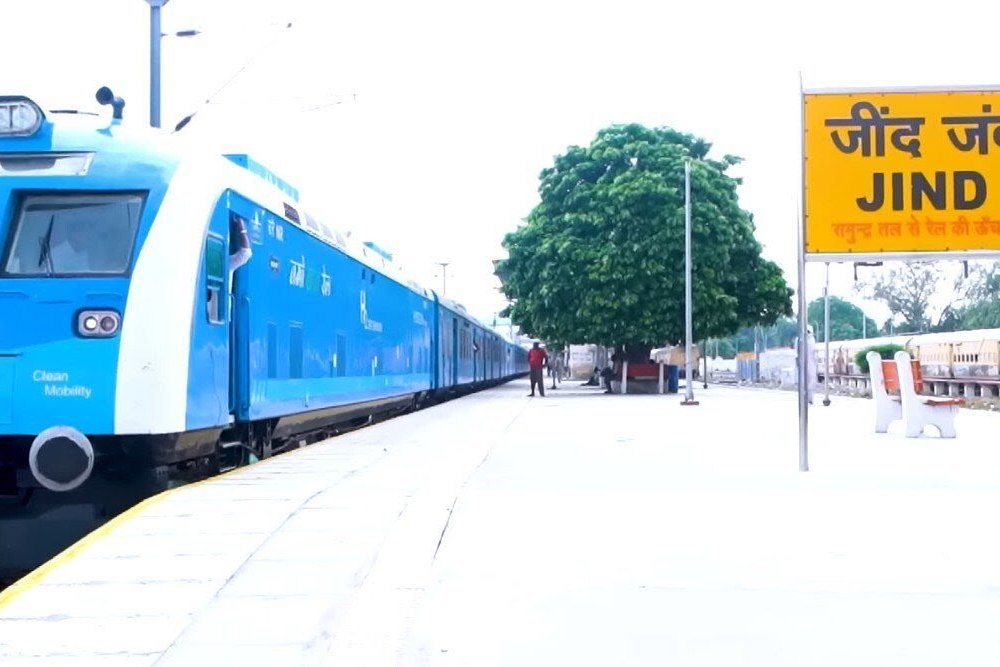
For months, the only sign of progress was the quiet hiss of water vapour. Not smoke. Not diesel fumes.
Just steam, drifting off a test track in Haryana. That was the sound of Indian Railways trying to prove something: that a train can move without burning anything at all.
The hydrogen fuel-cell train now being tested on the Jind–Sonipat corridor runs on a 1,200 kW propulsion system. It is a 10-coach configuration — two power cars, eight passenger cars. On the test track, engineers have pushed it to 120 km/h.
In service, it will be capped at 75 km/h. That gap tells you something about how early this still is.
The technology works. The question is whether it works at scale, every day, on a real route with real passengers. Indian Railways has been talking about hydrogen trains for years.
The idea was always simple in theory: replace diesel with hydrogen fuel cells, which combine hydrogen and oxygen to produce electricity. The only by-products are heat and water vapour. No tailpipe emissions.
No particulates. No CO₂.
But building a system that can store compressed hydrogen, refuel trains safely, and keep the fuel cells running reliably in Indian conditions — that is the hard part. The Jind–Sonipat corridor was chosen as the pilot route partly because it is short enough to manage the early risks. The Indian Embassy in the UAE released a video calling the train a “Swadeshi” achievement — homegrown.
That label matters. India is not buying this technology off the shelf.
The fuel cells, the power train, the integration with the existing rail infrastructure — all of it was developed domestically. For a country that still runs thousands of diesel locomotives, that is a deliberate strategic choice. Hydrogen fuel-cell technology is still expensive.
The infrastructure to produce and distribute green hydrogen barely exists in India. But the thinking inside Indian Railways is that you have to start somewhere, and a single pilot line on a 75 km/h corridor is that somewhere. The train is still undergoing testing.
No launch date has been set. The service speed will be modest — 75 km/h is slower than many express trains.
But the point of this project was never speed. It was proof of concept. If the Jind–Sonipot trials succeed, the next step will be longer routes, higher speeds, and eventually a fleet of hydrogen trains that could replace diesel engines on non-electrified lines.
For the communities along the Jind–Sonipat route, the change is immediate and tangible. No diesel fumes in the stations.
No black smoke over the fields. Just a train that moves on water vapour. That is a small thing on a single corridor.
But Indian Railways runs one of the largest rail networks in the world. Every diesel locomotive it replaces is a measurable cut in emissions. The hydrogen train is not going to decarbonise the network overnight.
It does not have to. It just has to prove that the technology works, so that the next step — building the hydrogen supply chain, training the crews, scaling the production — becomes possible.
The stakes are not abstract. India has committed to net-zero emissions by 2070. Rail is the backbone of the country’s freight and passenger movement.
If that backbone stays diesel, the target is unreachable. The hydrogen train on the Jind–Sonipat corridor is a small piece of a much larger puzzle.
But it is a piece that now actually exists, moving under its own power, leaving nothing behind but steam.




