Indonesia opened its national carbon-trading market on 11 March 2025, aiming to turn the archipelago’s vast forests and geothermal reserves into saleable emission credits. The bourse, operated by the Indonesia Stock Exchange under regulations signed last year by President Joko “Jokowi” Widodo, lists 33 projects offering 1.8 million tonnes of carbon dioxide equivalents in the first auction. Traders logged 462,000 tonnes of deals on launch day, priced at an average USD 6.40 per tonne. Yet minutes after the opening bell, environmental groups questioned whether half of the listed offsets represent real, additional cuts, warning that inflated baselines could flood the market with “ghost credits” and undermine Jakarta’s 2060 net-zero pledge.
Doubts over forest baseline
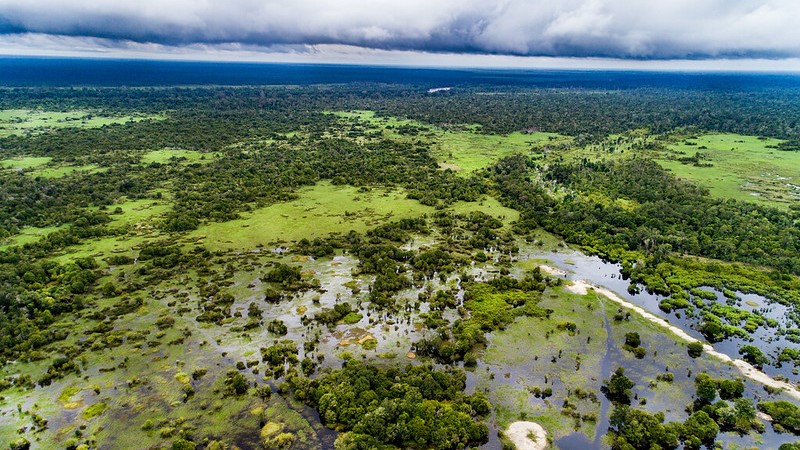
The largest single offering comes from the 234,000-hectare Rimbo Paitan forest concession in East Kalimantan, where project developer PT Rimba Raya Conservation claims it will prevent 25 million tonnes of peat-fire emissions over 30 years. The company’s reference scenario assumes the entire area would otherwise be converted to oil-palm estates, a projection that Greenpeace Indonesia says “bears no resemblance to current zoning maps”. The Ministry of Environment and Forestry reclassified the site as a “protection forest” in 2019, effectively banning plantation licences.
“Once the government has ruled out conversion, the threat is no longer credible, so any credit issued is selling hot air,” said Tata Mustafa, climate policy lead at the Indonesian Forum for the Environment (Walhi). The ministry’s director-general of climate control, Laksmi Dhewanthi, countered that the reference level was set using 2018 data, before the reclassification, and therefore complies with the 2022 carbon-exchange decree. Analysts at Climate Analytics note the argument legalistically fits the rulebook but warn investors may still discount the credits.
Geothermal projects draw scrutiny
Three geothermal plants on Sumatra also listed offsets, arguing that without carbon revenue they would have built cheaper coal units instead. The plants, Sarulla (330 MW), Sorik Marapi (240 MW) and Ulubelu (220 MW), are already operating and have long-term power-purchase agreements with state utility PLN at feed-in tariffs that outprice coal. Market rules allow “financial-additionality” tests to be run at the investment-decision date, yet the plants began commissioning between 2014 and 2019.
“Retro-crediting is a red flag,” said Melissa Brown, director of energy finance at the Asia Society Policy Institute. “Buyers need certainty that their money moves the needle, not rewards decisions taken years ago.” The exchange requires project owners to publish additionality narratives, but there is no independent review board; verification is handled by domestic auditors licensed by the Ministry of Environment. The ministry says international standards such as Verra’s VCS may be used voluntarily, yet only two of the 33 inaugural projects have submitted third-party certification.
Oversight gaps and price volatility
Trading rules cap daily price swings at 15 percent and oblige sellers to deposit 5 percent of proceeds into a newly created “green fund” managed by the state budget. Still, secondary-market liquidity is thin: only 14 brokers have received trading licences, and offshore buyers must route orders through local banks. On 12 March the spot contract slid 8 percent to USD 5.90, prompting the exchange to pause afternoon dealing.
Finance Minister Sri Mulyani told reporters the volatility was “normal for a start-up market” and pledged tougher disclosure rules by June. The financial regulator OJK has yet to spell out penalties for false project claims. A 2023 Supreme Court audit found the ministry’s carbon-registry database vulnerable to double-counting because logging and plantation concessions use separate serial numbers. Officials say a unified blockchain ledger will be ready by 2026.
Corporate buyers tread carefully
Indonesia’s largest coal miner, PT Bumi Resources, bought 50,000 tonnes of offsets on opening day, describing the purchase as a hedge against future export tariffs. Consumer giants Unilever Indonesia and Indofood stated they would “observe” the market before replacing existing Verra credits that underpin their net-zero roadmaps. Singapore-based carbon trader Climate Impact Partners said it walked away after failing to obtain satellite evidence of deforestation threats in two peatland projects.
“Price is attractive, but reputation risk is not,” said the firm’s Jakarta representative, Andhika Mahardika. Analysts at BloombergNEF estimate that Indonesian credits trade at a 30 percent discount to similar Verra-labelled units, reflecting the uncertainty premium.
What happens next
The government plans to expand the market to cover domestic compliance obligations starting in 2026, when coal-fired power plants rated above 100 MW must offset excess emissions. That could generate demand for 15-20 million tonnes of credits annually, according to the Institute for Essential Services Reform. Yet if early vintages are discredited, analysts warn the market could meet the same fate as China’s regional pilot bourses, where liquidity dried up after a series of fraud scandals.
Jakarta will also have to align its registry with Article 6 rules under the Paris Agreement to allow international transfers. Climate negotiators meeting in Bonn this June are expected to discuss corresponding-adjustment templates; without them, Indonesian credits cannot count toward other countries’ climate targets. “We are committed to transparency and will adopt UN standards,” said Environment Minister Hanif Faisol Nurofiq at the launch ceremony. Whether traders and activists believe him will determine if the bourse becomes a credible climate tool or a brief experiment in carbon speculation.