Panama City, July 14 — For more than a century, the United States has participated in a system of tolls at the world’s major man-made shipping chokepoints, but a proposed transit fee on the Strait of Hormuz would represent a break with all prior practice: never before has any U.S. administration suggested charging for passage through a waterway the United States does not control. The proposal would apply to a natural strait where the U.S. Navy has maintained a presence since 1949, but where no toll has ever been collected by any outside power.
If enacted, the fee would mark a fundamental redefinition of Washington’s role in one of the globe’s most critical energy arteries, raising questions that extend far beyond the Persian Gulf.
Contrasts With Established Canal Tolls
The United States has long accepted the principle that the sovereign operator of a canal or artificial waterway sets its own rates. The Panama Canal, opened in 1914, has charged tolls based on ship size and cargo from its inception, with the Panama Canal Authority determining the schedule.
The Torrijos–Carter Treaties of 1977 transferred full operational control to Panama by 1999, ending U.S. authority over toll setting. Since that transfer, the United States has never attempted to levy a transit fee on the Panama Canal. Similarly, the Suez Canal, which opened in 1869, is operated by Egypt and charges tolls that generated $9.4 billion in revenue in fiscal year 2022-2023. Both canals are national assets controlled by their sovereign states, and the Panama Canal Authority’s rates have been a recurring source of tension with shipping lines—but those tensions have never prompted a U.S. fee proposal for either canal.
The proposed Strait of Hormuz fee stands in direct contrast. The strait is not a canal built by a single nation; it is a natural waterway shared by coastal states Iran and Oman.
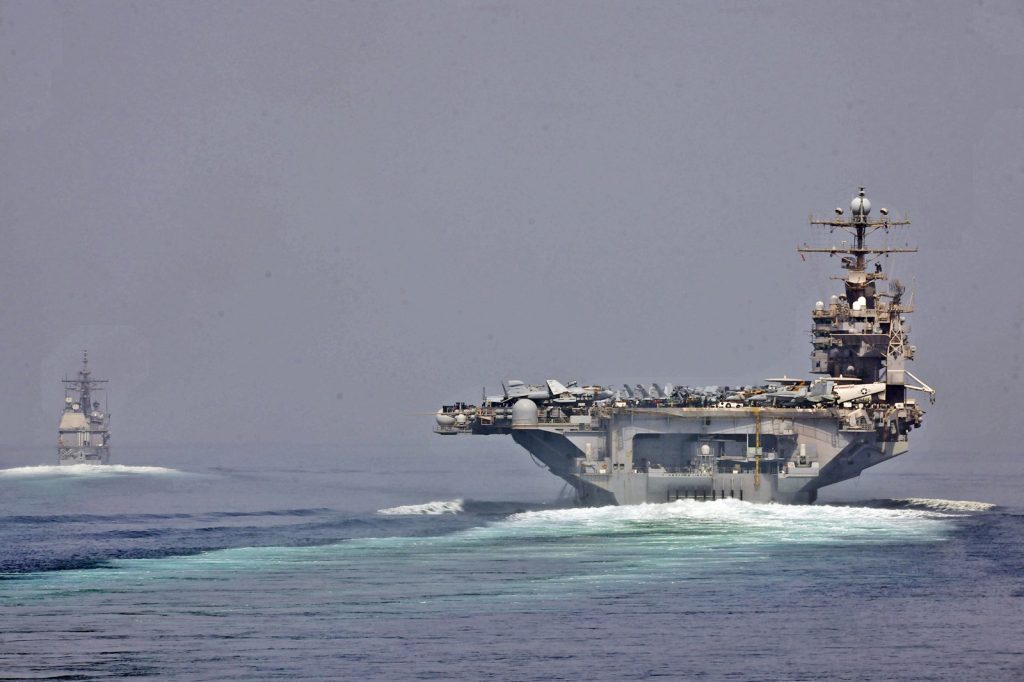
Its transit is governed by customary maritime law rather than a canal authority’s tariff schedule. The U.S. Navy has patrolled the strait since 1949 under what became the U.S. Fifth Fleet, based in Bahrain. That military presence has always been focused on keeping the chokepoint open for global oil shipments, deterring interference rather than managing the waterway.
No previous U.S. administration had ever proposed turning that patrol mission into a revenue-collection function.
An Unprecedented Step for a Shared Waterway
The Strait of Hormuz connects the Persian Gulf to the Gulf of Oman and the wider Indian Ocean. Its geography makes it the sole maritime passage for seaborne energy exports from several Gulf producers.
For much of the twentieth century, regional instability and naval competition drove outside interest in keeping the strait open. The U.S. Fifth Fleet’s mission has been about freedom of navigation, not revenue collection. A toll would represent a fundamental shift in how Washington views its role in that strategic waterway.
The practical consequence for global shipping is significant. The Panama Canal and Suez Canal both operate under clear national ownership; the Strait of Hormuz does not.
That distinction matters for international maritime law and for the cost of moving goods by sea. If the United States can impose a transit fee on a shared international strait, it could set a precedent that might be applied to other chokepoints around the world. Past administrations treated free passage through the strait as a strategic aim, not a revenue opportunity.
Legal and Diplomatic Hurdles Ahead
The proposal faces significant legal and diplomatic obstacles. International law generally recognizes that coastal states have sovereignty over their territorial waters, but the Strait of Hormuz includes international waters where the right of transit passage applies. How the United States would enforce such a fee—and how Gulf states, especially Iran and Oman, would respond—remains an open question.
The strait lies in coastal waters claimed by those two nations, with transit governed by customary principles rather than any canal authority’s rules. For ordinary readers, the core issue is straightforward: if the U.S. can charge for transit through a waterway it does not control, it breaks with decades of established practice.
The U.S. Navy began steady patrols in 1949 under what became the Fifth Fleet, a presence designed to deter interference with shipping rather than to manage the waterway. The current proposal departs from that entire history. Any move to charge for transit through a shared international strait would raise questions about the limits of naval presence and the rights of coastal states.
Global shipping routes and energy supplies could face new uncertainty if the precedent shifts.